







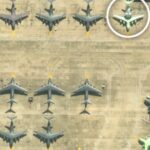

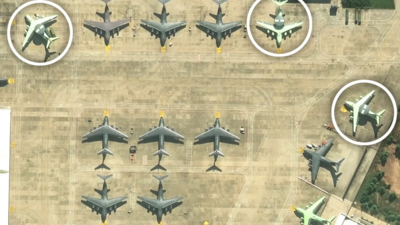
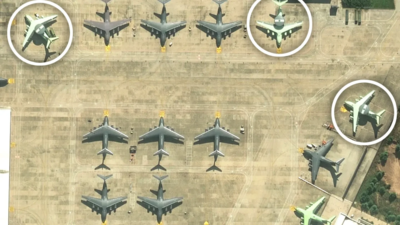
New satellite imagery shows four of China’s KJ-3000 Airborne Early Warning and Control (AEW&C) aircraft at the Xi’an Aircraft Company factory at Xi’an-Yanliang, raising the possibility that the type is moving into serial production. The imagery, captured on October 5 and provided by Vantor, shows three KJ-3000s near the factory and a fourth at the nearby China Flight Test Establishment, US based think tank Mitchell Institute for Aerospace Studies assesses that four aircraft point to serial production.The KJ-3000, also called the KJ-20, is based on the four-engine Y-20B transport with Chinese-made engines. It has a large circular radome above the rear fuselage and an aerial refuelling probe above the cockpit. The first poor-quality photographs appeared in December 2024, and clearer images followed in May 2025. It is meant to address limits in China’s existing large AEW&C fleet, since only four KJ-2000 aircraft, built on the Russian Il-76MD, have been completed. The Pentagon’s 2025 report on China’s military noted the KJ-3000’s initial flight.The Chinese armed forces currently operate over around 70 AEW&C aircraft split between the air force and the navy. The most numerous of these is the smaller KJ-500 aircraft. The KJ-500 is based on the Y-9 transport aircraft, which is based on the Soviet An-12.India’s own airborne early warning fleet is far smaller. The Israeli Phalcon system on Russian-built Il-76 aircraft came first, under a 2004 agreement with Israel and Russia for three systems. The first aircraft entered service in 2009, with the other two following over the next two years. Its rotating radome gives 360-degree coverage, but three aircraft cannot provide continuous cover across the northern and western airspace.The indigenous Netra Mk I was developed by DRDO’s Centre for Airborne Systems on the Brazilian Embraer EMB-145. Its indigenous AESA radar in a dorsal radome gives about 240-degree coverage. The first aircraft flew with its surveillance equipment in 2011, and the IAF received its first Netra in 2017, a second in 2019 and a third in 2023. On June 25, 2026, DRDO handed over the Final Operational Clearance certificate, after the integration of additional electronic-support measures and radar-warning receivers. These aircraft were used during the Balakot airstrikes and Operation Sindoor. As of October 2026, the IAF has three Phalcon and three Netra Mk I aircraft. The air force has an estimated requirement of at least 18 such platforms.The next step is the Netra Mk II, built around six Airbus A321 aircraft acquired from Air India. In July 2026, DRDO’s Centre for Airborne Systems (CABS) signed a contract with AI Engineering Services Limited to prepare the aircraft for conversion to military configuration, and a separate contract named Adani Defence Systems and Technologies as development-cum-production partner for the mission systems. Airbus Defence and Space is to deliver the modified aircraft, after which the Indian team will integrate and test the equipment. Separately, in January 2026 the IAF issued a request for information for six more AEW&C aircraft, with at least 10 hours’ endurance or air refuelling, high-altitude operation and 360-degree radar coverage.