








Checking into a hotel has traditionally meant being greeted by reception staff, assisted with luggage and served by teams working behind the scenes. A new project in southern China aims to challenge that familiar experience. Scheduled to open in 2027 on the WestArtificial Island of the Shenzhen–Zhongshan Link in Guangdong Province, the hotel is being developed as what its creators describe as the world’s first full-scenario robot-serviced hotel. From check-in and room service to cleaning and security patrols, nearly every guest-facing task will be performed by autonomous robots working together through a shared artificial intelligence platform. The project reflects China’s growing investment in embodied AI and raises broader questions about how robotics could reshape the future of hospitality.
Why China is building a hotel where robots handle every stage of the guest experience
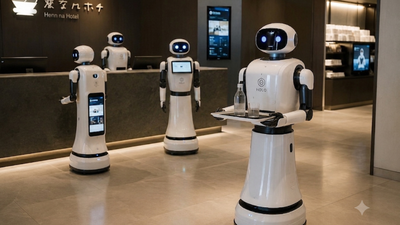
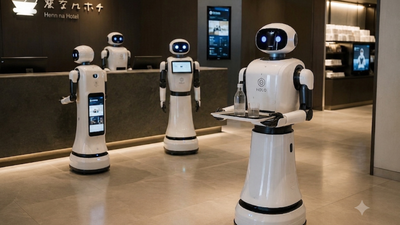
The project is being jointly developed by Pudu Robotics and Shenzhen Culture & Tourism Industry Development Co. Ltd., following the signing of a strategic partnership announced in June 2026. Located on the West Artificial Island of the Shenzhen–Zhongshan Link, the hotel forms part of a wider plan to transform the newly developed island into a technology-driven tourism destination.Unlike many existing smart hotels that use robots for only selected tasks, this project is designed around what Pudu Robotics calls a “full-scenario robot service” model. Robots are expected to undertake guest reception, check-in support, luggage guidance, room service, food delivery, housekeeping, public-area cleaning, security patrols and interactive guest assistance throughout the property.The planned hotel will include guest rooms, a restaurant, fitness facilities, and other hospitality services, all connected through an integrated robotic operating system.According to Global Times, in announcing the project, Guo Cong, Co-founder and Chief Technology Officer of Pudu Robotics, said:“This full-scenario model means robots will be deeply involved in every part of hotel operations, with no service gaps and no human interruptions.”According to the company, the aim is not simply to automate individual tasks but to allow multiple robots to collaborate continuously throughout the guest experience.
How Pudu Robotics plans to automate reception, housekeeping and room service
Rather than relying on independent machines working in isolation, the hotel will operate through PuduAgent and PuduFM 1.0, the company’s embodied AI platform that enables different robots to communicate and coordinate their activities.Reception robots will be designed to recognise speech, gestures and social interactions during check-in. Delivery robots will transport meals, amenities and luggage while selecting routes autonomously. Cleaning robots will maintain guest rooms and public areas, adapting their movements to changing environments without direct human control.According to Pudu Robotics, these robots share a common intelligence framework that combines vision, language, navigation and task execution, enabling them to cooperate rather than function as separate automated systems.The company describes the project as an opportunity to explore how embodied artificial intelligence can move beyond restaurants and commercial buildings into a fully integrated hospitality environment.Trial operations are expected to begin before the hotel’s full opening, allowing developers to refine robot coordination and guest services under real operating conditions.
Could fully autonomous hotels become the future of hospitality
Although automation has become increasingly common across the hospitality industry, completely replacing human staff remains an ambitious objective. Hotels around the world already use self-service kiosks, robotic delivery assistants and AI-powered concierge systems, but most continue to depend on people for complex customer interactions and operational management.The Guangdong project represents a significant step towards testing whether coordinated fleets of service robots can reliably perform these responsibilities on a much larger scale. Its success will depend not only on robotic capabilities but also on how guests respond to an experience where nearly every interaction is mediated by artificial intelligence.Researchers continue to point out that hospitality extends beyond efficiency. Personalised communication, empathy and adaptability remain qualities that are difficult to replicate through automation alone. For this reason, the project is likely to serve as an important real-world case study for understanding both the opportunities and limitations of embodied AI in customer-facing industries.Whether robot-operated hotels become commonplace or remain a technological niche, the development illustrates how advances in robotics are beginning to reshape industries once considered firmly centred on human interaction.