








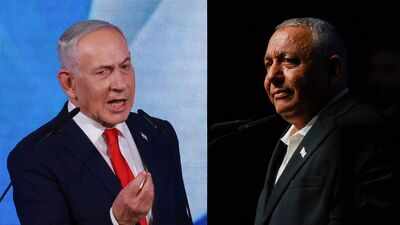
Gadi Eisenkot, a former Israeli military chief, has been given the first opportunity to form the next government after President Isaac Herzog invited him on Saturday. The inconclusive October 27 election failed to give any party a clear parliamentary majority.However, with his coalition falling short of the numbers needed to govern, Eisenkot faces several challenges.He has options laid out to form a minority government. He can secure support from Arab parties, reach an understanding with ultra-Orthodox factions or explore a broader unity arrangement.But if he fails within the 42-day deadline, the incumbent Israeli Prime Minister Benjamin Netanyahu could get another chance to form a government.Eisenkot’s Yashar party and its potential allies have 48 seats in the 120-member parliament.While his seats fall short of the 61-seat majority mark required, support from Israel’s two Arab parties, which together hold 19 seats, could help his bloc reach 67. The parties could support his government from outside without formally joining the coalition, allowing Eisenkot to attempt a minority government.
How can Eisenkot form a minority government
One possibility is for Eisenkot to bring together his natural allies, including the centre-right Together party, The Democrats and Avigdor Lieberman’s right-wing Israel Our Home. Their combined strength stands at 48 seats.The two Arab parties, Ra’am and the Joint List, could then provide outside support. Both have endorsed Eisenkot to form the next government and expressed willingness to work with his broader camp to prevent Netanyahu’s return to power.However, this arrangement faces political hurdles. Eisenkot had pledged during his campaign not to include Arab parties in his government. Reversing that position could prove difficult, particularly after the October 7, 2023, Hamas attack hardened attitudes towards Israel’s Arab minority.Lieberman has also repeatedly ruled out forming a minority government with Arab parties. So far, only The Democrats, a centre-left party, have publicly supported their inclusion.Netanyahu has also focused his campaign on delegitimising any government that relies on Arab support.There is a precedent for such an arrangement. Ra’am joined former prime minister Naftali Bennett’s government in 2021. Bennett, who now heads the Together party, is among Eisenkot’s potential partners. However, that government collapsed after 18 months, partly because of disagreements over the occupied West Bank.
Can ultra-Orthodox parties give Eisenkot a majority
Another option is to seek support from Israel’s two ultra-Orthodox parties, which together hold 13 seats. Their backing could take Eisenkot’s bloc to the 61-seat majority needed to form a government.However, reaching an agreement will not be easy. The main sticking point is military service exemptions traditionally granted to ultra-Orthodox seminary students. The exemptions have drawn criticism from many Israelis who believe the burden of military service is unfairly placed on the wider population.Eisenkot and his allies, particularly Lieberman, have strongly opposed these exemptions. However, Lieberman signalled some flexibility on Friday, saying he was open to a compromise.“You cannot have it all”, he told supporters.The two ultra-Orthodox parties have also taken different positions following the election. United Torah Judaism declined to endorse any candidate, while Shas backed Netanyahu.
What happens if Eisenkot fails
Eisenkot has up to 42 days to form a government. If he cannot secure the necessary support, Herzog is likely to invite Netanyahu to make another attempt.Netanyahu’s religious-nationalist bloc has been reduced from its original 64 seats to 53. Despite this, the prime minister could try to weaken the opposition by persuading lawmakers from rival parties to defect and join his camp.He has used this strategy before. In the run-up to the 2022 election, Netanyahu managed to destabilise the government he was opposing by drawing support away from its ranks. However, the opposition bloc at the time had a much narrower lead, meaning fewer defections were needed to bring it down.If Netanyahu gets another opportunity, he would need to find enough support to rebuild a parliamentary majority.
Could a unity government emerge
If Eisenkot cannot form a government with Arab or ultra-Orthodox support, another possibility is a unity arrangement involving his Yashar party, Together, Israel Our Home and Netanyahu’s Likud.Likud emerged as the largest party in the October 27 election with 27 seats. A grouping involving these parties would command 67 seats, giving it a parliamentary majority.However, this appears unlikely for now. Eisenkot and his partners would have to abandon their central campaign promise of removing Netanyahu from power. Netanyahu, in turn, would likely have to distance himself from his traditional far-right and ultra-Orthodox allies.Still, prolonged coalition negotiations or renewed fighting with Iran could push the rival camps towards a unity arrangement.
Could Israel face another election
If both Eisenkot and Netanyahu fail to form a government, parliament can nominate another candidate. The process has a deadline of around 100 days. If no candidate succeeds, Israel will have to hold another election.Herzog has already warned against another vote. On Wednesday, he said everything must be done to avoid fresh elections and urged political parties to approach consultations with an open mind.