









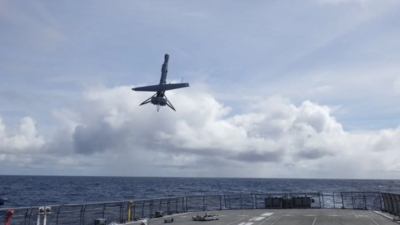
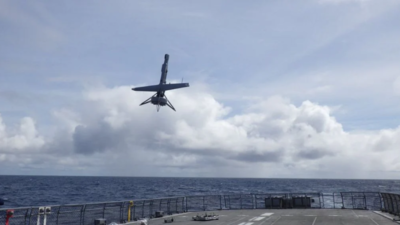
The idea of turning a warship to a miniature aircraft carrier is moving from concept to contract, with India and the United States both building shipborne drone capabilities, though at very different ends of the spectrum. Unmanned aircraft that can take off from a moving deck are changing what a warship can see, and in the American case, what it can strike.India’s effort is the Naval Shipborne Unmanned Aerial System programme. After the Defence Acquisition Council cleared it in July 2026, the Navy issued an industry notice to move the acquisition forward, with the process meant to be completed by January 31, 2027. The Navy plans to buy around 40 systems for warships longer than 100 metres, each originally envisaged as two unmanned aircraft, a primary control station and a standby control station. The requirement was first outlined through a Request for Information in 2022.The drones will mainly handle intelligence, surveillance and reconnaissance, tracking suspicious vessels and feeding real-time imagery and sensor data to a warship’s command centre. They are also expected to support anti-piracy, counter-terrorism, search-and-rescue and battle damage assessment tasks. Electro-optical and infrared sensors will allow imaging by day and detection at night, while radar and electronic intelligence payloads could pick up radar emissions and communications signals. Compared with helicopters, drones can stay airborne longer at lower operating cost, letting a ship watch a larger area and react faster, and their data can feed combat management systems.The category of the procurement seeks at least 60% indigenous content and at least 50% of materials, components and software must be made in India. Operating drones from a pitching deck is not easy, with strong winds, saltwater corrosion, secure data links and contested electronic environments among the challenges. Indian conglomerate JSW Group and US firm Sheild AI have partnered to make the V-Bat runway-independent drone in India, this unmanned system has demonstrated its naval applications.The American effort aims much higher. Shield AI’s X-BAT is billed as an AI-piloted, vertical takeoff and landing fighter-class aircraft that needs no runway. It has a 39-foot wingspan, a range of 2,000 nautical miles and a ceiling above 50,000 feet, and is run by the company’s Hivemind AI pilot, which can carry out strike, electronic warfare and surveillance missions even where GPS and communications are jammed. Shield AI says the first prototypes are due by the end of this month, with flight testing before the year ends and full production planned for 2029.The US Navy has now executed a $150 million modification to its existing agreement with the company, funded through a Pentagon exportability programme, with Shield AI matching it from its own capital. That follows a $50 million Navy investment earlier this year, made with the Defense Innovation Unit under the Runway Independent Maritime Expeditionary Strike effort, bringing the combined total to $400 million.The two programmes sit at opposite ends. India wants eyes in the sky for its escorts, while Washington is betting on drones that can fight from ships without a flight deck. Both rest on the same logic, that a warship need not be a carrier to project air power.