




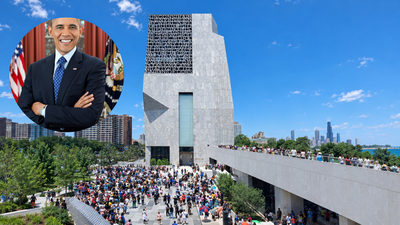
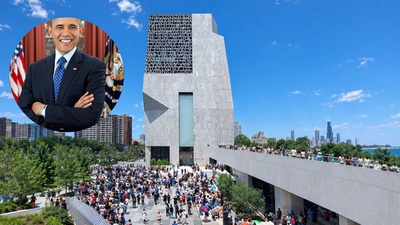
Barack Obama’s presidential centre in Chicago was planned as a major investment in the city’s South Side, the neighbourhood that shaped much of his personal and political life. The planning process began in 2014, and Chicago’s South Side was selected for the project in 2015. Jackson Park was chosen as the specific site in July 2016, followed by design reviews, a federal review and legal challenges before construction began in 2021.According to PBS News, the centre was backed by private donations which reveal the project’s estimated cost that rose from $500 million to roughly $830 million by 2021 further refined to approximately $850 million by 2026.Set within Jackson Park beside Lake Michigan, the development was designed to bring together a museum, educational facilities and public spaces. Yet its ambitions have also drawn scrutiny over the use of historic parkland, tree removal and fears that rising property prices could put pressure on long-standing residents.
Obama Presidential Center cost is backed by private donations
The Obama Presidential Center is being financed through private contributions rather than public funding for its construction. When the Obama Foundation released figures in August 2021, the projected cost had risen to approximately $830 million from an initial estimate of $500 million. By 2026, the reported cost had increased further to around $850 million, according to PBS News. The rising estimates reflect the scale of a project that spent years moving through planning, legal challenges and regulatory review before construction began in September 2021.The financial commitment is tied to the Obama Foundation’s plans for a permanent institution in Chicago. Unlike a conventional museum devoted primarily to displaying historical objects, the centre is intended to bring together exhibits, educational activities and public amenities. The former president has described the project as a way to recognise the community that shaped his life while creating a place with uses extending beyond his time in office.Private fundraising also places the foundation at the centre of the project’s long-term development. The 2021 figures offered a snapshot of the expected construction bill, rather than a final account of what the completed institution would cost to build and operate.
Barack Obama’s presidential centre takes shape on a 19-acre Chicago site
The centre occupies a 19-acre site within Jackson Park, a historic public landscape on the shore of Lake Michigan. The wider park covers hundreds of acres and has long been part of Chicago’s civic and recreational life. Choosing this location connected the presidential centre to the South Side, but it also made the development more contentious than a project on an ordinary vacant site might have been.Obama’s relationship with the area predates his presidency. He worked as a community organiser on Chicago’s South Side before entering electoral politics, later taught law at the University of Chicago and built his family life in the city. Michelle Obama also grew up on the South Side. The foundation’s decision to establish the centre there reflected those connections, placing the institution near places that played a part in the couple’s lives.At the groundbreaking ceremony on 28 September 2021, Michelle Obama said, “This city, this neighborhood courses through my veins and defines me at my very core.”“This substantial investment in the South Side will help make the neighborhood where we call home a destination for the entire world.”
Obama Presidential Center projects up to 1 million visitors a year
The plans outlined in 2021 included a museum, a branch of the public library, an athletic centre, a test kitchen and a children’s play area. The campus was designed to combine presidential history with facilities intended for public use, rather than operate solely as a repository for documents and memorabilia.As reported by PBS News in 2021, the Obama Foundation projected that the centre could attract around 750,000 visitors annually. By 2026, estimates had been refined, with approximately 600,000 visitors expected each year at the ticketed museum and up to 1 million anticipated across the campus’s free public amenities.The development was also expected to bring new trees and employment opportunities to the site. Obama presented those additions as part of the centre’s potential contribution to the surrounding area, alongside its cultural and educational role.
Construction faced years of opposition and review
The groundbreaking followed a lengthy period of disputes over the project’s location and potential consequences. Legal challenges and a federal review delayed progress, in part because Jackson Park is listed on the National Register of Historic Places. The site’s protected status meant that the development required scrutiny beyond the ordinary planning process.Environmental concerns became a separate point of contention. Critics objected to the use of parkland and the removal of trees, arguing that the project would reduce green space in an established public park. During the September 2021 ceremony, an aircraft flew over the site carrying a banner urging the organisers to stop cutting down trees and move the centre elsewhere.
Barack Obama’s presidential centre opens in Chicago after years of delays and debate
Barack Obama’s presidential centre finally opened to the public on Chicago’s South Side on 19 June 2026. The opening marked the completion of a long-running project intended to preserve Obama’s presidential legacy while creating a space for education, public engagement and community activities. Although the centre was designed to attract visitors and investment to the neighbourhood, questions about historic parkland, environmental changes and housing affordability remain part of the wider discussion about its impact. Its lasting success will depend on whether the opportunities it creates benefit the surrounding community as well as visitors from around the world.