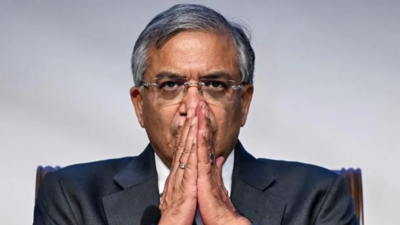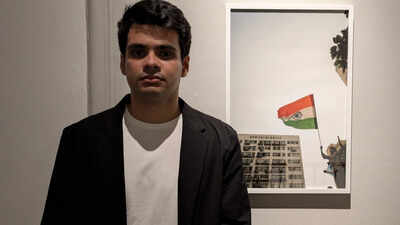







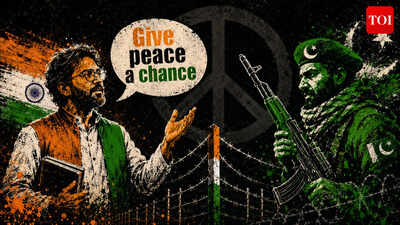
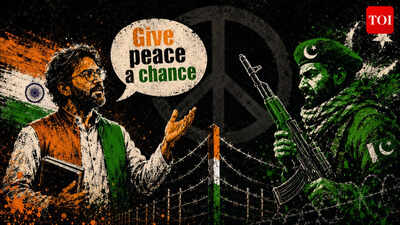
Remember that Manna Dey classic from Manoj Kumar’s Upkar?“Kasme, waade, pyaar, wafa,Sab baatein hain, baaton ka kya.”Promises, vows, love, loyalty,All are just words.Nearly six decades on, that Upkar lament could be the theme song of India-Pakistan diplomacy: Track two, three, or four and so on.Here’s what has prompted the thought. Over 100 prominent citizens from India and Pakistan have written an open letter to PMs of both countries. The letter listed “confidence-building measures” to restore dialogue and a lasting peace.The appeal, steered by Centre for Peace and Progress chairperson OP Shah, reads like a wish-list built over decades. Restore full diplomatic relations. Bring back high commissioners. Resume normal visas. Reopen comprehensive dialogue. Revive discussions on Jammu and Kashmir, including the framework negotiated between 2004 and 2007. Demilitarise and de-escalate.The signatories include Farooq Abdullah, Mehbooba Mufti, Mirwaiz Umar Farooq, Mani Shankar Aiyar, Manoj Jha, AS Dulat on the Indian side; and from Pakistan, figures such as Khurshid Mahmud Kasuri, Ashraf Jehangir Qazi, Shamsher Ahmed Khan and Beena Sarwar.But here’s the uncomfortable truth the letter glides past. India and Pakistan are not stuck only because decent people have not met often enough. They are stuck because the dispute is ideological, political and institutional.These were once people of the same undivided land, but Partition came from the belief that they were separate political communities with different destinies. That argument still shadows every peace effort.Civil society can soften the edges of that history, but it cannot settle questions of power, territory, terrorism, security and identity. That requires a political settlement, backed by states, not just signatures,
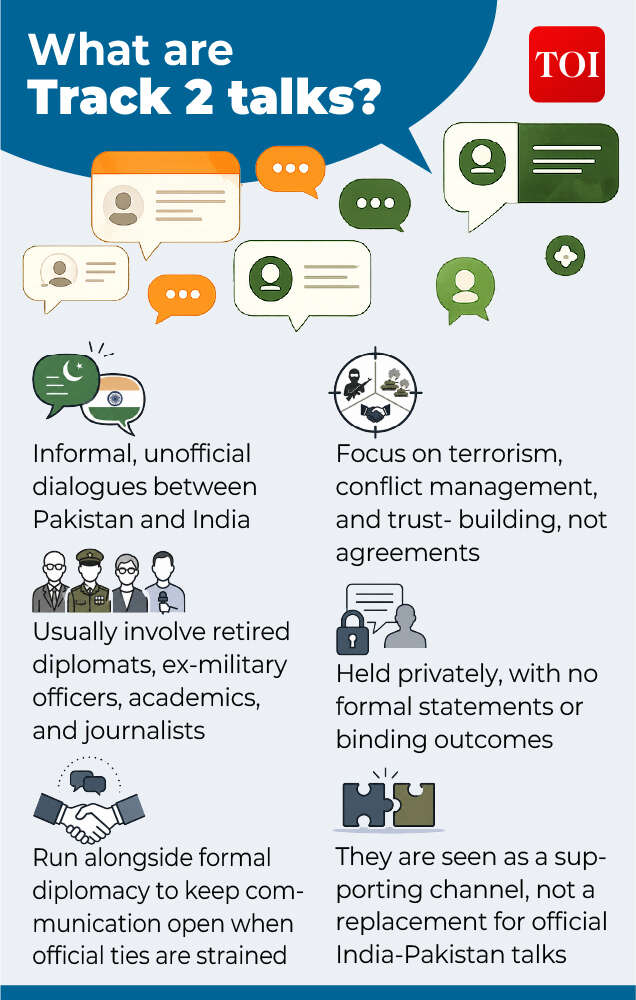
What are Track 2 talks
India-Pakistan talks fail because of who actually calls the shots across the border. Pakistan runs on a hybrid governance model: An elected government in Islamabad as the face, and the army in Rawalpindi holding the real levers, especially on India policy. That grip has only tightened since Operation Sindoor, with the army chief now wearing a field marshal’s baton.This is why New Delhi’s reaction to recent Track II chatter has been sharp. Foreign secretary Vikram Misri dismissed the recent flurry of “Track II” reports, saying the government takes “no cognisance” of such events. Private gatherings, private opinions, the retired diplomats and generals in attendance speak only for themselves, he said.
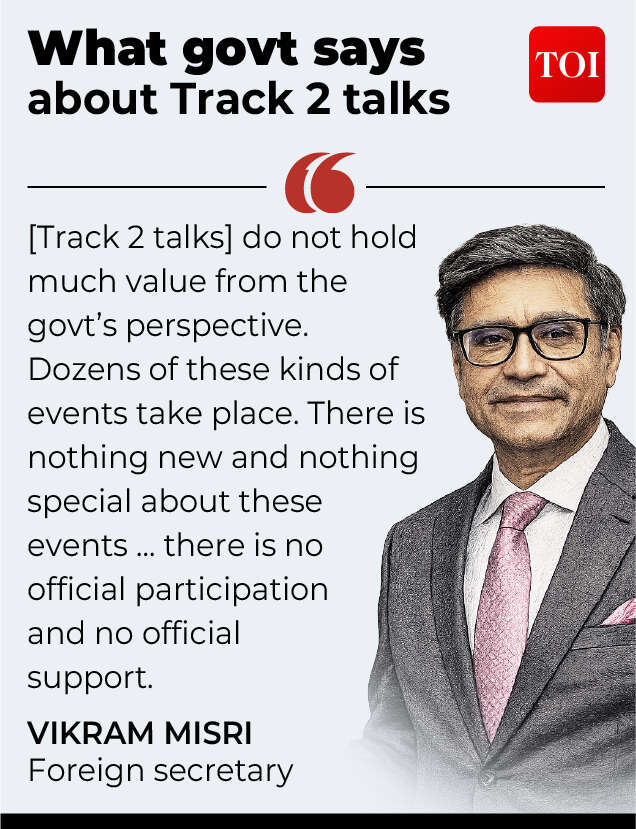
What govt says about Track 2 talks
Delhi’s remaining bandwidth for Islamabad, in fact, is going into harder instruments. At the FATF meeting later this year, India will table video and other evidence of Pakistan’s continuing terror links to push it back onto the grey list. A government preparing dossiers is not looking for dialogues.Moreover, what’s the point of any talks if the Pakistan military is not behind it? The elected prime minister can sign whatever he likes; the Kashmir file, the India file, the terror file all sit in Rawalpindi. And under the recent 27th constitutional amendment, that arrangement has only grown more formal, with the army chief’s powers constitutionally consolidated rather than curtailed. Any dialogue with the civilian facade is a conversation with someone who can’t sign the cheque.And if you want a measure of what that establishment does to those who challenge it, consider Imran Khan. Whatever you think of his politics — and he is far from blameless, having ridden the same hybrid arrangement to power before falling out with it — he was arguably the most genuine star Pakistan has produced in any walk of life. World Cup-winning captain, philanthropist who built a cancer hospital, prime minister.In his prime, Imran, aka the ‘Kaptan”, was a living example of “owner’s pride, neighbour’s envy” ad tagline. Today he sits behind bars in Adiala jail, and periodic rumours about his health and even his whereabouts swirl because independent verification is so scarce. It is painful to watch Imran’s continued internment, even from across the border.If a system can do this to its biggest star, largely because he crossed the red lines of the military, what guarantees can it really offer on cross-border terrorism, long-term dialogue or Kashmir? If the army remains judge, jury and final arbiter at home, how seriously will any civilian pledge to India be taken in Delhi? The establishment will surely not let its India policy to be decided by peaceniks with pens
What would actually change the script?
If we are honest, only two broad kinds of shifts can break this cycle.One, a genuine structural change in Pakistan. That means a slow, painful transition where the army accepts a narrower, professional role; where elected governments stop looking over their shoulder on every India-related file; where there is a real consensus that cross-border militancy is a strategic liability, not an asset. Without such a reset, Pakistan will remain trapped between economic crises, political churn and a permanent security state.Two, a hard-headed political decision in Delhi to test the waters despite the structural risks. That has happened before — think of Vajpayee’s Lahore bus and later the 2003 ceasefire; Manmohan Singh’s quiet backchannel on Kashmir; even the 2015 surprise Lahore visit by PM Narendra Modi. Each time, though, the lack of structural change across the border meant that the next attack, the next crisis, reset the clock.For now, neither condition is visible. Pakistan’s hybrid regime looks more entrenched than reformed. India’s political mood is more hawkish than hopeful.Pran’s character in Upkar, Malang Chacha, sang that line with a one-armed shrug of hard-earned wisdom, not bitterness. That’s roughly the right posture for watching Track II diplomacy today: Listen to the song, appreciate the sentiment, and remember what the lyric actually says. Promises and vows are just words.Baaton ka kya?