








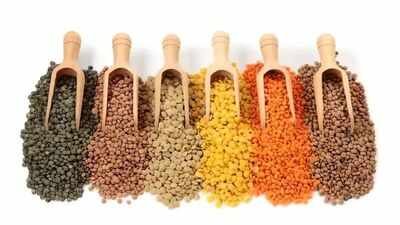
NEW DELHI: India may not yet be fully secure in meeting its food requirements, with heavy dependence on imports for essential commodities such as edible oils and pulses, NITI Aayog vice-chairman Ashok Kumar Lahiri said on Friday.Speaking at an event in Delhi, Lahiri said India imports more than half of its edible oil requirements and relies on other countries for several pulses. He questioned whether the country was sufficiently prepared to deal with disruptions in global supplies and sudden price increases.“We are talking about Viksit Krishi in Viksit Bharat in 2047. As we move towards Viksit Bharat at 2047, are we secure regarding our food supply across the various products? Perhaps not as yet,” he said.Lahiri said he was surprised to learn that chana (gram) consumed in India comes from Australia, while masoor dal is imported from Australia and Canada. Some pulses also come from Myanmar, African countries and Russia.“Now you can ask what is wrong with India importing edible oils or oil seeds from Indonesia, Malaysia, Argentina, Brazil, Russia, and Ukraine, and pulses from Australia, Canada, Myanmar, Africa, and Russia.“The problem is, first, the issue of vulnerability to global supply disruptions or price shocks,” he said.India meets more than half of its edible oil demand through imports. These imports are estimated at 17 million metric tonnes, worth around $20 billion, Lahiri said.India is also the world’s largest producer and consumer of pulses, accounting for nearly a fourth of global consumption. The country consumes around 25-27 million tonnes of pulses every year.“For our dal-chawal or dal-roti, we require pulses and edible oils. Any disruption of supply of these essential commodities or price shock can assume the gravity of a strategic disaster,” he said.Lahiri said reducing dependence on imports would require greater focus on domestic production of pulses and edible oils. He pointed to the need to diversify crops and reduce the dominance of wheat and paddy in Indian agriculture.
Share your thoughts in the comments
Be respectful · TOI community guidelines
Since pulses and oilseed crops generally require less water, he said, promoting their cultivation could also help address agricultural challenges.The NITI Aayog vice-chairman also stressed the need to reduce and eliminate waste in Indian agriculture.