







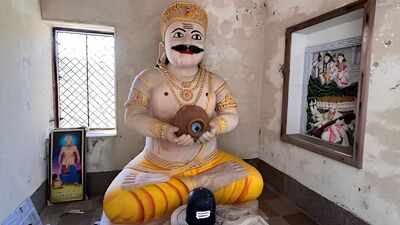
JODHPUR: As Ravana’s towering effigies go up in flames across India on Dussehra, a small community in Rajasthan’s Jodhpur does something that sets it apart from the celebrations around it.Its members wait for the fires to die down, bathe, change their sacred threads and gather at a temple to offer prayers to the very king whose death the festival commemorates.For the Dave Godha community, a gotra of Shrimali Brahmins who consider themselves descendants of Ravana, Dussehra is not a celebration of his defeat but a day of mourning and remembrance.“We worship Ravana and try to imbibe his good qualities,” says Kamlesh Kumar Dave, chief priest of the community’s temple near Mehrangarh Fort. For the families who follow this tradition, Ravana is not merely the ten-headed king cast as the embodiment of evil in popular retellings of the Ramayana. They revere him as a learned ruler, a master musician and a scholar of the Vedas.Their observance begins after the customary Ravana Dahan is over. Male members of the community take a bath, change their janeu, the sacred thread worn by Brahmins, and assemble at the temple for special prayers. Flowers, sweets and food offerings are made as they seek peace for Ravana’s soul.“Even though Ravana Dahan may not take place, we have always observed mourning on this day, and this year too, we will do the same,” Dave has said of the annual ritual.The practice rests on a local legend that places Ravana’s marriage to Mandodari in Mandore, now a garden suburb about 11km from Jodhpur. According to the belief, Mandodari was the daughter of Mayasura, the king associated with Mandawar, and Ravana travelled from Lanka with a wedding procession, or baraat, to marry her.Dave says some members of Ravana’s wedding party stayed behind after the marriage, eventually giving rise to the community that now claims him as its forefather.“When he came to Mandor to tie the knot with Mandodari, many of his relatives accompanied his ‘baraat’ from Lanka to Mandor. After the marriage, Ravana returned to his kingdom with his queen but some of his relatives stayed here,” he says.The legend has endured across generations, shaping a tradition that runs counter to the dominant symbolism of Vijayadashami — the triumph of good over evil. For the community, remembering Ravana means looking beyond the familiar narrative of his abduction of Sita and his eventual defeat by Lord Rama.“Beyond his image as Sita’s abductor, he was a veena virtuoso and a sage whose mastery of mantras could command nature,” says Ajay Dave, Kamlesh Dave’s son. He also describes Ravana as a scholar whose knowledge of the Vedas and Puranas earned him reverence.The community’s temple, built in 2008 at the foot of Mehrangarh Fort, gives this belief a permanent home. Before its construction, families worshipped Ravana at their homes. The temple now houses idols of Ravana and Mandodari, along with Kharanana, regarded as the community’s kuldevi, or clan deity. The statues depict Ravana worshipping Lord Shiva.Around 100 Dave Godha families live in Jodhpur, mainly in the old-city localities of Chandpol and Brahmpuri. Other families of the clan are also reported to live in Phalodi district.The temple’s daily worship continues beyond Dussehra, with musicians and students of the Vedas among those who visit to seek Ravana’s blessings. For the community, his reputation as a scholar and musician remains central to the way he is remembered.In Mandore, the landscape itself is woven into the story. A spot on Mandore hill is known locally as Ravana’s Chanwari, believed to be where the wedding vows were exchanged. The legend also links the area to Mayasura and Mandodari, whose story is passed down as part of the region’s cultural lore.Mandore later became a capital of Marwar under the Rathore dynasty before the rulers shifted their capital to Jodhpur in 1459. Its gardens remain a popular attraction today.But for the Dave Godha families, Mandore holds a significance beyond its history and gardens. It is the place where, according to their tradition, their ancestor’s story began — and where a wedding legend helps explain why a day of public celebration is observed in their homes and temple as one of mourning.