

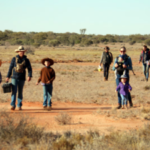



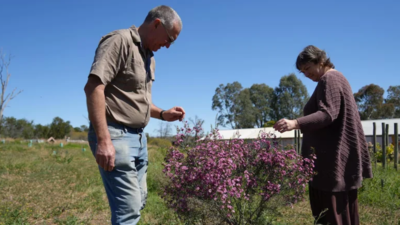
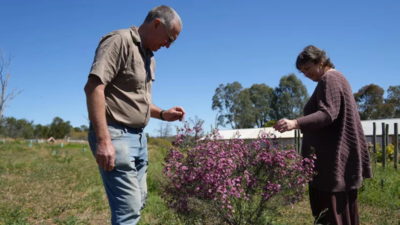
An Australian couple who once managed a vineyard in South Australia’s Riverland region have taken an unusual route after leaving the wine industry: restoring their land to its natural state. Their decision has helped create a potential refuge for the threatened regent parrot, a native Australian bird whose population has suffered from habitat loss. As reported by ABC Riverland’s Jackson Byrne and highlighted in conservation updates by the Murraylands and Riverland Landscape Board and Trees For Life, Tony and Cherie Townsend began transforming their 40-acre vineyard at Murtho in 2022. Instead of replacing the grapevines with another commercial crop, they chose to bring native vegetation back to the property. The restoration is now becoming a family effort, with four generations taking part in planting native species. The project is also part of a wider conservation push to rebuild the habitat that regent parrots need to feed, move and survive.
Rebuilding a lost habitat
The property, located along the River Murray, was identified as a suitable location for supporting regent parrots because of its position along the birds’ natural movement routes. The restoration has been carried out with support from the Murraylands and Riverland Landscape Board, alongside conservation organisations and local volunteers.According to the Landscape Board’s September 2026 update, the three-year restoration project covered around 14 hectares of former vineyard land. Its final phase was completed in 2026, with more than 3,000 native seedlings planted to help establish food sources and shelter for wildlife. The effort is part of a wider conservation programme aimed at reconnecting fragmented habitats across the River Murray landscape. Trees For Life, which works with landholders and conservation authorities on the Regent Parrot Conservation Project, has also been using direct seeding to restore native vegetation. Its wider Murtho project includes 40,000 plants belonging to 25 locally native species across a 40-hectare site.For regent parrots, restoring vegetation is particularly important because the birds depend on different types of habitat at different stages of their lives. They typically nest in deep hollows of mature river red gum trees, while nearby mallee woodlands provide food. Native seeds, buds and flowers form an important part of their diet. The availability of connected vegetation also allows the birds to travel between breeding and feeding grounds without having to cross exposed areas.
A vulnerable species in need of protection
The regent parrot, scientifically known as Polytelis anthopeplus monarchoides, is listed as vulnerable nationally. Its population in South Australia has experienced a significant decline, with fewer than 400 breeding pairs estimated to remain in the state. Habitat destruction, the loss of mature nesting trees, declining native food sources and competition for suitable nesting hollows are among the major threats facing the species. Conservation efforts have therefore increasingly focused on protecting existing habitats and restoring vegetation in areas that can support breeding and foraging.Monitoring is another important part of the recovery effort. The Nature Foundation, working with the Regent Parrot Recovery Team and the Landscape Board, has been conducting annual breeding surveys. Its 2025 survey at Murbpook Nature Reserve identified a pair nesting in a previously unrecorded section of the reserve, marking a third distinct nesting area at the site.
A family effort spanning generations
Beyond its conservation benefits, the restoration has brought together different generations of the Townsend family. Four generations have participated in planting and nurturing the native vegetation, while local school students, youth council members, Aboriginal corporation rangers and conservation staff have also contributed to the work.The Landscape Board says the final planting phase involved more than 3,000 seedlings, giving younger members of the community an opportunity to participate directly in threatened-species conservation. The restored property will take time to develop into a mature habitat, but the project offers an example of how privately owned agricultural land can contribute to biodiversity recovery.For the Townsends, the decision has meant giving up the possibility of earning an income from those acres. In return, they have helped create a landscape that could support native wildlife long after the vineyard has disappeared.