








Deep in the Brazilian Amazon, the Amondawa have offered linguists an unusual glimpse of what life looks like when time is not treated as something that can be counted. In their language, researchers found no numerical calendar system built around familiar units such as weeks, months and years. Instead, daily life is organised around events, changes in the environment and the stages of a person’s life. The distinction matters because people in clock-based societies often speak about time as though it were a physical thing: we move through it, lose it, save it or run out of it. The Amondawa language does not appear to work in quite that way. According to the study by the University of Portsmouth, titled ‘When time is not space: the social and linguistic construction of time intervals and temporal event relations in an Amazonian culture’, the community talks about events and intervals, challenging the assumption that humans everywhere must understand time through the same linguistic framework.
How the Amondawa tribe understands time without a calendar
The Amondawa do recognise changes in the day and in the seasons. Day and night provide familiar divisions, while rainy and dry periods mark important changes in their surroundings. What is missing is the numerical framework familiar to people who arrange their lives around dates and fixed periods. The researchers found that the language does not use its extensive vocabulary for physical space and movement to describe temporal relationships in the way many other languages do. According to Australian Geographic, there was no equivalent system for routinely referring to a week, month or year as an abstract measure.This does not mean that the Amondawa have no understanding of events happening before or after one another. They clearly recognise sequences and changes. The difference is in how those relationships are expressed. An event can provide the reference point instead of a numbered point on a calendar. That distinction was central to the researchers’ argument: the ability to experience events and their order may be widespread, while the idea of dividing life into measured intervals may depend partly on cultural and material systems such as calendars and numbers.
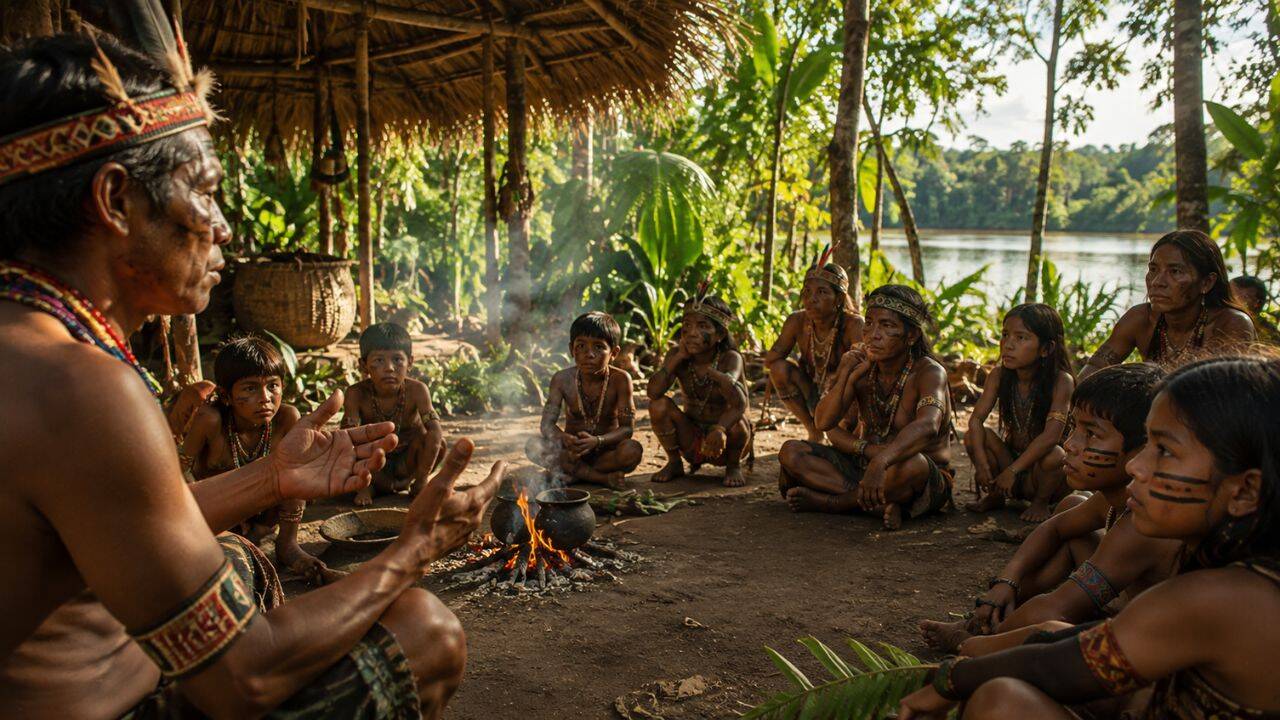
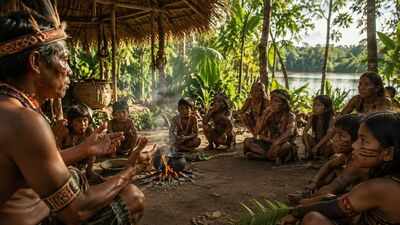
image AI generated
Amondawa tribe uses life stages instead of numerical age
The research also described a striking difference in how age and identity are represented. Members of the community did not use age in the same numerical way as people in societies where a person’s identity is routinely accompanied by several years. Names could change as individuals moved through different stages of life and as their position within the community changed. In one example reported from the fieldwork, an older child could give up a name when a new sibling was born and take on another name. Life stages, rather than a fixed numerical age, therefore became part of how a person’s place in the community was understood.
What the Amondawa tribe reveals about how humans understand time
The Amondawa research was not an argument that the community somehow lives outside time. People still experience sequence, change, seasons, ageing and the consequences of events. The researchers were questioning something narrower: whether humans naturally organise all of those experiences through an abstract, measurable concept of time. Their findings suggested that the familiar habit of treating time as a kind of space may be shaped by language, numbers and cultural objects rather than being identical across all societies. The study, published in Language and Cognition, proposed that systems for measuring time can emerge alongside numerical and material technologies such as calendars.The work also placed the Amondawa within a much wider question about language and thought. In many languages, people casually describe time using spatial ideas, speaking of the past as being behind them or the future as lying ahead. The Amondawa language provided a useful counterexample because researchers found that this particular pattern of mapping spatial relationships onto time was not used in the same way. It did not suggest that language completely determines how people think, but it did show that a concept that feels almost universal to outsiders can be organised differently in another culture.
How modern life is changing the Amondawa language and culture
The research took place against a changing social background. The Amondawa had traditionally relied on hunting, fishing and cultivation, while contact with the outside world had brought Portuguese, electricity and television into the community. That contact also placed pressure on their own language. The researchers’ work therefore captured not simply an unusual way of describing time, but a linguistic system existing during a period of cultural change.It drew on observations and structured linguistic tasks carried out with Amondawa speakers. The researchers argued for a more careful distinction between experiencing events and treating time as an abstract quantity that can be counted, divided and discussed independently of what is happening.