








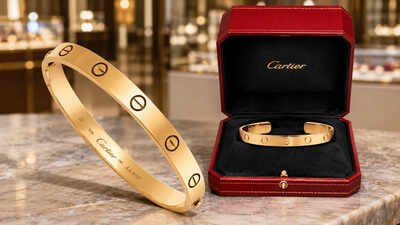
A woman who spent £4,550 on a Cartier bracelet as a birthday treat has won a court battle against luxury department store Harrods after it refused to refund her money over allegations of damage. Georgia Romain, a hypnotherapist from Kingston upon Thames, London, had ordered the 18-carat gold bracelet online but decided to return it in July 2025 after finding that it was too small for her wrist. However, Harrods rejected the return, claiming that the jewellery had scratches and could no longer be resold. Romain challenged the retailer’s evidence and eventually took the dispute to court without legal representation. The judge ruled in her favour, ordering Harrods to pay £5,131, including the original purchase price, interest and court fees.
Woman returns Cartier bracelet after finding it too small
Romain had reportedly saved for years to purchase the Cartier Love bracelet, which she had planned as a birthday treat for herself. However, after receiving the 18-carat gold piece, she found that it was too small and did not fit her wrist properly.Having purchased it through Harrods’ online store, she arranged to return the bracelet in its original box in July 2025, expecting a refund.The retailer subsequently informed her that the return had been rejected because the bracelet allegedly contained scratches and defects. Harrods also warned that the jewellery would be transferred to its lost property department unless she reclaimed it within 30 days.The decision left Romain without the bracelet or the money she had paid for it, prompting her to challenge the retailer’s assessment of the returned item.
Harrods claims bracelet had scratches and could not be resold
The dispute centred on a pre-inspection video recorded by Harrods after receiving the returned bracelet. The retailer’s customer service team used the footage to identify what it described as scratches and defects on the jewellery’s soft gold surface.Harrods maintained that the bracelet had been damaged and argued that it could no longer be resold in that condition.However, Romain questioned whether the bracelet shown in the inspection footage was actually the one she had purchased. She pointed out that the video did not display the item’s unique serial number and also suggested that the bracelet being examined appeared thicker than the one she had ordered.In an email to the retailer, she asked how she could be certain that the footage showed her bracelet without seeing its serial number. She requested evidence linking the alleged scratches to the specific item she had returned.According to the court proceedings, Harrods’ subsequent response did not address her concerns about the missing serial number. Instead, the retailer formally rejected the return and informed her that the bracelet was legally her property.
Judge questions Harrods’ evidence over alleged scratches
After failing to resolve the dispute with the retailer, Romain brought a claim against Harrods at London’s Mayors and City County Court, representing herself without legal assistance.Deputy District Judge Elaine Vignoli ruled in her favour, finding that Harrods had failed to establish, on the balance of probabilities, that the bracelet was returned with the alleged scratches.The judge questioned why the retailer had not provided the evidence Romain had reasonably requested, particularly footage showing the bracelet’s unique serial number alongside the alleged damage.She described Harrods’ position in its email correspondence as “frankly staggering”, noting that Romain had made a reasonable request concerning an item of considerable value.Harrods’ lawyers argued that the bracelet would have been secured safely and handled carefully throughout the return process. However, the judge said there was no evidence before the court to substantiate that assurance.She concluded that the retailer had not proved that the scratches were present when it received the bracelet from Romain.
Judge says she would happily take home supposedly worthless bracelet
The court also examined Harrods’ argument that the alleged scratches had made the 18-carat gold bracelet worthless because it could no longer be resold.Judge Vignoli questioned this position, particularly because the retailer had not provided convincing evidence demonstrating how the alleged damage had affected the jewellery’s value.In a pointed observation during the proceedings, she said: “If it is genuinely worthless I would happily take it home with me.”The judge also described the bracelet as a “rather pretty, luxurious item” while discussing the retailer’s claim that it had become worthless because of minor scuffs and scratches.She ultimately concluded that Harrods had failed to provide sufficient evidence to support its defence and ruled in favour of the customer.
Harrods ordered to pay £5,131 to customer
Following the ruling, Harrods was ordered to pay Romain £4,550, representing the original cost of the bracelet. With accumulated interest and court fees, the total amount payable came to £5,131.Romain described herself as “very relieved” after the outcome and said she would not shop at the luxury retailer again.“I’m never buying from Harrods again,” she said after the hearing.She also explained that she had spent years saving for the bracelet and had wanted to buy it as a special birthday present for herself.“I was saving for years, I wanted to treat myself,” she said, adding that she would return to saving money rather than making another expensive purchase.