









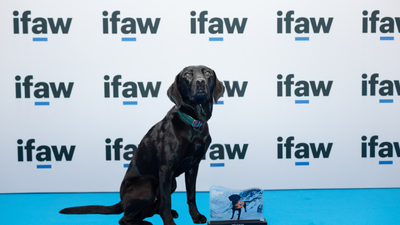
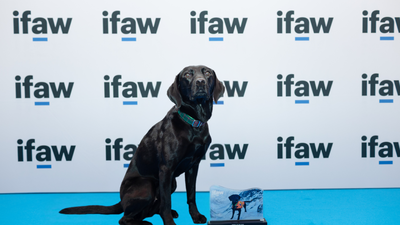
A six-year-old black Labrador from the Scottish Highlands in the UK has found an unusual new role in conservation. Sgiath, who was originally trained as a mountain rescue search dog, can now detect an invasive marine organism known as “sea vomit” by smell. Her work has earned her the 2026 Animal of the Year Award from the International Fund for Animal Welfare (IFAW). According to IFAW’s announcement, Sgiath is believed to be the first dog in the world trained to detect ‘Didemnum vexillum,’ commonly called carpet sea squirt or “sea vomit”. She works alongside her handler, marine ecologist Dr Texa Sim, to help locate the organism in UK waters.Sgiath received the award at IFAW’s annual Animal Action Awards ceremony, held at BAFTA in London on October 15. The event recognised six people and one animal for their contributions to conservation and animal welfare.
What is ‘sea vomit’ and why is it a concern?
Despite its nickname, sea vomit is not vomit. It is an invasive marine organism that can grow in thick, slimy colonies on seaweed, pontoons, oyster cages and other marine structures. According to IFAW, the species can spread rapidly and poses a threat to native marine life. As reported by The Independent carpet sea squirt can spread across harbours and oyster farms, where it can smother native organisms and become difficult to control once established.The organism is believed to have originated in Japan and was first reported on shorelines in England and Wales in 2008, according to a BBC report. Its appearance can make it difficult to distinguish from other marine growth. Finding it early is important because conventional identification can require specialist laboratory analysis and DNA testing. Sgiath offers another way to search for it: using her sense of smell.
How Sgiath moved from mountain rescue to marine conservation

Photo credit: The International Fund for Animal Welfare (IFAW)
Sgiath was initially trained as a mountain rescue search dog. Her ability to track scents led Sim, a marine ecologist, to explore whether the Labrador could help identify an invasive species threatening marine habitats. The idea developed while Sim was working on a native oyster restoration project on Scotland’s west coast. She recognised that dogs, already used to locate invasive plants and animals on land, might also help detect an invasive organism in the marine environment. The early results were encouraging.Sgiath has since been trained to give a passive indication when she detects the organism. Rather than barking or rushing towards it, she signals the find by becoming still and staring at the target. This is different from the more active indication she was trained to use during mountain rescue work. According to the BBC, Sgiath has already discovered hundreds of colonies of the invasive sea squirt.
Why a dog’s nose could help conservationists
Detecting an invasive species before it spreads widely can give conservation teams more time to respond. Sgiath’s scent-based searches could help identify the organism in places where visual inspection alone may not be enough. Her work is also helping explore a new use for detection dogs in marine conservation. IFAW described the project as a pioneering approach to tackling invasive marine species in UK waters. The approach does not replace all existing detection methods, but it could provide conservationists and site managers with another tool for finding the species earlier and more efficiently.
Another Labrador is learning the job
Sgiath is not the only dog involved in the project. Sim is also training Uisge, a three-year-old Labrador, to detect the invasive organism and support the work. According to West Coast Today, the dogs have demonstrated an ability to distinguish the target species from other sea squirts and marine organisms, including detecting traces of its scent in water samples. Their work could become increasingly useful if changing sea conditions allow invasive marine species to spread into new areas. Early detection is particularly important because established colonies can be difficult and expensive to manage.