







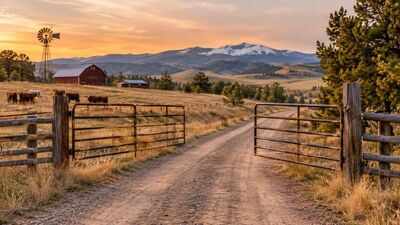
A road used by a ranching family for decades can become the subject of a property dispute when ownership changes and questions arise over who has the right to cross the land. In Colorado, a family that had used a three-mile road to move livestock and equipment since 1958 lost its claim to a permanent access right after the new owners of the neighbouring ranch challenged its continued use. The Colorado Court of Appeals upheld a permanent injunction against the family on November 12, 2026, finding that the road had been used with the previous owner’s permission during at least part of the 18-year statutory period.According to the court’s memorandum opinion in Camilletti Ranch Properties, LLC v. Seely, available on Justia, the dispute concerned a road crossing nearly 2,000 acres of ranchland in Routt County. The appellate court affirmed the district court’s decision that the Seely family had not established a prescriptive easement, which would have given them a legally recognised right to continue using the road without needing the landowner’s permission.
How the ranching family’s road access began
The history of the dispute goes back to 1958, when Lowry Seely, the father of David Seely and grandfather of Sue Voloshin, purchased a ranch in Routt County. In 1971, David acquired a neighbouring property and also used it for ranching operations. The adjoining land was owned by Harvey and Velda Wyman, and later by the Velda L Wyman Revocable Trust. Their property covered almost 2,000 acres and contained an unpaved road approximately three miles long, running from northwest to southeast.From at least 1958 through 1976, the Seely family and its predecessors used the road twice a year to transport livestock and equipment between their properties and US Forest Service grazing parcels. The family continued using it after the property changed hands. Darrell and Carol Camilletti purchased the Wyman property in 2021 and transferred it to Camilletti Ranch Properties LLC (CRP) in 2024. The Seely family continued crossing the land twice annually, but the new ownership eventually led to disagreement over whether the family had an independent legal right to use the road.
Why the new owners challenged the access
In 2023, CRP learned that the Seelys claimed a prescriptive easement over the road and intended to use it without requesting permission. The company filed a lawsuit seeking an injunction, a declaration of its property rights and damages for trespass and conversion. The Seelys filed a counterclaim arguing that their long-standing use had established a prescriptive easement.Under Colorado law, a prescriptive easement is a non-exclusive right to use another person’s land for a particular purpose. To establish one, the claimant generally must demonstrate that the use was open or notorious and continuous for at least 18 years. Once these requirements are established, the law presumes that the use was adverse. However, the property owner can rebut that presumption by demonstrating that the use was permitted.The district court ruled in favour of CRP following a bench trial. It granted a permanent injunction, rejected the family’s easement claims and awarded nominal damages for trespass.
Why the appeals court upheld the injunction
The central question was whether the Wymans had allowed the Seely family to use the road with their permission. There was no direct evidence of an express agreement between Lowry Seely and Harvey Wyman. However, the district court considered the surrounding circumstances, including Wyman’s reputation for closely monitoring his property and the presence of gates at both entrances to the road by 1964.Although there was no evidence that the gates had been locked during the relevant 1958-1976 period, Wyman eventually locked them in 1988 following a disagreement involving a hunter and commercial hunting activities. The district court inferred that Wyman had installed the gates to maintain control over his property and that the family had used the road with his implied permission.The Seelys challenged this conclusion, arguing that the court had relied on speculation rather than evidence. They also contended that implied permission required proof of the landowner’s words or actions. The appeals court disagreed. It explained that permission could be inferred from surrounding circumstances and did not always require an explicit conversation or agreement. It found sufficient evidence to support the conclusion that Wyman had permitted the family’s use during at least part of the statutory period.The court acknowledged that the case was a close one and that some of the district court’s reasoning was inconsistent. Nevertheless, it concluded that the evidence supported the finding of permissive use. Because use that begins with permission cannot develop into a prescriptive easement, the family’s claim failed. The court also rejected David Seely’s separate arguments that he could combine earlier family use with his own or establish an independent easement through his personal use of the road. The November 12, 2026, ruling affirmed the district court’s judgment and left the permanent injunction and nominal trespass damages in place. The opinion was issued as an unpublished decision under Colorado Appellate Rule 35(e).