








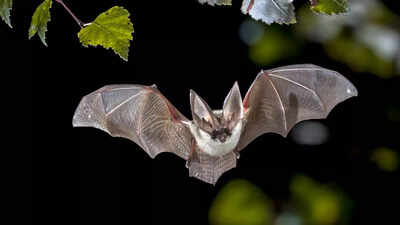
For an animal that spends much of its life upside down and in the dark, the bat has left scientists with a surprisingly long list of unanswered questions.Where did the first bats appear? How did they acquire powered flight? Did echolocation come before or after modern bats emerged? And why has it been so difficult to work out which bat families are actually close relatives?A new study published in the journal Nature offers some of the clearest answers yet. By combining chromosome-level genomes from 103 bat species with fossils and detailed anatomical data, researchers have reconstructed a new version of the bat family tree. The biggest twist is that the ancestors of bats most likely took to the skies in Europe, rather than Africa, Asia or North America.The study also suggests that echolocation was already present in some very early bats, meaning one of the animals’ most recognisable abilities may be almost as old as bat flight itself.
A mammal mystery hiding in plain sight
Bats are not just another branch of the mammal family tree. With more than 1,500 living species, they make up more than one-fifth of all living mammal species.They also possess a combination of unusual traits. They are the only mammals known to have evolved true powered flight. Many use laryngeal echolocation to navigate and hunt, while some species can live unusually long lives for their size, show distinctive immune adaptations and hibernate.Yet figuring out how these features evolved has been unusually difficult.Part of the problem is that the bat fossil record is patchy. The oldest known bat fossils date to the early Eocene, roughly 56-52 million years ago, and show that flight and echolocation had already evolved by then. But the record between the earliest bats and their later descendants contains large gaps.That left scientists with fossils from several continents but little evidence for where the very first bats actually originated.
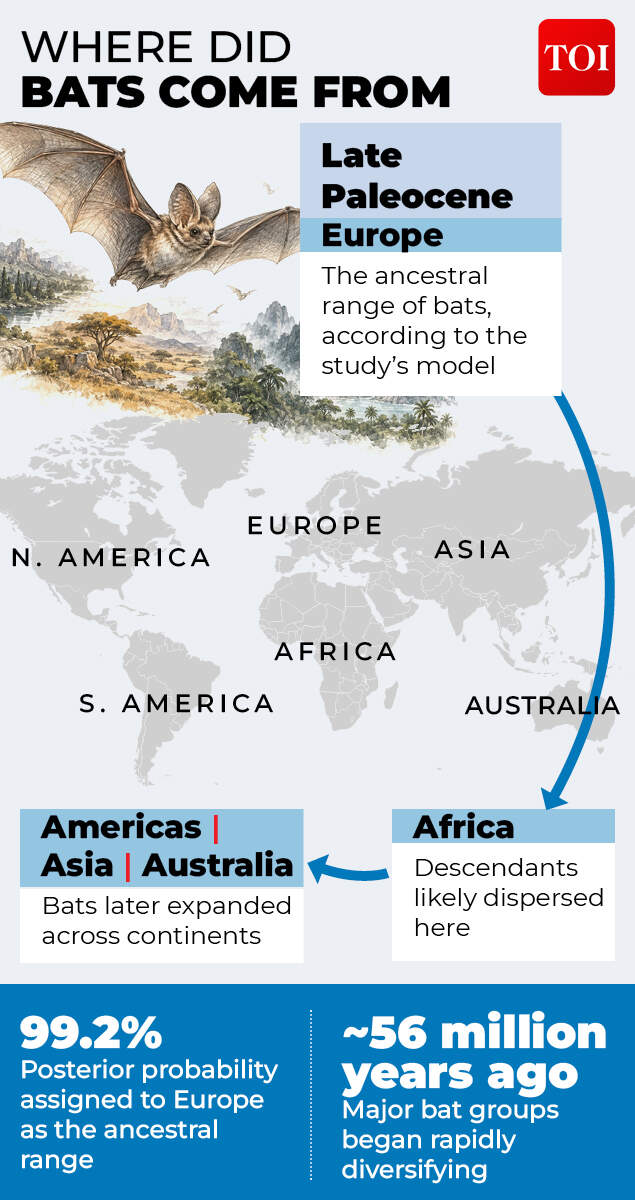
A new study points to Europe as the ancestral home of bats, with a 99.2% posterior probability
The researchers essentially rebuilt the bat family albumThe new study comes from the Bat1K project, which aims to generate high-quality genomes for living bat species.Researchers analysed 103 bat species representing all 21 currently recognised bat families. The dataset included 42 newly assembled genomes, many produced using long-read sequencing and chromosome-level techniques.That matters because earlier studies often had to work with fewer species or lower-quality genomes. The researchers also analysed eight non-bat mammals as evolutionary reference points.But genomes alone were not enough.The team combined the genetic data with a morphological dataset covering 699 anatomical characters from 65 species, including 44 extinct bats. In other words, the researchers did not simply compare today’s bats with one another; they brought long-dead species back into the evolutionary conversation.That combination helped tackle one of the biggest problems in reconstructing evolution: different clues can tell different stories.
Why previous bat family trees got confused
Think of evolution as a family tree whose branches have occasionally tangled together.Some bat lineages evolved rapidly, while genetic material could also move between related populations through introgression. As a result, different parts of the genome can retain different versions of evolutionary history.The researchers found exactly this kind of genomic disagreement.For example, protein-coding genes — which make up only about 2% of the genome — sometimes pointed towards one evolutionary relationship, while neutral parts of the genome and other chromosome-level analyses supported another.The team concluded that previous studies relying heavily on protein-coding genes could have been misled by this conflicting signal. In one particularly complicated part of the bat family tree, the researchers found evidence that widespread introgression had left different chromosomes carrying different evolutionary histories.So the lesson is not simply that scientists “got bats wrong”. Rather, the new study had access to a much larger and more varied genetic dataset that allowed the researchers to separate competing signals in the genome.
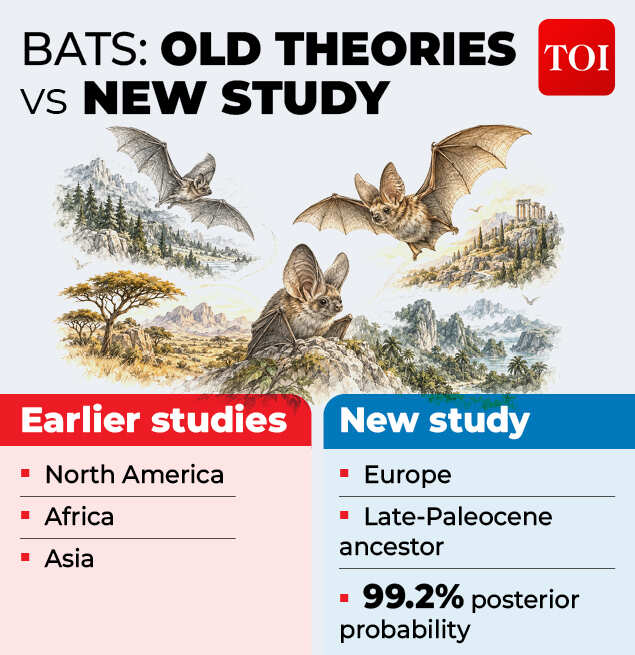
Earlier studies proposed several possible origins, while the new analysis places the late-Paleocene bat ancestor in Europe
A mysterious Madagascar bat changes address
One of the study’s more technical, but revealing, findings involves the strange sucker-footed bats of Madagascar, belonging to the family Myzopodidae.Their position on the bat family tree has long been difficult to determine. Different datasets had placed them in different parts of the tree.The new analysis repeatedly placed Myzopodidae as the earliest branch within Vespertilionoidea, rather than within Noctilionoidea as some earlier studies had suggested.It may sound like an obscure reshuffling of names, but these placements matter because a family’s position changes scientists’ understanding of when and where different bat groups evolved.
So, where did first bats actually come from?
Here is the headline-changing part.Previous research had proposed North America, Africa or Asia as possible birthplaces for bats.The new analysis points somewhere else: Europe.Using fossil evidence, genome data and a model that considered dispersal, extinction, distance and continental movement, the researchers inferred that the ancestor of bats lived in Europe during the late Paleocene, before the Eocene began.The study assigns a 99.2% posterior probability to Europe as the ancestral range in its model.From there, descendants appear to have expanded into Africa and, over relatively short evolutionary intervals, into Asia, Australia and the Americas.That is important because bats’ ability to fly has made geography unusually difficult to reconstruct. Once an animal can travel long distances through the air, its present-day distribution tells scientists surprisingly little about where its ancestors lived.The researchers therefore accounted for bats’ exceptional dispersal ability instead of treating today’s geographical distribution as a simple map of their past.
Flight may not have been whole story
The study also adds an intriguing piece to the mystery of echolocation.A fossil called †Vielasia was placed within the oldest branch of bats, a group the researchers refer to as Eochiroptera. Because this fossil is associated with laryngeal echolocation, its position supports the idea that echolocation evolved before the diversification of modern, or crown, bats.That changes the picture of the early bat.Rather than imagining a primitive mammal gradually becoming a flying animal and only later developing sophisticated echolocation, the evidence suggests that powered flight and laryngeal echolocation may have been closely connected in the earliest stages of bat evolution.The study does not establish every step of that transformation. The fossil record remains incomplete. But it moves echolocation deeper into the bat story.
Bats were already experimenting with lifestyles
The ancient bat story was apparently not just about flying insects at night, either.The researchers identified fossil evidence suggesting that some early bat lineages had already begun experimenting with different diets.One fossil, †Aegyptonycteris, represents the earliest example identified in the study of bat omnivory. The researchers also found evidence suggesting that omnivorous or herbivorous forms could have evolved from echolocating, presumably insect-eating ancestors.In other words, the bat family tree was branching into different lifestyles surprisingly early.That helps explain how today’s bats ended up occupying such a remarkable range of ecological niches — from nectar and fruit to insects, fish, meat and even blood.
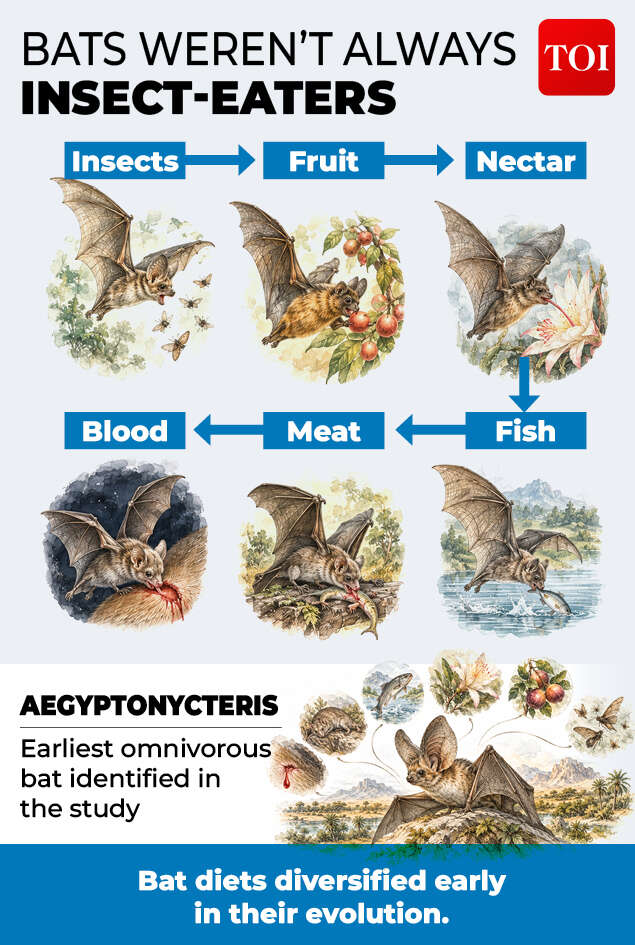
Fossil evidence suggests bats began diversifying their diets early, eventually evolving to feed on fruit, nectar, fish, meat and blood
The bat family tree also reveals a world in fluxThe researchers estimate that bat evolution was more dynamic than some earlier analyses suggested.Their model produced an average speciation rate of 0.314 species per million years, roughly three times previous single-rate estimates. The estimated extinction rate was 0.270 species per million years, about nine times higher than previous estimates.Together, these figures point to much greater evolutionary turnover than earlier studies had captured.The timing is also striking.The researchers suggest that the major bat superfamilies radiated around the Palaeocene-Eocene Thermal Maximum, about 56 million years ago, a period of major global warming and environmental change.That does not mean climate change “created” bats. Rather, the timing suggests that a rapidly changing world coincided with a period of major diversification in their family tree.
And their ancient chromosomes tell another story
The study went even deeper — into the chromosomes themselves.Researchers reconstructed an ancestral bat genome containing 26 chromosomes. They found that modern bat chromosomes most likely evolved predominantly through chromosome fusions, rather than through chromosome splitting or translocations.Fusions were seen to dominate in 97% of the 103 bat genomes analysed.That provides another window into how this unusually diverse mammalian group evolved.It also matters because bats have some of the smallest mammalian genomes, yet have managed to produce an extraordinary variety of body forms, diets, behaviours and survival strategies.
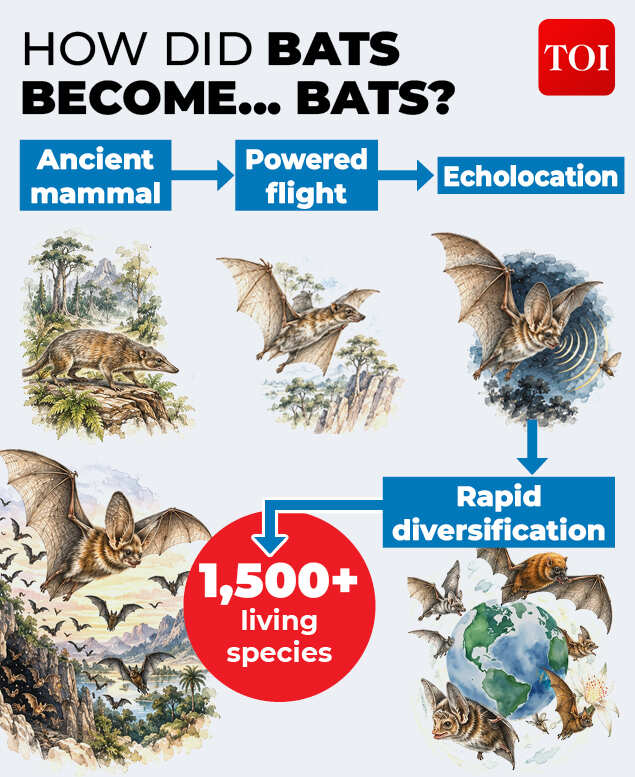
Powered flight and echolocation emerged early in bat evolution, followed by rapid diversification into more than 1,500 living species.
The mystery is not completely overThe new study does not turn bat evolution into a closed book.The fossil record remains incomplete, and the researchers note that some evolutionary relationships still contain uncertainty. Even their reconstruction estimates that a substantial proportion of evolutionary branch length remains absent from the fossil record.But the picture is considerably sharper.The emerging story is of a late-Palaeocene European ancestor, followed by rapid diversification and dispersal across continents; an early connection between flight and echolocation; and a family tree whose complexity was partly hidden by different evolutionary histories preserved in different parts of the genome.For an animal that seems almost perfectly designed for the night sky, perhaps the most surprising revelation is that its origins were hidden not in the darkness — but in the gaps between fossils, chromosomes and continents.The new study has filled in some of those gaps.