







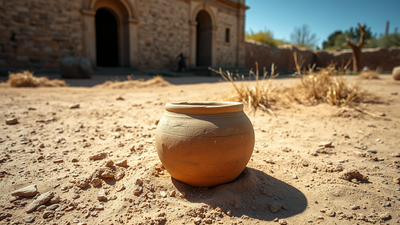
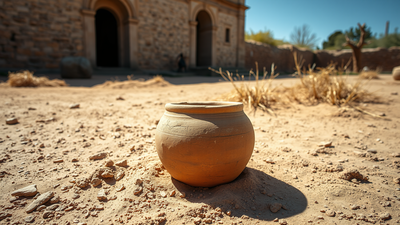
University of Florida students have unearthed a nearly 400-year-old clay pot at the site of a 17th-century Spanish mission in Gainesville, and remarkably, it survived completely intact. The pot was likely made by a member of the Indigenous Potano Timucua tribe while the mission was still active, and its discovery is considered highly unusual since buried pottery this old is almost always found broken or in pieces by the time archaeologists reach it. The find was made during a hands-on field course led by archaeologists at the Florida Museum of Natural History, at a site known as Mission San Francisco de Potano, which has been under excavation since 2006 and has already yielded more than 7,000 artefacts.
How the intact pot was found at Mission San Francisco de Potano
According to the University of Florida’s archaeology field school programme, students take part in weekly excavation sessions during the spring semester, working in small marked plots across a wooded site in northwest Gainesville. The course is led by Gifford Waters, who manages the museum’s historical archaeology collections, alongside Charles Cobb, curator of historical archaeology at the Florida Museum. Students use the same fieldwork techniques as professional archaeologists, carefully troweling through soil layers in search of artefacts left behind by the Potano people and Spanish missionaries who once lived at the site.The pot itself is small and simple, smooth grey in colour and about the size that would fit in the palm of a hand, with no decoration on its surface. Based on how deep it was buried, archaeologists believe it was crafted sometime while the mission was still active, though its particular style does not match anything researchers at the museum have seen before at other Florida sites.
Why finding an unbroken pot is considered so rare
Waters, who has spent years working on artefact collections recovered from historic shipwrecks, said this marked the first time in his career that he had been part of a team that unearthed a fully intact pottery vessel on land. Pottery buried for centuries is typically crushed by the sheer pressure of the earth above it, or broken apart by farming and development that disturbs the ground long before archaeologists arrive. Even pieces that were discarded whole by their original owners rarely survive the passage of time without cracking or shattering.This makes the newly found pot especially valuable to researchers, since whole vessels can reveal far more about their original shape, size and possible use than broken fragments typically allow. Archaeologists are still unsure exactly what the pot was used for, though some slight scorch marks on its exterior suggest it may have been placed near a fire at some point, possibly to warm food.
What the mission site reveals about Potano and Spanish history
Mission San Francisco de Potano was established in 1606, when the Spanish government sent a single friar to live among the Potano, a subgroup of the Timucua people who had settled in the area after being displaced from their original homeland by Spanish colonists. The mission was one of the earliest of more than 100 Catholic missions that Spain would go on to establish across Florida over the following century, according to earlier findings published by the Florida Museum of Natural History, which first confirmed the mission’s physical location in 2006 after decades of uncertainty based only on historical records.At its peak, the mission village would have housed a few hundred Potano residents alongside just one European friar, which explains why the vast majority of artefacts recovered from the site since excavations began are pieces of Native American pottery. Alongside the newly found intact pot, researchers have also recovered glass trade beads, stone tools, iron nails and animal bones left over from meals of turtle, freshwater fish and turkey, all of which help build a picture of daily life at the mission over its roughly century-long history.
Why context matters as much as the artefacts themselves
Researchers involved in the excavation stressed that an artefact’s value comes not just from what it is, but from exactly where it was found and what surrounded it. Clusters of animal bone recovered from a single area of the site, for instance, helped confirm that the spot was once used for cooking and disposing of household waste, rather than for some other purpose. This kind of contextual detail allows archaeologists to reconstruct patterns of daily activity across the site rather than treating each artefact in isolation.The mission was eventually abandoned for good in 1706, following raids during a period of conflict between Spanish, English and Indigenous groups competing for control of the region. More than three centuries later, the site continues to yield new discoveries each excavation season, offering researchers an unusually detailed record of how Potano and Spanish communities lived, worked and interacted with one another during a critical period of Florida’s colonial history.