









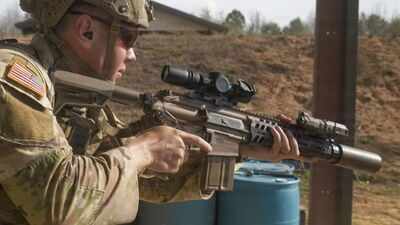
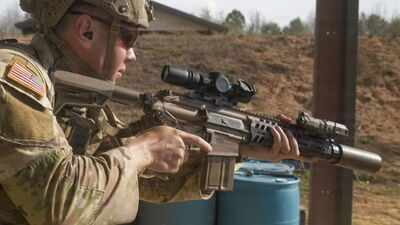
The US Army is moving on from the M7 rifle barely three years after beginning to field it, with soldier feedback over the weapon’s weight, length and handling driving the development of a new M8 carbine. The Army is set to begin fielding the M8 in December, marking a rapid redesign of its Next Generation Squad Weapon system.According to Defense News, citing Sig Sauer executives, the M8 will initially be fielded with units at Fort Bragg, North Carolina. The weapon, earlier designated the XM8, is a shorter and lighter variant of the M7 developed after soldier feedback and Army testing.The M7’s weight has been one of the major concerns. The rifle weighs more than 8 pounds (3.6 kg) unloaded and nearly 10 pounds (4.5 kg) with its suppressor, significantly heavier than the Army’s M4A1. Soldiers also raised concerns about the weapon’s length and handling while carrying it alongside their other combat equipment.The M8 is designed to address those problems without abandoning the Army’s new 6.8mm weapon concept. The Army says the M8 is more than a pound (0.45 kg) lighter and has a barrel 3.5 inches (8.9 cm) shorter than the M7, while retaining the 6.8×51mm ammunition and compatibility with the M157 fire-control system.Defense News reported that the Army’s fiscal 2027 budget request seeks 14,944 M8 carbines but no additional M7 rifles, even though roughly 50,000 M7s have already been delivered.Why soldiers wanted a lighter rifleThe M7 was introduced as a major upgrade over the M4, but its increased size and weight created a practical problem for infantrymen. The rifle’s heavier configuration adds to the overall load soldiers already carry in body armour, ammunition, optics, communications equipment and other battlefield gear, making mobility a key concern.According to Defense News, the Army’s experience with the M7 led to feedback on its weight and length, while soldiers also raised concerns about component wear linked to the weapon’s high-pressure ammunition. The M8 was subsequently developed with a shorter barrel and lighter configuration to address those concerns.Sig Sauer executive Dave Buehler said the M8 allowed the company to incorporate feedback that could not easily be addressed in the original M7 design because of the Army’s initial programme requirements. He described the M8 as a significantly improved version of the weapon.The M8 also has a fixed stock instead of the M7’s folding stock, a redesigned handguard and changes intended to improve the weapon’s balance and ergonomics, according to Sig Sauer and Army documentation.Meet the M8 rifleThe M8, formerly designated the XM8, is a lightweight, short-barrel variant of the M7 developed by Sig Sauer for the US Army’s Next Generation Squad Weapon programme.The Army describes it as a modular, piston-driven, select-fire, magazine-fed 6.8mm rifle designed to give close-combat troops greater mobility while retaining the lethality of the 6.8×51mm ammunition.The M8 weighs 7.3 pounds (3.3 kg) empty and 8.8 pounds (4 kg) with its suppressor and heat shield, according to the US Army. It is more than 1 pound (0.45 kg) lighter than the M7 and approximately 3.5 inches (8.9 cm) shorter.The M8 uses a free-floating M-LOK handguard, allowing soldiers to mount accessories while keeping the barrel free from contact with the handguard.The M8 retains universal compatibility with the M157 Small Arms Fire Control system. The M157 combines a variable-magnification optic with a laser rangefinder, ballistic calculator, atmospheric sensors, compass, visible and infrared aiming lasers and a digital display overlay.The M157 weighs 2.67 pounds (1.21 kg) and has 1–8x magnification, according to the Army. It is designed to provide soldiers with a calculated ballistic solution and corrected point of aim, including for engagements beyond 600 metres.