









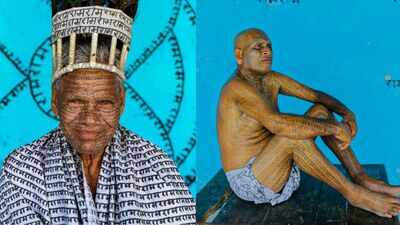
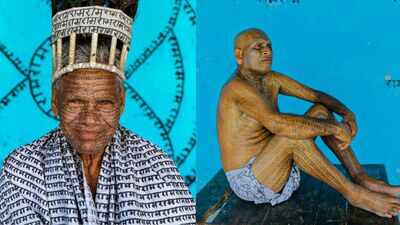
They think it… and they ink it. For members of Chhattisgarh’s Ramnami community, Ram is a complete mind-body affair: God is not only a constant presence in their hearts, but also on nearly every inch of their bodies. And the story of these ‘living temples’ is an extraordinary mix of faith, identity, and social defiance.Last month’s National Award for Bharathala Ganapathy’s documentary, ‘Ram-Nami’, has brought the community renewed attention, with Chhattisgarh hailing it as a recognition of its cultural heritage. This year, the 82-year-old Chaltabagan Durga Puja pandal in north Kolkata will be based on the theme ‘Nishaan—The Mark’, drawing inspiration from the Ramnamis.The last of the Ramnamis, who live mainly in villages along the Mahanadi in Chhattisgarh, and in the border regions of Maharashtra and Odisha, are getting on in years. Their skin is thinning, hair greying, and eyesight dimming, but the name of Ram remains indelible on their skin, as does their faith.It’s tattooed across their foreheads and cheeks, down to their chests and arms, and their feet. The oldest Ramnamis had the tattoos even on their eyelids and, in earlier generations, even their private parts. From ‘nakh’ to ‘shikh’—toe-nail to crown—the body itself became rosary for them.
Born Of Defiance
It all began out of a rebel spirit. More than a century ago, when Dalits in parts of what is now Madhya Pradesh and Chhattisgarh were denied entry into temples and faced restrictions on worship, members of the community answered exclusion in a devotional, but radical way: if a caste-based society would not allow them into God’s house, they would carry Him on their skin.According to one belief, the Dalit saint Sant Parasuram, born in the 1870s in Charpora village in Bilaspur, was the first person to tattoo the word ‘Ram’ across his forehead in the 1890s.But Ramdas Lamb, in his 2014 book, Rapt in the Name: The Ramnamis, Ramnam, and Untouchable Religion in Central India, writes that the sect may be much older and a continuation of the 15th-century Bhakti movement. But all accounts agree that it was born out of defiance.Today, that defiance seems to be nearing its end.According to Gularam Ramnami, general secretary of the Ramnami community, only two people with complete nakh-shikh (head-to-toe) Ramnami tattoos now remain. Fewer than 50, he estimates, retain extensive traditional tattooing. The wider Ramnami community survives, but full-body inscriptions have disappeared among the younger generations.Gularam, at 54, is among the youngest of those still extensively tattooed.“My face is still left, including the eyelids, eyebrows and head,” he tells TOI. “As long as one can bear the pain, one continues. Then one takes a break, only to be tattooed after some time.” He also takes the arithmetic of possible extinction in stride. “What happens will happen by Ram’s will,” he says. “A tradition can decline and rise again. We do not force anyone.”Culturally, the countdown is unmistakable.
“My face is still left, including eyelids, eyebrows and head. As long as one can bear the pain, one continues. Then one takes a break, only to be tattooed after some time.”
—GULARAM RAMNAMI, Gen secy, Ramnami community
The New-Age Ramnamis
Nowadays, the youth no longer want their entire body tattooed.It’s not a question of ‘abandoning’ Ram. Many young Ramnamis still sport the tattoo on their hands, chest and foreheads; they attend bhajans; they inherit the songs. But very few are willing to surrender their entire face and body to an identity that cannot be concealed.The reasons are modern and practical: education, jobs, migration, city life.A young person may leave the village for college or an office. A full facial tattoo can become a permanent social marker in spaces where the old Ramnami world has little context.“Earlier, children used to be marked on the sixth day after birth,” Gularam says softly. “Now, everyone has a choice. You cannot compel anyone.” In his eyes, a person with four Ram tattoos and another with the entire body covered are both Ramnami. That generosity may yet help the sect survive.But it also means that the spectacular nakh-shikh tradition is passing into history.

Who is a Ramnami?
Tattooing was done by members of the community itself, with ink traditionally prepared at home. Women collected soot from a ghee lamp, mixed it with clean water and herbs, and produced a black pigment which, Gularam says, could retain its colour for decades.And devotion extended beyond the body. White cloth was covered with Ramnam, to be wrapped around the body. A peacock-feather crown carrying Ramnam is worn by older Ramnamis. Earlier, the community wove much of its own cloth; even today simplicity remains central to the Ramnami attire.There are no temple rituals, and no priesthood stands between the believer and Ram. Three vows—vegetarianism, teetotalism and rejection of discrimination—are central to the faith, Gularam says. “To become a Ramnami, you should not discriminate on the basis of caste, religion, language, colour, or gender.”Ramnamis gather every year for a three-day Bhajan Mela at the end of the harvest season in Dec-Jan in the village of Sarsiwa in Raipur district, where they erect a pillar with Ramnam written around it and read ‘Ramcharitmanas’.