





M.C. Davis spent close to 90 million dollars buying up 54,000 acres of heavily logged land in the Florida Panhandle, turning what timber companies had stripped bare into one of the largest private nature preserves in the southeastern United States. Since founding what he called Nokuse Plantation in 2000, Davis and his team have planted more than eight million longleaf pine seedlings across the property, working to bring back a forest ecosystem that once stretched across roughly 90 million acres of the American South before logging reduced it to a tiny fraction of its original size. Davis passed away in 2015, but the restoration project he built continues, guided by a plan he openly admitted would take 300 years to complete.
Why M.C. Davis decided to buy up logged Florida land
Davis grew up in a modest home in the Florida Panhandle before making a fortune buying and trading land and mineral rights. According to a widely cited account of his story, Davis’s shift toward conservation began almost by accident, when he pulled off the road during a traffic jam after spotting a sign advertising a black bear presentation at a local high school. He had not previously known Florida was home to black bears, and the talk set him on a path of reading extensively about ecology and native habitats, eventually convincing him to put a large share of his fortune toward restoring a piece of Florida’s original landscape.Starting in 2000, Davis began purchasing land in Walton County that had previously been owned by paper and timber companies, much of which had been heavily logged and replanted with fast-growing, non native pine species for industrial use. Rather than developing the land further, Davis set out to slowly convert it back into native longleaf pine forest, a project he named Nokuse, the Muscogee word for black bear.
How eight million trees have been planted across Nokuse
According to Nokuse’s own restoration programme, between 2004 and 2014 the team planted eight million containerised longleaf pine seedlings across 24,000 acres of the property, at an average density of 300 seedlings per acre. The seedlings were hand-planted in a random, non-row pattern to mimic how longleaf pine forests naturally regenerate, rather than being planted in the straight commercial rows typical of industrial timber plantations.Since completing that initial planting phase, restoration work at Nokuse has shifted toward rebuilding the forest’s understory, the layer of native grasses and wildflowers that grow beneath a mature longleaf pine canopy. This groundcover plays a critical role in the ecosystem, since it provides food for pollinators and the fine, dry fuel needed to sustain the regular low-intensity fires that longleaf pine forests depend on to stay healthy. To help meet demand for this material, the team has also established dedicated seed production fields to grow the native plant species needed for these efforts.
What longleaf pine restoration means for Florida wildlife
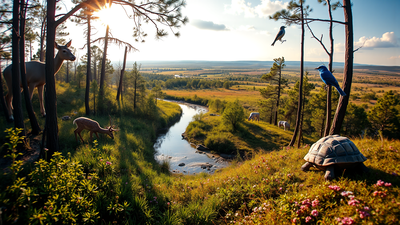
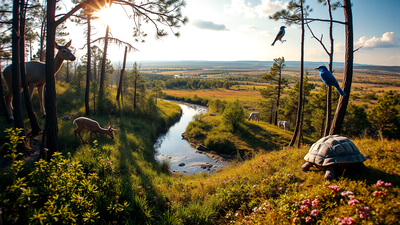
Longleaf pine forests once covered a vast stretch of the southeastern United States, but logging reduced this habitat to a small remnant of its original range by the early 20th century. Restoring this ecosystem at Nokuse has already created habitat for a wide range of species, including gopher tortoises, foxes, bobcats, raccoons and armadillos, along with birds of prey such as eagles and ospreys that rely on open pine woodland for hunting.The property also sits alongside Eglin Air Force Base, which retains a rare fragment of old-growth longleaf pine forest containing trees estimated to be around 500 years old. A wildlife underpass now connects Nokuse to this neighbouring remnant forest, allowing animals to move between the two areas and helping link Nokuse’s restoration work to one of the last surviving stretches of original longleaf habitat in the region.
Why Davis planned for a 300-year restoration
Unlike most conservation projects designed around shorter-term goals, Davis was explicit that restoring Nokuse to something resembling an old-growth longleaf pine forest would take roughly 300 years, since these trees can live for centuries and a mature forest depends on multiple overlapping generations of growth. He often described the project as an attempt to leave behind a lasting ecological resource, regardless of how future economic or political conditions in the country might change.To support environmental education alongside the restoration work itself, Davis also built a 28,000 square foot nature discovery centre on the property, named in honour of the evolutionary biologist E O Wilson, at a cost of around 12 million dollars. More than two decades after Nokuse’s founding, the slow, patient work of restoring longleaf pine continues largely as Davis originally envisioned it, a multi-generational project built on the belief that some of the most meaningful conservation work is the kind that will only be fully realised long after its founder is gone.