








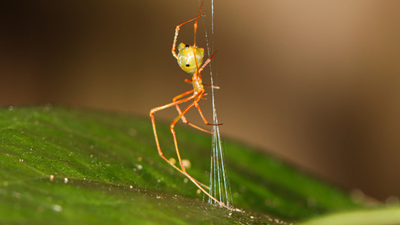
Deep in the rainforests of far north Queensland, Australia, scientists have discovered a tiny spider with an extraordinary hunting strategy. Nicknamed the “ballista spider”, the newly described species uses a silk-powered trap that launches prey into its web with accelerations reaching up to 140 times the force of gravity. Researchers say the spider specifically targets aggressive green tree ants, pulling them into the air using a mechanism that resembles a medieval siege weapon. The discovery, published in Current Biology, has astonished scientists and revealed one of the most specialised and powerful prey-capture systems ever documented in nature.
Why scientists call it the ‘ballista spider’
The spider gets its nickname from the ballista, an ancient Roman siege engine designed to launch projectiles over long distances. Researchers say the comparison is fitting because the spider stores energy in specially constructed silk threads before suddenly releasing it to propel prey into its web.The species belongs to the genus Propostira in the cobweb spider family, Theridiidae. Although the spider has not yet received a formal scientific name, its unique hunting technique immediately caught the attention of researchers.Unlike many spiders that capture a wide variety of insects, the ballista spider appears to focus almost exclusively on green tree ants (Oecophylla smaragdina). These ants are known for their aggressive behaviour, powerful bites and ability to quickly summon nestmates when threatened.Most predators avoid attacking green tree ants because of the risks involved. Yet the ballista spider has evolved a hunting strategy that allows it to capture the dangerous insects without coming into direct contact with them.Professor Ajay Narendra of Macquarie University described the spider’s behaviour as an example of extreme specialisation, noting that few spiders focus on a single prey species.
How the silk-powered catapult works
Researchers observed that the spider spends hours building an intricate trap. It first creates an anchor point on vegetation or the forest floor before constructing dozens of highly tensioned silk threads.These threads are bundled into a small cone-shaped structure positioned near the ground. Scientists believe the spider may also use chemical cues to encourage ants to investigate and attack the cone.When an ant bites the structure, the trap is triggered instantly. The stored energy in the stretched silk is released, ripping the ant from the surface and launching it upward into the spider’s waiting web above.
The forces involved are astonishing
Using high-speed cameras, researchers measured accelerations of up to 1,367 metres per second squared, equivalent to roughly 140 times Earth’s gravity.For comparison, fighter pilots typically experience around 9g during extreme manoeuvres. The trapped ants are subjected to forces roughly 15 times greater than those encountered by pilots.The ants can be launched more than 30 centimetres into the air, an impressive distance considering both the size of the prey and the spider itself.
The prey activates the trap
One of the most unusual aspects of the hunting system is that the spider does not actively spring the trap.Instead, the ant triggers the mechanism itself when it attacks the silk cone. This means the spider can remain safely positioned in its web while the prey effectively launches itself into captivity.Researchers say this may be the only known spider web specifically designed for a single prey species and activated by the prey rather than the predator.
Scientists spent days documenting the behaviour
The spider was first noticed by biomedical researcher and spider photographer Greg Anderson. Intrigued by the unusual web structures, researchers from Macquarie University launched a detailed field investigation.The team, including Professor Ajay Narendra and postgraduate researcher Pranav Joshi, spent 10 days and nights studying the spiders near Cooktown in Queensland. Using infrared and high-speed cameras, they recorded the hunting behaviour and analysed how the silk structures stored and released energy.Their findings were published in the journal Current Biology under the title Ballistic high-powered spider webs overcome dangerous prey defenses.The ballista spider offers a remarkable example of how evolution can produce highly specialised solutions to ecological challenges. By using stored energy in silk rather than direct physical force, the spider can safely capture prey that would otherwise be dangerous to attack.Researchers say the discovery also expands our understanding of biological engineering. The spider’s silk-powered trap demonstrates how animals can use natural materials to create sophisticated mechanical systems that rival some of the most impressive human-made devices.