









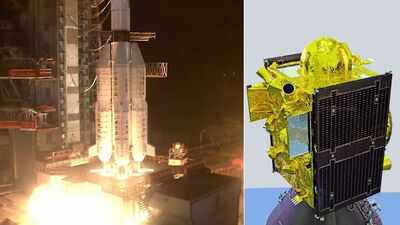
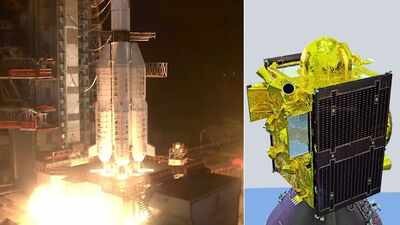
NEW DELHI: The successful night launch of Isro’s navigation satellite NVS-03 carrying an indigenously-manufactured atomic clock along with procured (foreign) atomic clocks on Friday will make India’s indigenous satellite navigation system NaVIC or desi GPS up and running again. The success of GSLV-F18 mission is a big boost for India’s strategic forces as they are till now dependent on foreign navigation systems like American GPS and Russian GLONASS for missile navigation.NaVIC was down to three active satellites as compared to the minimum quorum of four needed to keep the navigation system operational. But as four operational satellites are required for a standalone GPS-style position tracking system to work, NaVIC is currently not being used by the armed forces for the purposes of missile navigation, precise positioning and coordination of warships at sea, and indigenous navigation support for troop movement and combat aircraft. The strategic forces are, therefore, dependent on foreign navigation systems like American GPS and Russian GLONASS.Relying on foreign-operated navigation systems like GPS creates a critical dependency under which access can be restricted, downgraded or completely cut off during a conflict or a war, as India had experienced during the 1999 Kargil war.But the successful launch of NVS-03 has changed everything. It will make the NavIC constellation not only operational for strategic use but also for civilian use across India and up to 1,500 km (930 miles) beyond the country’s geographical borders.After the successful launch, space minister Jitendra Singh posted on X on Friday night, “Congratulations Team Isro for the successful launch of GSLV-F18/NVS-03 mission! This remarkable achievement reflects India’s growing prowess in Space technology and our unwavering commitment to strengthening sovereign indigenous navigation capabilities. With revolutionary Space reforms announced by PM Shri Narendra Modi ji in recent years, India’s success stories in Space vindicate the dream of founding fathers Vikram Sarabhai and Satish Dhawan. Today is the celebration of another proud moment for India!”Indian security forces need an operational NavIC to maintain strategic autonomy and secure tactical advantage without relying on foreign-controlled networks. The four-satellite constellation will ensure secure, uncompromised communication, mobility and targeting data. Modern military hardware such as ballistic missiles and precision-guided munitions require highly accurate Position, Navigation and Timing (PNT) signals to function effectively.NavIC was originally designed with a constellation of seven satellites and a network of ground stations operating 24 x 7. Three satellites of the constellation were placed in geostationary orbit, at 32.5°E, 83°E and 129.5°E respectively, and four satellites in inclined geosynchronous orbit with equatorial crossing of 55°E and 111.75°E respectively, with inclination of 29° (two satellites in each plane). But with time, NavIC came down to three satellites as replacement satellites could not be placed in orbit due to setbacks. NVS-02 satellite was launched on Jan 29, 2025, but it failed to reach the intended orbit due to a pyro valve signal loss in the engine.