









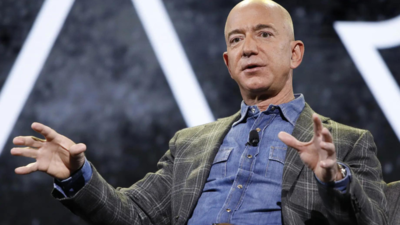
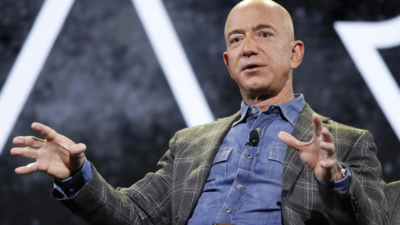
Amazon founder Jeff Bezos has outlined an ambitious vision for the future of space exploration, arguing that while Mars remains a long-term destination for humanity, the United States should focus on returning humans to the Moon first and establishing a permanent presence there. Speaking in an interview with Bret Baier on Fox News’ “Special Report”, the Amazon founder and Blue Origin executive chairman said the US must win the race against China to put humans back on the Moon. He expressed confidence that an American crewed lunar landing could happen by 2028, less than three years from now. “We have to beat China to the moon, and I believe we will beat China to the moon,” Bezos said, adding that NASA and Blue Origin are working toward that goal.
‘We’ll go to Mars, but we need to go to the Moon first’
While Mars is often viewed as the next frontier for human exploration, Bezos said skipping the Moon would be a mistake. He described Earth’s natural satellite as “a gift” because of its proximity and potential resources that could support deeper space missions. “We’ll go to Mars. We’ll do all the other things. But we need to go to the moon first,” Bezos said during the interview. According to Bezos, establishing a sustainable lunar base could provide critical infrastructure for future exploration. He said routine cargo missions would be required to support a long-term human presence on the Moon, rather than treating lunar landings as one-off missions.Bezos argued that the Moon’s resources could eventually play a significant role in supporting space development. He noted that lunar soil could potentially be used to manufacture solar cells, while oxygen produced on the Moon could serve as rocket propellant for missions travelling deeper into the solar system. “It won’t just be a mission and leave,” Bezos said. “It’ll be a real sustainable lunar base.”
Jeff Bezos said Blue Origin plans to return its New Glenn rocket
Bezos said Blue Origin plans to return its New Glenn rocket to flight in December, after an explosion during an engine test in May that Baier raised during the broadcast. The next flight will carry Blue Ring, a vehicle designed to move payloads into different orbits and farther into space, he said. He praised the team for repairing the launch pad.Asked about plans to raise launches from one pad from 12 to 50 a year, he said Blue Origin is building three more pads. His long-term target is far bigger: fly daily, then hourly, then every minute. He acknowledged that his own team thinks he is crazy, but said he has seen “crazy things” come true before.He said he has personally invested $28 billion in Blue Origin, which recently raised $10 billion from outside investors for the first time. He said an IPO could come several years from now.
Data centers in space
On the debate over data centers and electricity costs, Bezos pointed to Blue Origin’s Project Sunrise. He said the company has applied to the Federal Communications Commission to launch more than 50,000 satellites that would act as orbital data centers, adding that there are good reasons to do so.
AI and work
Bezos predicted AI would deliver double-digit productivity gains across the economy. He said some families might get by on one income or a three-day workweek, and that this could make hiring harder as people choose to work less. Baier challenged him by citing the roughly 30,000 corporate roles Amazon has cut since late last year. Bezos said Amazon was in a “very special position” because it expanded its workforce substantially during the pandemic.At Prometheus, the startup where he is co-founder and co-CEO, Bezos said the goal is an “artificial general engineer” that helps people turn ideas into physical products. Asked whether AI is a bubble, he said it is very hard to know, but argued that the inventions survive even if the bubble bursts, as fiber-optic cable did after the internet boom. He urged a light regulatory touch while the technology is young, saying rules should target harmful uses rather than the technology itself.