








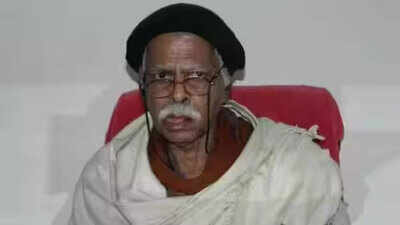
Vashishtha Narayan Singh’s story begins in Basantpur, a village in Bihar’s Bhojpur district, far removed from the world’s leading centres of mathematics. Born on April 2, 1942, into a poor family, Singh showed an unusual talent for mathematics from a young age.That ability eventually took him from a residential school in Bihar to the University of California, Berkeley, where he completed his PhD in mathematics. But his academic achievements tell only one part of his story. Behind them was a life marked by extraordinary ability, a career abroad and, later, a long struggle with mental illness.
A mathematical talent noticed early
Singh studied at Netarhat Residential School before joining Patna Science College. It was there that his mathematical ability reportedly caught the attention of American mathematician Professor John L Kelley.Kelley recognised his potential and encouraged him to pursue higher studies in the United States. Singh travelled to California in 1963 and eventually completed his PhD from the University of California, Berkeley, in 1969.For a young student from rural Bihar, the journey was extraordinary. But Singh’s academic career did not end with his doctorate.
From Berkeley to mathematics classrooms in India
After completing his PhD, Singh taught mathematics in the United States, including at Washington University in St Louis. Accounts of his career have also linked him with work associated with NASA.He later returned to India and taught at institutions including IIT Kanpur and IIT Kharagpur.His academic career established him as one of India’s better-known mathematical prodigies, although several popular accounts of his work have also added claims that are difficult to independently establish.One such claim is that Singh challenged Albert Einstein’s theory of relativity through a paper called The Theory of Relativity: The Peace of Space. This claim has circulated widely in accounts of his life, but it should not be presented as proof that he disproved or overturned Einstein’s theory.
A life that became increasingly difficult
Away from mathematics, Singh’s life took a much harder turn.He married in 1973, but the marriage later ended in separation. He was known to have an interest in books and music and reportedly played the flute.His health also became a major part of his later life. Singh was diagnosed with schizophrenia and lived with the condition for decades.In 1987, he returned to his native village. His condition and circumstances deteriorated over the years, and in 1989 he reportedly disappeared while travelling.He was eventually found years later near Chhapra.
Remembering the mathematician beyond the headlines
Singh’s later years have often overshadowed the remarkable academic journey that came before them.He came from a poor family in Bihar, displayed exceptional mathematical ability as a student, travelled to the United States in the 1960s and earned a doctorate from Berkeley at a time when opportunities for Indian students to study abroad were far more limited than they are today.His life was also a reminder that intellectual brilliance does not protect a person from illness or personal hardship.Vashishtha Narayan Singh died in 2019, but his story continues to attract attention, particularly in Bihar, where he is remembered as a mathematician who travelled from a small village to one of the world’s leading universities.His life cannot be reduced to either his mathematical achievements or his illness. Both were part of a much more complicated story of a gifted man whose abilities took him remarkably far, even as his later years became increasingly difficult.