









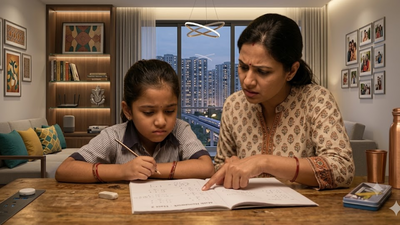
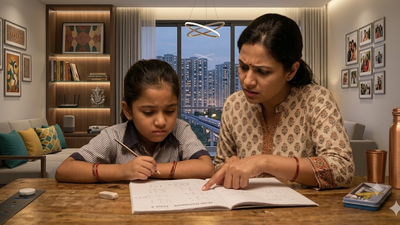
A child can spend an hour doing maths homework and still repeat the same mistakes the next day. The problem is often not the amount of time spent studying, but what the child does during that time. Maths teacher Ashwini Anand suggests a more practical approach: break practice into small tasks, identify repeated mistakes and make children work through the steps instead of simply checking the final answer. Here are six habits parents can introduce over the next three months.
Make them learn all the tables and square roots
22 Sept 2026 | 15:04
What pregnancy purchase turned out to be genuinely useful?
Tables and square roots form the foundation of calculation and should be practised regularly rather than only before exams. Set aside 10 minutes every day for this practice. Children can revise multiplication tables, recall square numbers and gradually learn their corresponding square roots. For example, they should become familiar with facts such as 12 × 12 = 144 and √144 = 12. Ten minutes of daily recall can make basic calculations quicker and leave them with more time to focus on the actual problem.
Tell them daily that maths is easy and interesting
The way children hear adults talk about maths can influence how they approach the subject. Parents can make a habit of telling children every day that maths is easy and interesting and that they can learn it with practice. Positive reinforcement can help replace statements such as “I am bad at maths” with a more constructive attitude towards the subject. Instead of reacting strongly when a child gets an answer wrong, acknowledge the effort and ask them to try the problem again.
Make them show every step

Photo: Canva
A child may write the wrong answer without knowing where the calculation went wrong. Ask them to write the process clearly instead of doing calculations mentally and putting down only the final answer. If the answer is incorrect, look at the first wrong step. Correcting that step is often more useful than explaining the entire problem again. This is particularly useful for multiplication, division, fractions and algebra, where one small error can change the final answer.
Use the 10-minute mental maths drill
Set a timer for 10 minutes and give the child a small number of calculations. Use questions such as: 25 × 4, 150 ÷ 5, 99 + 36, Half of 86, 15% of 200 or 17 × 8. The questions should match the child’s level. The purpose is not to make the child race through difficult calculations but to make basic number operations quicker and more familiar. Keep a record of how many questions were solved correctly. Repeat a similar set after a week and compare the result.
Mix old and new questions
Children can become comfortable with a chapter when they practise only questions that look similar. A better practice session can include a mixture of topics. For example, five questions could include one on fractions, one on percentages, one word problem, one algebra question and one topic the child recently learned. This forces the child to first identify which method is needed, instead of simply following the same steps repeatedly. Keep one short weekly session for older topics. If the child is currently studying decimals, Monday to Friday can focus on the current chapter. On Sunday, include a few questions from multiplication, fractions, percentages or previous chapters.A useful pattern is:
- Monday-Friday: current schoolwork
- Saturday: mistakes and difficult questions
- Sunday: old topics + a short mixed test
Increase difficulty slowly
Giving a child very difficult questions from the beginning can make practice frustrating. Start with questions the child can solve independently, then gradually increase the difficulty. Once the basic method is clear, introduce questions that require two or three steps. The goal over three months should be steady progress: fewer repeated mistakes, better understanding of basic concepts and greater confidence in attempting unfamiliar questions.
What to do for the next three months
Parents do not need to turn the house into a classroom. A simple routine can be enough. For the first month, focus on finding weak areas and correcting repeated mistakes. In the second month, increase mixed practice so the child has to decide which method to use. In the third month, introduce short timed tests and compare the child’s accuracy with where they started.