








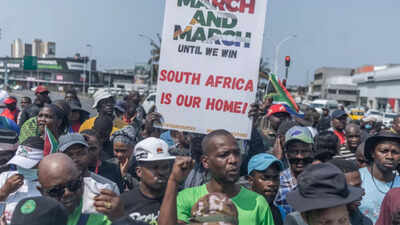
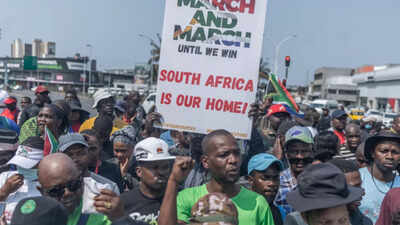
A September 30 deadline declared by South Africa’s March and March, an anti-immigration movement that has led anti-migrant protests across the country this year, has renewed fears of violence among migrant communities.Refugees are also fearing fresh unrest as South Africa will hold local government elections on November 4, with migration emerging as an increasingly prominent political and social issue.“I am in hiding now because they say they are going to kill me for speaking about the rights of foreigners,” Al Jazeera quoted Bishop Raphael Bahebwa, a refugee from the Democratic Republic of Congo (DRC), as saying.Bahebwa has lived in South Africa for 26 years and has witnessed repeated flare-ups of anti-foreigner sentiment. But he says this year feels “different.”“It has been very tough. They are scapegoating us as foreigners. It is not going to end on September 30. It has to do with the elections. Never before have I experienced something like this,” he added.According to Kafuti Muyumba, another refugee from the DRC, many members of the refugee community were “afraid” to return to neighbourhoods where they had built businesses and lives. Muyumba, a small business owner and representative of the refugee community, said tensions had left many “fearful” for their safety.“People are afraid. Even the police allow March and March violence. They came with sticks and say we are attacking them. This is not the first time we are experiencing xenophobia. In 2008 and then in 2015 we also experienced this,” Muyumba stated.In 2008, xenophobic violence spread through townships and informal settlements across South Africa, killing dozens of people and displacing thousands. Further outbreaks of violence against foreign nationals followed in subsequent years.
‘We’re not xenophobic; campaign is against undocumented migration’
March and March has described its mobilisation as a “campaign against undocumented immigration, crime and deteriorating conditions in South African communities,” while arguing that the South African government’s response to immigration enforcement has been “insufficient”.The group has called for undocumented foreigners to leave South Africa and warned of further demonstrations if its demands are not met.Its leaders have repeatedly rejected accusations that the campaign is xenophobic, insisting that its target is undocumented migration rather than foreign nationals generally.March and March maintains that its sole demand is for undocumented immigrants to leave South Africa and return to their home countries.
How has the South African government responded
In response to the ongoing protests, the South African government has intensified immigration enforcement.Between June 14 and August 20, authorities processed 86,596 foreign nationals for deportation and repatriation, according to the government’s Inter-Ministerial Committee on Migration.Malawians made up the largest group, followed by Zimbabweans and Mozambicans.Government data indicates that 90% of those repatriated had entered South Africa illegally, while 95% were classified as having crossed the border outside official ports of entry.The government maintains that the operations form part of a broader effort to strengthen border management and enforce immigration law.At the same time, officials have repeatedly warned private groups against taking immigration enforcement into their own hands.March and March’s September 30 deadline has no legal authority. The government maintains that ordinary citizens cannot deport anyone from South Africa.