









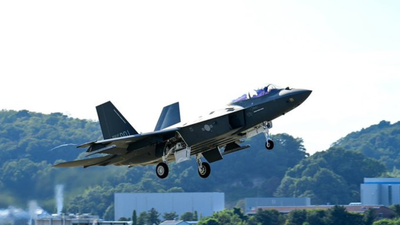
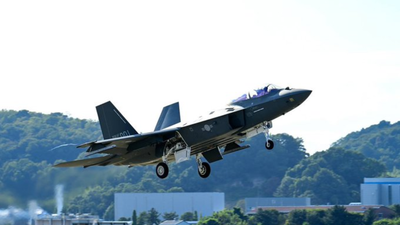
South Korea and India are both developing twin-engine fifth-generation fighter jets, but as of September 26, 2026, the two programmes could not be at more different points on the development curve.The Republic of Korea Air Force has already taken delivery of its first production KF-21 Boramae, while India’s Advanced Medium Combat Aircraft (AMCA) is still waiting for the industry partner that will build its first prototypes to be finalised. The contrast is not just about timelines. It also reflects two fundamentally different philosophies for developing a next-generation fighter.
Korea inducts the Boramae
The Boramae programme has shown what the AMCA project can achieve.
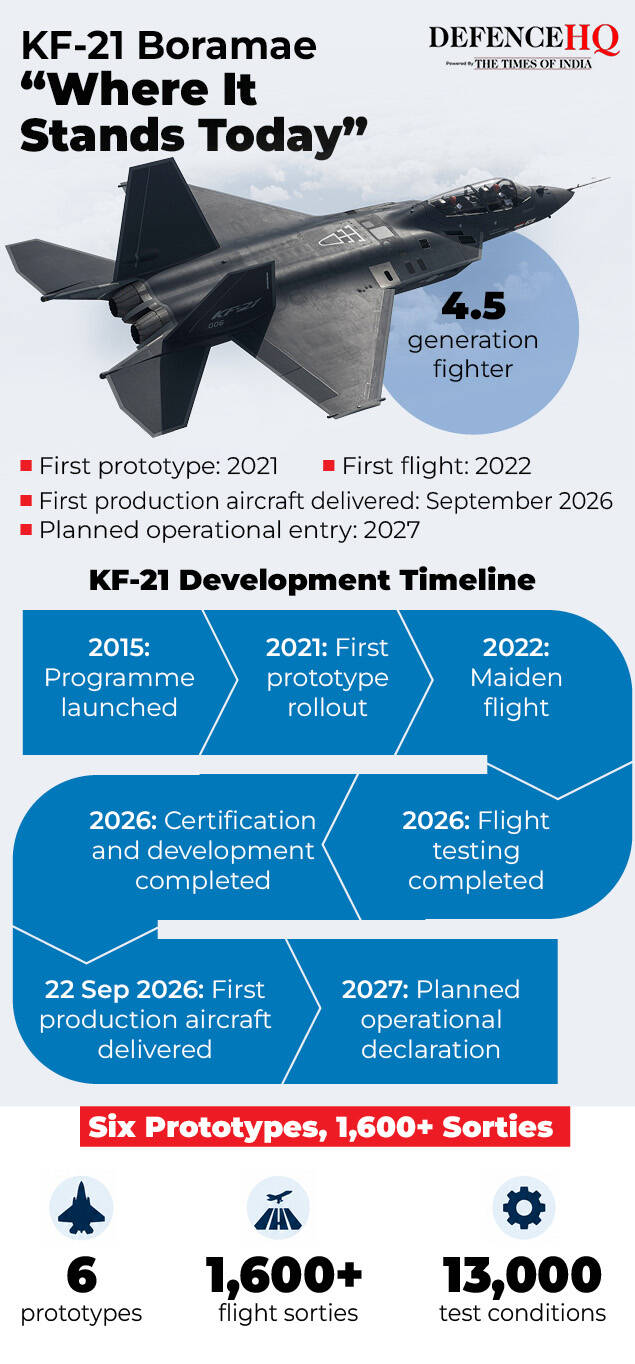
The KF-21 programme formally began in December 2015. Korea Aerospace Industries rolled out the first prototype in April 2021, and it made its maiden flight in July 2022. Over the following years, six prototypes completed more than 1,600 test sorties across roughly 13,000 test conditions, covering weapons trials, aerial refuelling, high-angle-of-attack manoeuvres and radar testing.The flight-test campaign concluded in January 2026. The aircraft received final approvals in May, secured type certification in June, and the system development phase was formally closed the following month.On September 22, the first production KF-21 was handed over to the South Korean Air Force at Yecheon Air Base. The aircraft was escorted by Korean-developed jets, including the FA-50, TA-50 and T-50. Seoul plans to formally declare the KF-21 operational in the second half of 2027.But the KF-21 entering service today is not the final version envisioned by the South Korean Air Force. Seoul has deliberately structured the programme around successive capability blocks.Block I, the version now being delivered, is a 4.5-generation aircraft focused primarily on air-to-air combat. The first 40 aircraft will be delivered in this configuration. Block II will add air-to-ground capabilities, and South Korea has brought forward the timeline for their integration. The Defence Acquisition Program Administration (DAPA) announced in August that these weapons would begin arriving in stages in the first half of 2027, rather than being integrated in bulk only by the end of 2028.The broader plan calls for 120 KF-21s. The first 40 will focus on air superiority, while the remaining 80 are planned to have air-to-ground and anti-ship capabilities by 2032.
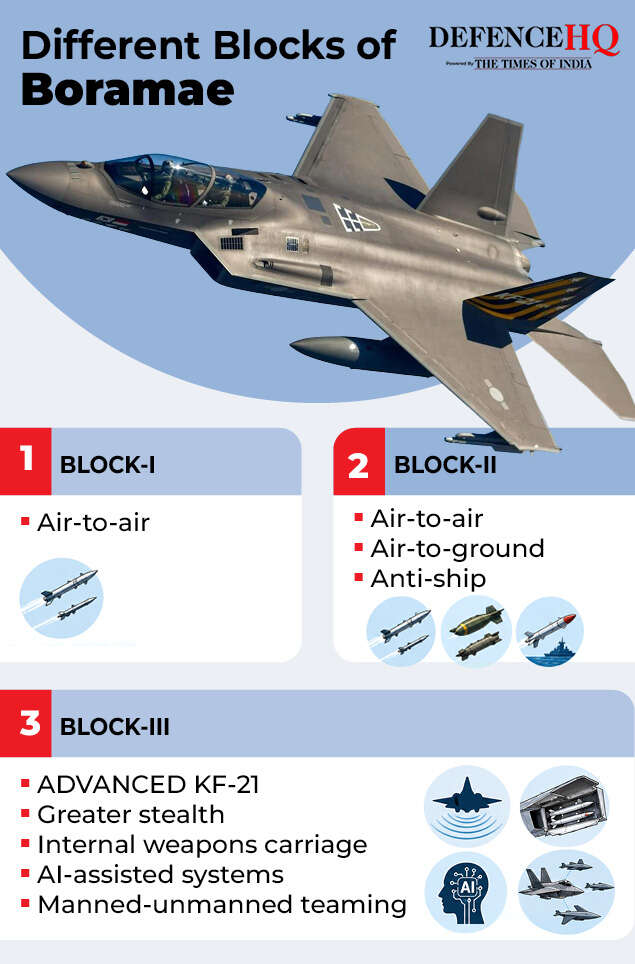
The aircraft is being manufactured in different tranches, each adding additional capabilities to the aircraft.
South Korea has also outlined a longer-term evolution towards a full fifth-generation configuration, with improved stealth characteristics and, eventually, sixth-generation features such as an internal weapons bay, which would reduce radar signature and improve aerodynamics, along with AI-assisted systems and manned-unmanned teaming. These, however, remain future ambitions rather than capabilities of the aircraft entering service today.
Long road for AMCA
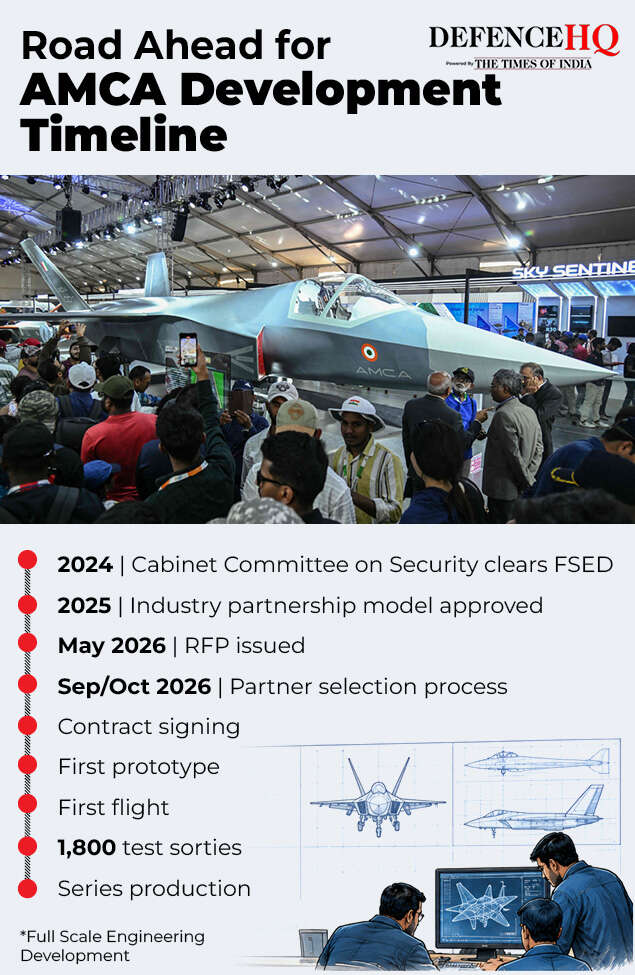
The Indian Air Force is facing a massive numbers shortfall, with the indigenous 5th-gen fighter no way near the horizon.
India’s AMCA has been conceived differently from the outset. Rather than starting with a 4.5-generation aircraft and building up its capabilities, the AMCA is being designed from the ground up as a fifth-generation stealth fighter, with low observability and internal weapons carriage central to its architecture.Two variants are planned. The AMCA Mk1 will be powered by the GE F414 engine, while the more advanced Mk2 is expected to use a higher-thrust indigenous engine being developed with foreign collaboration. This has been envisaged from the outset as the aircraft’s long-term growth path, rather than simply as a future weapons upgrade.The programme received a major institutional boost in 2024, when the Cabinet Committee on Security cleared the Full Scale Engineering Development (FSED) phase at a cost of roughly Rs 15,000 crore for five flying prototypes.In May 2025, the defence ministry approved a model under which the Aeronautical Development Agency would execute the programme jointly with a private industry partner. This opened prototype construction to the private sector for the first time in a major Indian fighter programme.By May 2026, the ministry had issued a request for proposals to three shortlisted contenders: Tata Advanced Systems, an L&T-BEL-Dynamatic consortium, and a Bharat Forge-BEML-Data Patterns grouping. The deadline for submitting bids has since been extended twice.As things stand, India has not yet reached the point South Korea had already crossed in 2021, when the first KF-21 prototype rolled out of the factory.The bidding deadline for the AMCA industry partner, originally set for late July, has now been extended to the end of September, with bids scheduled to be opened the following day. The winning company will have to build five prototypes and one structural test specimen, achieve a maiden flight within 30 months of signing the contract, and complete an 84-month, seven-year programme involving 1,800 test sorties before series production can begin.
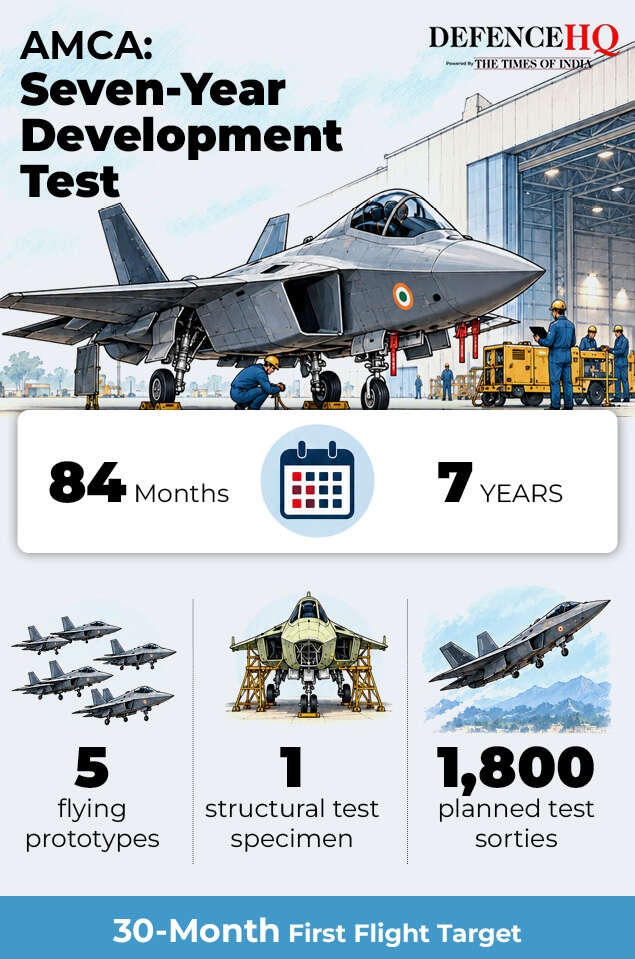
Even when the test bed is ready, the aircraft will still have to undergo a testing phase, which would be seven years long.
Placed side by side, the timelines tell their own story. South Korea moved from the formal launch of the KF-21 programme in December 2015 to prototype rollout in less than six years. The aircraft flew for the first time the following year and, roughly a decade after the programme began, a production aircraft has already been handed over to the air force.India, by contrast, is still selecting the company that will build its first AMCA prototype. Its equivalent milestones, including first flight, certification and induction, therefore remain years away and will depend heavily on when the production contract is finally signed.Earlier projections had pointed to an AMCA prototype rollout in late 2026 or early 2027 and induction by 2034. With the industry-partner selection itself now delayed, however, those timelines increasingly look aspirational.
IAF’s big falling numbers worry
India faces a two-front threat from Pakistan and China, with the risk of collusive action between them, making a whole-of-government strategy involving diplomacy, economic leverage, alliances and credible military deterrence essential. Air power remains central to this calculus, and the immediate priority is building up IAF numbers quickly. This context is key to assessing the upcoming Rafale deal. Delays in the AMCA programme could eventually force New Delhi to choose between competing priorities, making it critical that the government designates AMCA a mission of national importance to ensure timely delivery. Meanwhile, the IAF’s dangerously dwindling fleet need urgent augmentation. It needs MRFA of at least 4/4.5 generation; ideally that should have been LCA Mk1a and Mk2. However, the delay forces an unpleasant choice- import.
Group Captain Ajay Ahlawat (retired)
The comparison matters for reasons beyond admiration or anxiety about another country’s fighter programme. It comes at a time when the Indian Air Force’s fighter squadron strength has fallen to 29, well below its sanctioned strength of 42, largely following the retirement of the MiG-21 fleet last September.That shortfall of roughly 13 squadrons is unlikely to disappear soon. The Jaguar fleet, which still numbers around 120 aircraft across six squadrons, will eventually need replacement even as DARIN III upgrades are expected to keep the aircraft flying until around 2035.
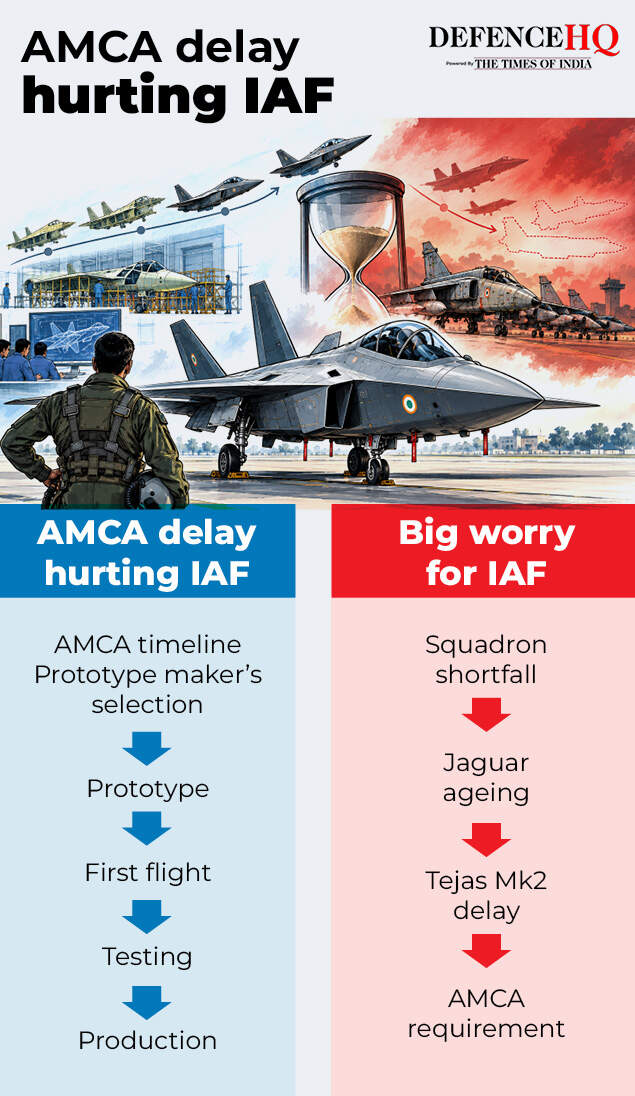
The delay in developing new fighter aircraft is severely affecting the combat capability of the air force.
The Tejas Mk2, which was once expected to help plug the gap with a first flight in 2026, has also slipped, with recent estimates now pointing to 2027.India is looking further ahead as well. The defence ministry is exploring possible participation in the French-led Future Combat Air System (FCAS) for a future sixth-generation fighter, an option it discussed with the parliamentary committee on defence.But that programme itself remains in flux. France and Germany parted ways on their joint crewed-fighter effort earlier this year, although they are continuing cooperation on the combat cloud. India’s sixth-generation discussions are therefore taking place at an even earlier and more uncertain stage than the AMCA programme.India is also a dialogue partner in the Global Combat Air Programme (GCAP), the sixth-generation fighter effort being developed jointly by the UK, Japan and Italy.The picture is ultimately one of two very different approaches to fighter development.South Korea chose to get a workable, upgradeable aircraft into the hands of its air force relatively quickly and build its capabilities over successive blocks. India is betting on a more ambitious leap directly to fifth-generation stealth.That ambition, however, comes with a longer runway. And every month spent finalising an industry partner is another month before the IAF gets its first AMCA prototype, while the service continues to operate with a fighter fleet well below its authorised strength.