








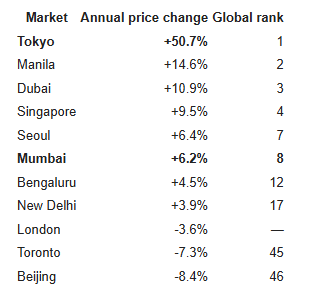
MUMBAI: Mumbai’s prime residential market has entered the world’s top 10, with prices of high-end homes rising 6.2% year-on-year in Q2 2026, more than double the 2.6% global average, according to Knight Frank’s latest Prime Global Cities Index.Mumbai ranked eighth among 46 cities, with prime prices also increasing 1.7% over the previous quarter. The performance puts the city ahead of established global luxury markets such as Vienna, San Francisco and Perth.For Mumbai’s high-value housing market, the latest data points to continued price resilience despite a more moderate pace of growth globally.But the number comes with an important caveat for homebuyers: the index covers the prime residential segment and should not be read as a rise in prices across Mumbai’s entire housing market.Bengaluru recorded a 4.5% annual rise and ranked 12th globally, while New Delhi rose 3.9% to rank 17th. India therefore had three cities among the global top 20.
Mumbai gains while global growth remains measured
The 6.2% increase in Mumbai compares with a 2.6% rise across the 46-city index. Globally, annual growth accelerated from 2% in the previous quarter.Of the 46 cities tracked, 32 recorded annual price growth, while 15 saw prices decline. On a quarterly basis, 28 markets gained, 17 declined and two were unchanged, suggesting a broad but uneven improvement in prime housing conditions.Knight Frank India chairman and managing director Shishir Baijal said Mumbai’s ranking was significant given the more measured pace of global price growth.He attributed the city’s performance to demand at the top end, where location, quality and differentiated residential offerings continue to support values.The Mumbai market’s performance also reflects a structural feature of the city’s luxury housing segment: limited availability of premium homes in established locations can make well-located, high-quality stock relatively less sensitive to short-term market fluctuations.
Tokyo an extreme outlier
Tokyo topped the ranking with a 50.7% annual increase and 12.6% quarterly growth. Manila followed at 14.6%, Dubai at 10.9% and Singapore at 9.5%. Seoul, at 6.4%, was marginally ahead of Mumbai.At the other end, Beijing recorded an 8.4% decline, the steepest fall in the index, followed by Toronto at 7.3% and Wellington at 5.4%. London’s prime residential prices fell 3.6% over the year.Knight Frank global head of research Liam Bailey said the latest results indicated a modest improvement in global luxury housing conditions, but stressed that individual markets continued to behave differently.Supply, currency movements, wealth creation and interest-rate trends remain important factors influencing city-level performance.
What the 6.2% means for Mumbai buyers
The latest ranking is particularly relevant to buyers and investors looking at Mumbai’s premium housing corridors, but it does not establish that a typical Mumbai flat has appreciated 6.2%.The index measures prime residential property, representing the most expensive and desirable homes in a market. Its movement therefore captures the behaviour of the luxury end rather than the mass or mid-market housing segments.For Mumbai, the takeaway is narrower but significant: premium residential values continued to rise faster than the global prime-market average in Q2 2026, even as international luxury markets showed widely divergent performances.That makes the city’s eighth-place ranking less a measure of Mumbai’s overall housing inflation and more an indicator of the continued strength of its high-value residential segment.
Mumbai vs the World
Mumbai vs the World
Global 46-city average: +2.6%Mumbai Q2 movement: +1.7% quarter-on-quarterImportant: The index covers prime/high-value residential property, not average home prices across Mumbai.Source: Knight Frank Research, Prime Global Cities Index Q2 2026