






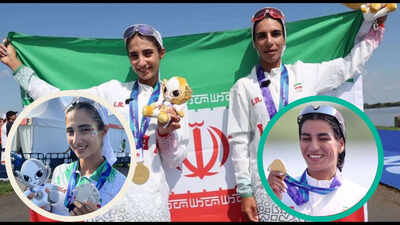
Iran’s rowers arrived at the Asian Games after a preparation unlike anything they had experienced before, with their training camp cancelled and athletes scattered across cities as the war disrupted life across the country. Yet when they finally returned to the water in Nagoya, they produced one of the strongest days in the history of Iranian women’s rowing, winning gold medals, adding silver and bronze, and turning months of uncertainty into a remarkable haul.
Iran’s rowers delivered a historic day in Nagoya
The breakthrough began with Fatemeh Mojallal, who won the women’s lightweight single sculls in 7:24.57 to claim the first Asian Games gold medal for Iranian women’s rowing.Later, Kimia Zarei and Zeinab Norouzi added another gold in the women’s lightweight double sculls, winning in 6:53.93 and finishing 5.31 seconds ahead of Hong Kong, with Japan taking bronze.Iran’s medal haul continued in the women’s quadruple sculls, where Mahsa Javer, Soha Fakhri, Saghi Maleki and Hengameh Kamyab finished second in 6:27.24, behind China and ahead of Japan.Zarei and Norouzi also collected a silver medal in the women’s double sculls, finishing behind the Chinese pair with a time of 6:55.78, while Amir Hossein Mahmoudpour won silver in the lightweight men’s single sculls.Mojallal also added a bronze medal in the single sculls, making the Nagaragawa International Regatta Course the setting for a particularly productive day for Iran’s rowing team. The venue features a straight 2,000-meter course and previously hosted the 2005 World Rowing Championships, the first World Rowing Championships held in Asia.The six-medal haul was built around the country’s first women’s rowing golds at the Asian Games, with Mojallal and the Zarei-Norouzi partnership reaching the top of the podium on the same day.For Zarei and Norouzi, the achievement also continued a partnership that had already produced international success before Nagoya. The pair won gold at the 2025 Asian Rowing Championships in Vietnam, finishing first in the final in 7:30.22 against crews from India, Vietnam, Thailand and Hong Kong. They had also won multiple gold medals at the 2024 Asian Rowing Championships in Samarkand.Their success in Nagoya therefore represented the latest step in an established partnership, although the circumstances surrounding their preparation this time were dramatically different.
Their training camp was cancelled when the war began
The Israel-Iran conflict had disrupted Iran’s sporting preparations months before the Asian Games, with the federation cancelling its training camp and sending the rowers back to their respective homes.Zarei returned to Hamadan, while her teammates went back to their own cities. With the athletes separated and unable to train together on the water, the federation provided each rower with an ergometer so they could maintain their fitness at home.For roughly 45 days, Zarei trained alone, following a programme sent by her coach and covering about 20 kilometres a day on the indoor rowing machine.“I was preparing to start training, and then I heard the bombing sounds,” Zarei said in a conversation with The Indian Express. “It was so close to our home. When you looked out of the window, you could see the smoke.The disruption was not simply a matter of finding somewhere else to exercise. When the bombing intensified, athletes sometimes had to leave their homes or move to other locations, while the training schedule continued whenever circumstances allowed.“All the cities in Iran were affected by the war,” Zarei said. “In the first month of the war, it was really hard, harder than before.”The federation’s decision to provide ergometers gave the athletes a way to continue preparing despite the collapse of their normal training environment.“We faced a lot of difficulties after the war began, but we wanted to show that we are strong. We have given every rower an ergometer so they could continue training at home,” federation chief Mohsen Shadi Naghadeh told The Indian Express.For Zarei, training and simply staying safe became intertwined during those first weeks.“It was both of them,” she said when asked whether she was trying to save her life or trying to row.Speaking to OCA News, Zarei described the decision to return to training despite the continuing conflict and the significance she attached to what they were trying to achieve.“Every day, I did 20 kilometres on the erg then we got back into camp even though there was still a war in our country,” she said. “It was a big risk for us but we risked our lives because we wanted this moment and we wanted this medal for Iranian girls and athletes, Asian Games medals really matter.”The Iranian women’s kabaddi team faced similar disruption, with its training camp also affected by the conflict before the players moved between cities and eventually travelled to Sonepat in India in August, where they trained twice a day and played practice matches to rebuild their rhythm.The rowers eventually returned to camp and resumed training on the water at Urmia, where the federation had access to a two-kilometre course, but the weeks spent indoors remained an important part of what they had endured to reach Nagoya.
Zarei had spent three years trying to erase one fourth-place finish
The 2026 Asian Games also gave Zarei a chance to settle something that had stayed with her since the previous edition.At the Hangzhou Asian Games, she finished fourth and missed out on a medal by only a quarter of a second, becoming the only member of Iran’s rowing team to leave without a medal. Norouzi, by contrast, had won two silver medals at those Games.“It was really a hard moment,” Zarei said.The disappointment changed her approach during the three years that followed. Inspired by her mother, who taught her to be independent, work hard and not rely on others, Zarei changed aspects of her training and diet and began using social media to promote the positive side of being an elite female athlete.“It can be positive in a way that you try to motivate the girls at home, try to show them and try to share your experiences with them,” she said.“Especially in the country where I live, because in Iran we have very unique challenges in my country, especially this year.”The partnership with Norouzi also continued to develop, culminating in their gold at the 2025 Asian Rowing Championships in Vietnam and building on the multiple gold medals won at the 2024 edition in Samarkand.By the time they reached the Asian Games final in Nagoya, Zarei and Mojallal had already spent years competing at the highest level and building towards this moment. Their preparations had been repeatedly interrupted, and the disruption caused by the conflict had made consistent training difficult. Still, they arrived in Nagoya with years of work behind them and finished the job with gold.Zarei captured what the medal meant to her after the race.“Three years of hard work, being motivated, trying to stay positive, trying to believe in myself and believing in God,” she said. “Today, I’ve got first place.”
The gold was for Iranian girls and athletes
When Zarei and Norouzi crossed the finish line first in Nagoya, Zarei splashed the water and broke down in tears. The medal came after the disappointment of Hangzhou, years of preparation and weeks of training alone during the conflict.Throughout that period, she said, her focus stayed on the medal, her family and the people she wanted to represent.“The only thing was thinking about the medal, thinking about my people, thinking about my family and my future,” Zarei said. “Because this medal really matters for Iranian people, especially Iranian girls.”“I cried,” she added. “It was a moment that I really cannot explain in words.”For Norouzi, the gold was the result of a demanding preparation that required them to push through difficult circumstances.“I have a very good feeling and it cannot be described,” she said. “We went through very hard training to win this medal and endured a lot of hardship to achieve this valuable medal.”She dedicated the victory to the Iranian public.“I dedicate this medal to the dear people of Iran, who have always supported the athletes and whose prayers accompany the Iranian national team members,” Norouzi said. “We always fight for the people of Iran, and this gold medal is for the dear people of Iran.”The road to the Nagoya medals was far from straightforward, with athletes separated from their teammates, confined to their homes for extended periods and forced to replace water training with indoor ergometer sessions.The Iranian rowing team had spent months preparing under difficult circumstances, with training disrupted by the conflict and athletes separated from their teammates. Zarei spent 45 days rowing alone in her room, sometimes with explosions close enough for smoke to be visible from her window, while the rest of the team continued preparing in similarly harsh conditions.In Nagoya, the team delivered a stellar performance, winning six medals, including Iran’s first-ever rowing gold medal at the Asian Games.