








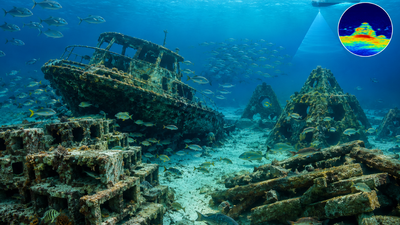
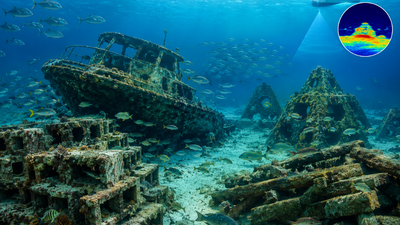
A collection of old boats, concrete blocks and railroad ties may not sound like the beginning of a thriving marine habitat. But off the Texas coast, these man-made structures have become part of a sprawling underwater reef where researchers have now estimated nearly 24.4 tonnes of fish biomass. A study published in PLOS One examined the 1,650-acre Rio Grande Valley Reef using sonar surveys and found that fish were not spread evenly across the site. Instead, some structures attracted considerably more biomass than others, with sunken boats recording the highest average biomass among the structure types studied.
How the artificial reef took shape
The Rio Grande Valley Reef lies roughly 10 nautical miles offshore from South Padre Island. It is part of Texas’ artificial reef programme, which uses suitable materials to create hard-bottom habitat in areas where the seafloor is otherwise dominated by soft sediment. According to the Texas General Land Office, the reef covers about 1,650 acres. Work on the site began in 2016 and was completed in 2019. Over that period, different kinds of material were placed on the seafloor, creating a mix of underwater structures rather than one continuous reef.Among them were boats, cinderblock pallets, prefabricated pyramids and concrete railroad ties. Some structures were relatively low, while others rose much higher from the seafloor. That difference in height turned out to matter when researchers later looked at where fish were concentrating. The idea behind an artificial reef is fairly simple. By adding solid structures to an otherwise relatively flat seabed, the project creates places where marine organisms can attach, hide, feed and gather. Over time, those structures can become occupied by a wider range of marine life.
Researchers turned to sonar
Counting fish across more than 1,600 acres of ocean is not something that can easily be done by divers or underwater cameras alone. For the study, researchers from the University of Texas Rio Grande Valley used hydroacoustic surveys to get a broader picture of fish activity around the reef. The team carried out surveys in 2023 and 2024, using split-beam sonar along more than 146 kilometres of transects. The surveys covered about 60% of the reef area.Instead of seeing fish directly, the sonar detected echoes produced as fish passed through the acoustic beam. Researchers could then use those measurements, together with estimates of fish length and weight, to calculate biomass. The surveys recorded 1,839 individual fish tracks and 121 fish schools near reef structures. Away from the structures, the researchers recorded another 1,037 individual tracks and 178 schools. The numbers were then converted into an estimate of the amount of fish biomass present.
The reef held an estimated 24.4 tonnes of fish
The resulting estimate was about 19,515 kilograms of fish biomass associated with reef structures. Another 4,482 kilograms was estimated in areas between the structures. Combined, the researchers estimated approximately 24,396.5 kilograms, or around 24.4 tonnes, of fish biomass across the RGV Reef area.The figure does not mean that researchers physically weighed 24.4 tonnes of fish. It is an estimate generated from the acoustic data and the relationships researchers used to convert those measurements into fish size and weight. The study also showed that the type of structure made a difference.
Why the boats attracted more fish
Of all the structure categories examined, boats had the highest average fish biomass, at about 756.6 kilograms per structure, although there was considerable variation between individual sites. One of the largest individual measurements came from the reef’s Big Pile, a large accumulation of concrete railroad ties. Researchers estimated about 3,435.4 kilograms of fish biomass there.The difference between the average and the individual measurements is important. While the Big Pile supported a particularly large amount of biomass, boats performed strongly when structures were compared by their average biomass. Researchers also found that taller structures tended to support more fish biomass than lower-relief structures. The larger vertical surfaces may provide more usable habitat and create different spaces in the water column for fish to occupy.The findings suggest that simply putting material on the seafloor is not the whole story. What that material looks like and how much vertical relief it creates can influence how fish use an artificial reef.
The study also looked at carbon
The researchers went beyond estimating fish biomass and considered how much carbon was contained within that biomass. Their calculations put the amount at roughly 2.81 metric tonnes of carbon in fish associated with the reef.The researchers point out that this aspect of artificial reefs has received comparatively little attention. However, the study does not present artificial reefs as straightforward carbon sinks. More research is needed to understand what happens to that carbon over longer periods and how it moves through the wider marine ecosystem.
A closer look at what artificial reefs can do
The Rio Grande Valley Reef offers researchers an unusually large site for studying how artificial structures change the use of the seafloor. Boats, concrete blocks, pyramids and railroad ties have created a patchwork of habitats, each with different shapes and levels of relief. The sonar results show that fish use these structures unevenly. Some sites attract far more biomass than others, and larger, taller structures appear to play an important role.For the Texas coast, the project also provides a long-term opportunity to study what happens after artificial reef material is placed underwater. The latest research does not simply put a number on the fish living around the reef; it shows how the design of an artificial structure can influence the marine life it eventually supports.From discarded boats to piles of concrete railroad ties, what was once simply material placed on the seafloor has become a large underwater habitat. And the sonar surveys are now giving researchers a clearer idea of just how much life those structures can hold.