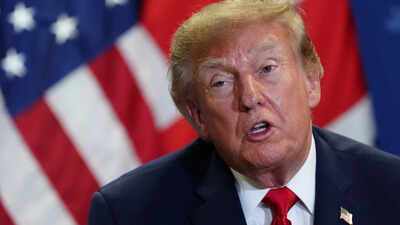








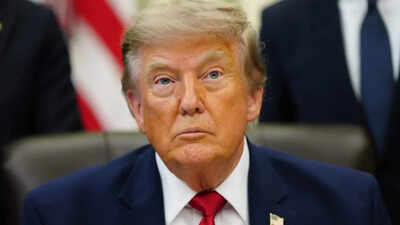
US President Donald Trump wants the world to stop saying “artificial intelligence”. Speaking at the United Nations General Assembly in New York on Tuesday (September 22), Trump said the US will now officially call the technology “super intelligence”, or SI. His reason is simple: the word “artificial” makes it sound fake. “It makes it sound fake, and it is not fake. It’s actually amazing,” he said.The change, according to Trump, will cover all US government documents. “From this point forward, all of the United States documents, and hopefully the world’s, will be changed to use the much more accurate term, super as opposed to artificial,” he told the assembly. There is no word yet on when the switch will happen or how it will be carried out. Trump himself did not sound too sure. “Let’s see if I have any power. Maybe I do, and maybe I don’t, we’re gonna find out pretty soon,” he said.
Trump picked ‘super intelligence’ after two social media polls
The idea did not come out of nowhere. On Saturday (September 19), Trump posted on X and Truth Social that “many people think that the words ‘Artificial Intelligence’ are inaccurate, and very ineloquent.” He then asked followers to vote on three options: Superior Intelligence, Extreme Intelligence and Supreme Intelligence.“Superior Intelligence” took an early lead with around 39% of the vote and later crossed 41%. Then, on Monday, Trump ran a second poll that pitted “Superior Intelligence” against a new entry, “Super Intelligence”. The new option won comfortably, and Trump started using “SI” in his posts almost immediately. So the name he announced at the UN was not even on the original ballot.The same weekend, Trump said he was forming an “AI Force”, modelled on the Space Force from his first term. He also promised to name an AI czar soon, adding, “Only High I.Q. individuals need apply!” He did not explain what either would do.
US president says whoever wins super intelligence wins the world
At the UN, the rename came wrapped in a larger message about the AI race. “Whoever wins super intelligence wins,” Trump said, adding that the US is “leading now over China by a lot.”He was clear that his government will not slow the technology down. “I’m not going to stifle growth of something that will be bigger than the Industrial Revolution,” he said. He added that the Department of Justice and other law enforcement bodies would “watch it closely” and step in if needed. In the same breath, he argued that the fear around AI gets it wrong. “In fact, it is exactly the opposite of what it purports,” he said.Trump also lumped AI safety warnings with climate change and the “Russia, Russia, Russia hoax”. Earlier in the week, he had called the backlash against AI a hoax pushed by his political rivals. The comments come after an Anthropic researcher resigned, saying leading AI companies believe the technology “could kill us all by the end of the decade.” Anthropic CEO Dario Amodei has since proposed a plan to “pace the frontier”, which OpenAI CEO Sam Altman and Elon Musk appeared to back.
Superintelligence already has a very different meaning in AI research
There is a catch with Trump’s pick. In AI circles, “superintelligence” is not a new word. Philosopher Nick Bostrom described it back in 1997 as “an intellect that is much smarter than the best human brains in practically every field.” Researchers use it for hypothetical future systems that outperform humans across most tasks. Today’s chatbots are not there yet, and Bostrom’s work is largely about the risks such systems could pose.“Artificial intelligence” itself has no legal status that a president can overwrite. Computer scientist John McCarthy coined it in a 1955 proposal for a Dartmouth College conference, co-authored with Claude Shannon, Marvin Minsky and Nathaniel Rochester. At the time, rival labels such as “automata studies” and “complex information processing” were also doing the rounds. “AI” won, and it has stuck for 70 years. It is even part of company names like OpenAI.Trump has renamed things before. The Gulf of Mexico and Denali got new labels, and digital maps in the US updated within days. A word used by millions of engineers, companies and users every day is a different test. Government files may say SI soon. Whether anyone outside Washington follows is the part Trump admitted he cannot predict.