







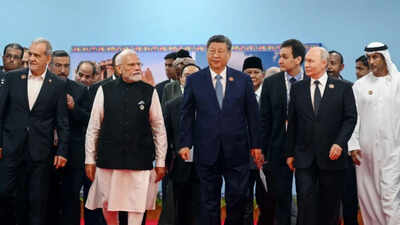
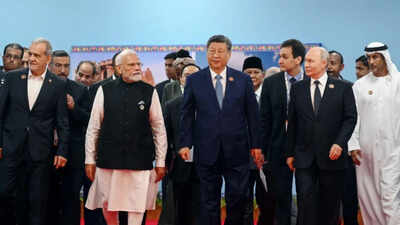
TOI correspondent from Washington: It’s a club MAGA boss Donald Trump loves to hate — one that New Delhi not only refuses to leave but wants to lead. As India hugged Brics without breaking up with America, presiding over a geopolitical game of musical chairs where nobody gets eliminated, reviews in Washington of the just-concluded summit sounded more wary than alarmed despite the group’s growing strength and a reprimand of Uncle Sam without calling him by name.While the New Delhi Declaration took aim at unilateral tariffs, trade barriers, and sanctions, warning that such measures distort global commerce and violate the spirit of the WTO — while dancing around the issue of wars involving the US, Russia, and several members — the reaction in Washington to the summit has been more hmmm than horror. The broad consensus in the American commentariat is that Brics is acquiring political heft, but remains far too divided to become a coherent anti-American alliance.Time went so far as to headline its assessment “Why a Divided Brics Poses No Challenge to America,” while emphasizing that India, the summit host, still wants Brics to accomplish things without antagonizing Washington. “Brics leaders gather in New Delhi as wars and rivalries strain the expanded bloc,” noted the Washington Post, while the NYT observed that while “China wants Brics to challenge American power, India wants it broad enough that countries don’t have to choose.”That may well be the central paradox of the New Delhi summit: Brics is becoming bigger, louder, and more confident about challenging Western dominance, while one of its key, pivotal members is simultaneously deepening ties with Washington. The Modi-Xi encounter was therefore watched especially closely, even more than the Modi-Putin engagement with one wag — referring to the Galwan flare-up — characterizing it as a diplomatic equivalent of reopening a restaurant that had been closed after a rather serious kitchen fire.Several analysts noted that Beijing’s longstanding concern has been India’s growing alignment with the U.S. “China wants to shape India’s strategic choice. It wants an India that does not see China as a threat. It also wants India to not side with the US by default because of China,” Stimson Center’s Yun Sun told FT, whose headline, “World’s biggest relationship? Xi and Modi look to rebuild ties for 2.8bn people” emphasized the size of the two nations.Jeffrey Sachs, the Columbia University economist and prominent critic of U.S. foreign policy, made the argument much more emphatically. In an interview ahead of the summit, he said: “India and China together can really make a multilateral world,” describing their cooperation as central to the emergence of a genuinely multipolar order, while noting that Brics represents roughly half the world’s population and economic output. Sachs, in fact, has gone further in pushing for an Asian partnership, arguing that “India should leave the Quad, period.”However, New Delhi, which seems quite happy to collect diplomatic memberships the way some people collect airline miles, is staying on as a member of a rather moribund Quad while using its Brics chairmanship to portray itself as a leading voice of the Global South. PM Modi is expected to attend the G20 leaders’ summit to be hosted by President Trump in Miami December 14-15.Then there was Modi-Putin tango that has long irked traditionalist foreign policy boffins in the U.S. The Russian president’s appearance alongside Modi provided another visual rebuttal to the US idea that Moscow has been diplomatically quarantined, with the optics of Putin, Xi, Modi and Iranian President Masoud Pezeshkian in the same frame demonstrating that Russia’s international relationships is more durable that U.S would like to believe. If anything, some analysts noted that Trumpian Washington was the one getting isolated – or isolating itself. “Trump gets wrecked at Brics,” read the headline for in MeidasTouch, a trenchantly anti-Trump vlog.Still, American analysts are hardly proclaiming the arrival of a Brics era or empire. While the expanded grouping now accounts for about half the world’s population, roughly 40% of global GDP and more than a quarter of global trade, one analyst smirked that Brics also looks like a family reunion where several relatives have hired lawyers. India and China remain strategic competitors; Iran and the UAE have sharply different interests; and Saudi Arabia and Iran have their own complicated history.So Washington takes comfort in the fact that Brics has not displaced the dollar, created a common currency or produced anything resembling Nato in reverse – things that President Trump growled against. Which is probably why, with its eminence grise out causing ripples in Ireland, there was no substantive public White House or State Department statement about the summit.