









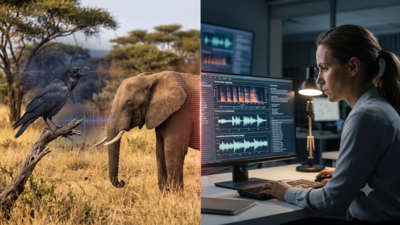
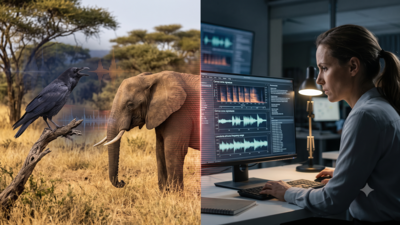
What once seemed distant is becoming possible. Artificial Intelligence (AI) may soon help humans communicate with animals. But the technology is also raising an ethical question over whether animals have a right to privacy. Machine learning models are helping researchers catalogue and reproduce animal sounds, allowing scientists to identify patterns in how animals communicate. But researchers writing in Springer Nature warn that collecting and decoding these signals could itself raise ethical concerns.“One risk that is currently not taken into account in research ethics is the concern that we might be violating the privacy of animals by collecting data on their vocalisations and movements,” the researchers wrote. “An interest in privacy is an interest in controlling how you appear to others, and the complex social lives of many nonhuman animals offer strong support for thinking animals have this interest.”
AI is decoding animal calls
Machine learning is helping researchers sort large collections of animal sounds and identify patterns that can be difficult to detect manually. Biologist Vittorio Baglione, who has spent years studying carrion crow calls, said he was struck by how AI models could sort his recordings and identify common features in different calls.One call, which Baglione described as essentially “Hey! Come help!”, is used by crows to summon others to defend a nest, he told Bloomberg.The ability to understand such signals could eventually make communication with animals possible. But researchers warn that the same technology could also be misused.One concern involves “playback,” the practice of broadcasting recorded animal calls into the wild. A person could use an imitation of a familiar call to influence an animal’s behaviour without fully understanding what the signal means.Baglione warned that hunters or others with malicious intentions could misuse the technology.“You can stress the animals. You can disrupt their social environment. You can pose conflicts between them, especially if you don’t really understand the meaning of the call,” he said.
When communication becomes manipulation
César Rodríguez-Garavito, director of the More-Than-Human Life, or MOTH, Program at New York University, has also raised concerns about playback technology.In a 2025 report on AI systems for animal communication, Rodríguez-Garavito said the technology could expose animals to large numbers of people seeking to communicate with them or potentially allow the animals to be weaponised.Previous playback experiments have shown how distressing an artificial call can be. In 2007, zoologist Katy Payne acknowledged that she had caused an elephant significant distress after playing a recording of its dead grandfather’s voice.The example highlights the difficulty of using animal communication technology responsibly. A system may reproduce a call accurately without researchers fully understanding its meaning or the effect it could have on the animal.
The race to talk to animals
Despite those concerns, researchers and technology developers continue to pursue systems that could establish communication between humans and animals.There is currently a $10 million reward for a project that can establish communication with an animal without the animal recognising that it is communicating with humans.Private equity billionaire Jeremy Coller, who funds the Coller Doolittle Challenge, said at the challenge’s latest prize event in June that humans could reach the goal within the next decade.“Because AI is so fast, I have absolute conviction we will crack the code by 2030,” he said.If that happens, the technology could change how humans understand animal communication. It could also force researchers to consider whether understanding an animal’s signals gives humans the right to use information the animals may never have intended to share.