




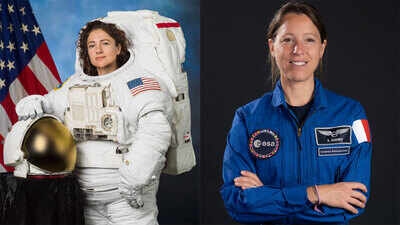
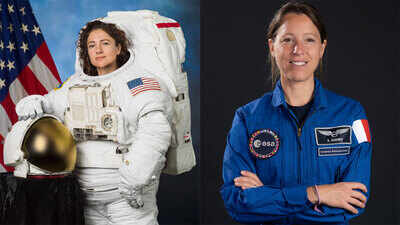
NASA astronaut Jessica Meir and European Space Agency astronaut Sophie Adenot made history with the sixth all-female spacewalk, stepping outside the International Space Station on September 1, 2026. The 6-hour-and-49-minute mission involved replacing a spacecraft docking aid and an HD camera, along with carrying out maintenance and scientific tasks. Their historic achievement is also the story of two astronauts who reached space through remarkably different career paths.
Jessica Meir: From studying penguins to walking in space
Jessica Meir is an American astronaut and scientist whose career began in biology and marine science. According to NASA’s official astronaut biography, Meir earned a bachelor’s degree in Biology from Brown University, a master’s degree in Space Studies from the International Space University, and a doctorate in Marine Biology from the Scripps Institution of Oceanography at the University of California, San Diego.Her scientific work focused on how animals survive in extreme environments. Her research included studying emperor penguins in Antarctica, elephant seals in California and bar-headed geese, which can fly at extremely high altitudes. She later worked on human physiology research related to spaceflight and participated in NASA’s reduced-gravity aircraft flights and underwater NEEMO missions.NASA selected Meir as an astronaut in 2013. She first travelled to the International Space Station in 2019 and subsequently became part of the crew that conducted the first all-female spacewalk, alongside NASA astronaut Christina Koch.The September 1 mission was Meir’s seventh spacewalk. According to NASA, she has now accumulated 49 hours and 22 minutes of spacewalking time, placing her among NASA’s most experienced female spacewalkers.
Sophie Adenot: From aerospace engineer to test pilot
Sophie Adenot followed a very different path to space. The European Space Agency says she studied aerospace engineering at ISAE-SUPAERO in Toulouse, specialising in spacecraft and aircraft flight dynamics. She later earned a master’s degree in human factors engineering from the Massachusetts Institute of Technology, where her research examined how the human vestibular system adapts to artificial gravity.Adenot then joined the French Air Force and trained as a helicopter pilot. Her career included search-and-rescue operations, formation flying and mission command. According to ESA, she graduated with honours as a helicopter test pilot from the Empire Test Pilots’ School in the United Kingdom in 2018.Before becoming an astronaut, Adenot accumulated approximately 3,000 flight hours across 22 helicopter types. ESA selected her as an astronaut in 2022, and she completed her basic astronaut training in 2024.She travelled to the International Space Station for the first time in February 2026 as part of her first space mission, known as the Epsilon mission. The September 1 EVA was her third spacewalk.
A historic mission and a lesson in teamwork
During the spacewalk, Meir and Adenot successfully replaced the docking-navigation reflector on the ISS’s Harmony module and replaced Camera Port 3, an HD camera mounted on the station’s truss.Late in the EVA, Adenot experienced reduced mobility in her left shoulder. Mission Control asked her to remain where she was until Meir could reach her. Once they returned to the airlock, Meir inspected Adenot’s spacesuit and freed what appeared to be a cable caught near the shoulder joint.Space.com reported that, after successfully freeing the old camera during the spacewalk, Meir announced, “And it’s off!” Her comment was followed by applause from Mission Control.The significance of their mission extends beyond the spacewalk record. Meir’s journey demonstrates how biology and scientific research can lead to a career in human spaceflight, while Adenot’s story shows how aerospace engineering, military aviation and human-factors research can converge in an astronaut career.Together, their journeys highlight a defining feature of modern space exploration: there is no single route to becoming an astronaut. Scientific expertise, engineering knowledge, aviation experience, resilience, adaptability and teamwork can all lead to the same destination: the frontier beyond Earth.