









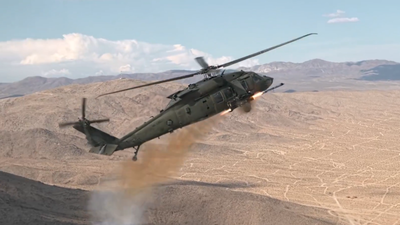
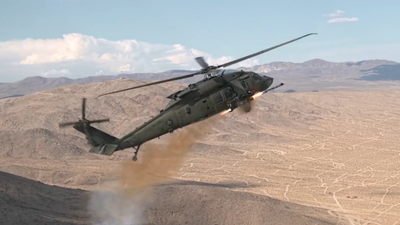
Helicopter-launched loitering munitions are quickly becoming the next big frontier in aerial warfare, and recent trials are showing just how far the concept has come. At Project Convergence Capstone 6, a US Army H-60M Black Hawk crew successfully executed a rocket-powered launch of the Altius-700, deploying a hunter-killer team that autonomously located a target, shared data across the formation, and carried out a strike, all without putting the helicopter crew in harm’s way. It marks another meaningful step toward fielding what the US Army calls launched effects, pushing sensors and weapons deeper into contested airspace while keeping manned aircraft further back from danger.Israel, too, has been busy on this front, a private firm in has developed a modular aerial launch system that lets both utility and attack helicopters deploy its Hero-120 loitering munition. What makes the system particularly versatile is its ability to hand over control of the munition mid-flight to ground forces, enabling beyond-line-of-sight engagements and tighter coordination between air and land units. Swappable warheads mean the same platform can switch between hitting armour, soft targets, or simply conducting surveillance, all decided on the fly.India is now moving to build a similar capability of its own. The Indian Air Force is seeking Non-Line-of-Sight guided ammunition for its helicopters, aiming for a lightweight, cost-effective system with a range of 50 to 60 kilometres that can hit both armour and softer targets with real-time video feed and man-in-the-loop control, allowing crews to alter or abort a strike mid-flight if needed. Alongside this, the IAF has released a Request for Proposal for drones deployable from helicopters, expected to carry at least a 500-gram warhead over an 80 km range, and a separate Request for Information for loitering munitions launched from transport aircraft, which would need a far longer 500 km range, a 30 kg warhead, and cruising speeds of 350-400 km/h.The strategic logic here is fairly straightforward. By spreading strike and surveillance capability across helicopters, the IAF could free up its fighter fleet for other missions, a meaningful advantage given the force’s ongoing squadron shortage. These air-deployable systems aren’t limited to strikes either, they can just as easily be used for electronic warfare, decoy operations, or to search for targets.India isn’t alone in this pursuit, the US Air Force’s parallel Gremlins programme and the broader Air Launched Effects initiative both envision networked drone swarms capable of overwhelming enemy defences from range, while China, Russia and the United Kingdom are reportedly pursuing comparable concepts of their own, suggesting helicopter and transport-aircraft-launched munitions could soon become a standard fixture of modern air combat doctrine.