









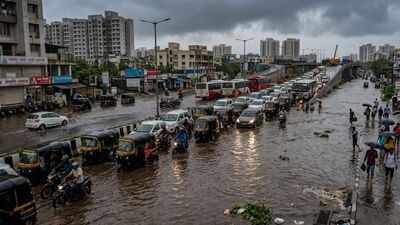
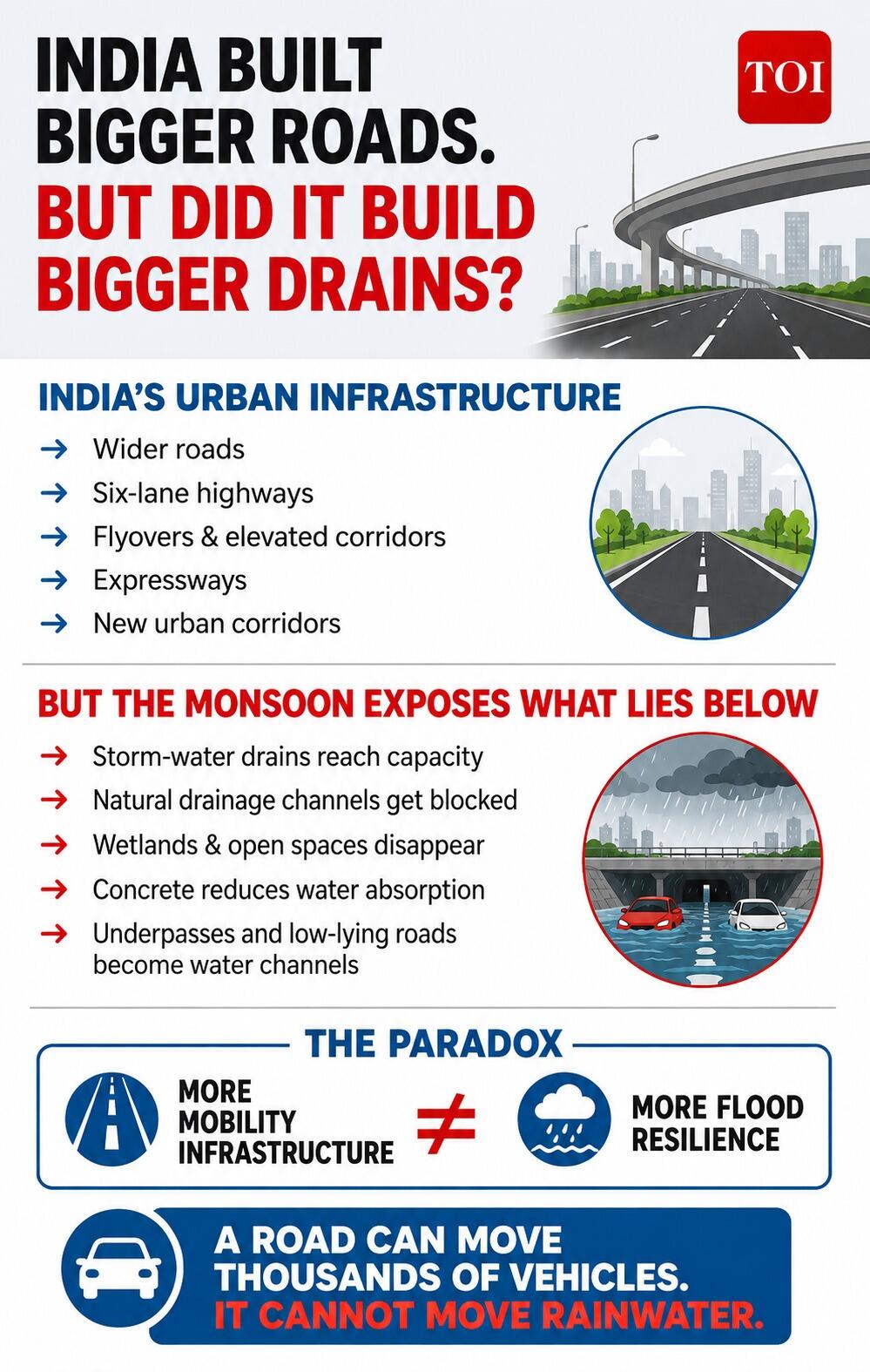
For years, India has been building bigger roads, wider highways, flyovers, expressways and new urban corridors. The country has invested heavily in improving the way people move through its cities. Yet every monsoon brings back an uncomfortable question: why can a city with six-lane roads, elevated corridors and new expressways still be brought to its knees by a few hours of heavy rain? The answer lies in what lies beneath and around those roads — the drainage, natural water channels, wetlands and basic urban systems that have not kept pace with construction.
Planned cities like Chandigarh also struggle with intense, short-duration rain events.
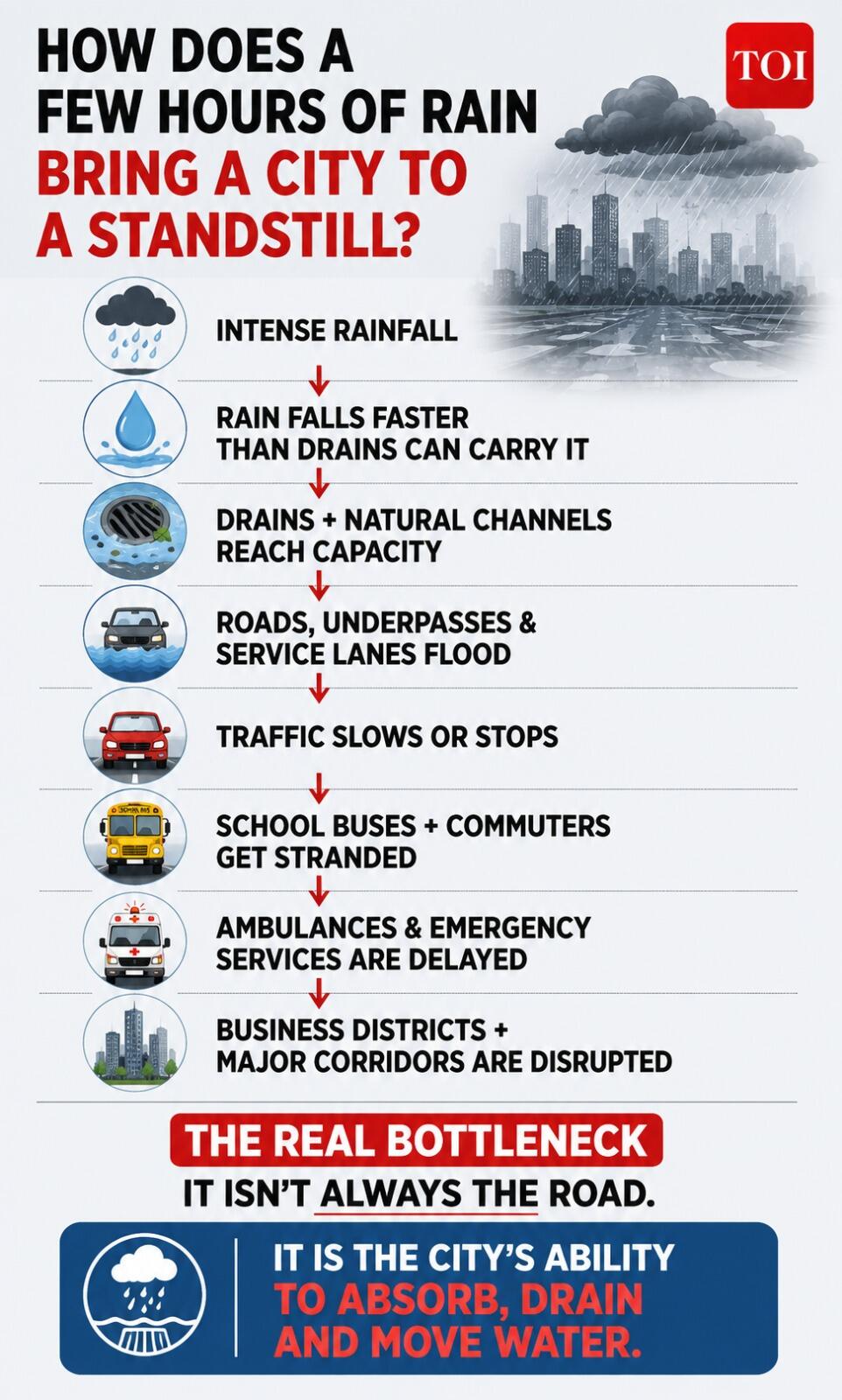
Gurgaon’s latest episode is a warningGurgaon offered a familiar but telling example this week. Around 70-75mm of rain in a relatively short spell on Monday was enough to flood major roads, trigger road cave-ins and turn routine journeys into hours-long ordeals. Parts of old Gurgaon, including Narsinghpur, Rajiv Chowk, IFFCO Chowk and Sohna Road, were badly affected. School buses, ambulances and commuters were caught in the water, while the administration advised people to work from home as the city struggled to restore normal traffic.The irony is hard to miss. Gurgaon has some of the country’s most expensive commercial real estate and some of its busiest roads, yet moving people around during heavy rain remains a recurring problem. The city has repeatedly spent money on drain desilting, road repairs, pumping equipment and flood-control measures. Still, many of the same stretches return to the headlines every monsoon. The civic body is now planning water-injection wells at four flood-prone locations. Useful as such measures may be, they also raise a larger question: why are cities still responding to flooding largely after it happens instead of designing infrastructure that anticipates it?Delhi shows it isn’t just a Gurgaon problemDelhi’s experience this monsoon makes it clear that Gurgaon is not an isolated case. Safdarjung recorded 127mm of rain in the first seven days of August, while several parts of the capital saw much heavier short-duration spells later in the month. During one recent spell, Janakpuri received 67mm in less than five hours. Heavy rain disrupted traffic on the Delhi-Gurgaon Expressway and also affected airport operations. The problem was not simply the amount of rain. It was the speed at which the rain came down and the city’s ability — or inability — to get rid of it.That distinction is becoming increasingly important. Indian cities are seeing intense bursts of rainfall that can dump large quantities of water over a small area within a few hours. A road may be perfectly capable of carrying thousands of vehicles every day, but that tells us almost nothing about how it will perform when several centimetres of rain fall in a short period. Once storm-water drains reach their capacity, roads, underpasses, service lanes and even parking areas start behaving like temporary drains. Traffic then becomes the first visible casualty.
Underlying urban systems and natural water channels have not kept pace with development.
Even planned cities are failing the monsoon testChandigarh provides another uncomfortable example. The planned city received 72.4mm of rain in just two hours in one of the heaviest two-hour spells of this monsoon. Roads turned into streams, vehicles were stranded in waist-deep water, homes and shops were flooded and thousands of commuters were caught in traffic jams. A city that was designed with planning and zoning at its core was still struggling to cope with a concentrated burst of rainfall.That tells us something important. The problem is no longer simply about whether a city has enough roads or whether a particular junction needs a flyover. Decades of construction have covered large areas with concrete and asphalt, leaving less open ground for rainwater to seep into the soil. In many places, natural drains, wetlands and traditional water channels have been narrowed, blocked or built over. When the rain comes, there are simply fewer places for the water to go. A six-lane road can move traffic efficiently, but it cannot compensate for a storm-water system designed for a much smaller or very different city.
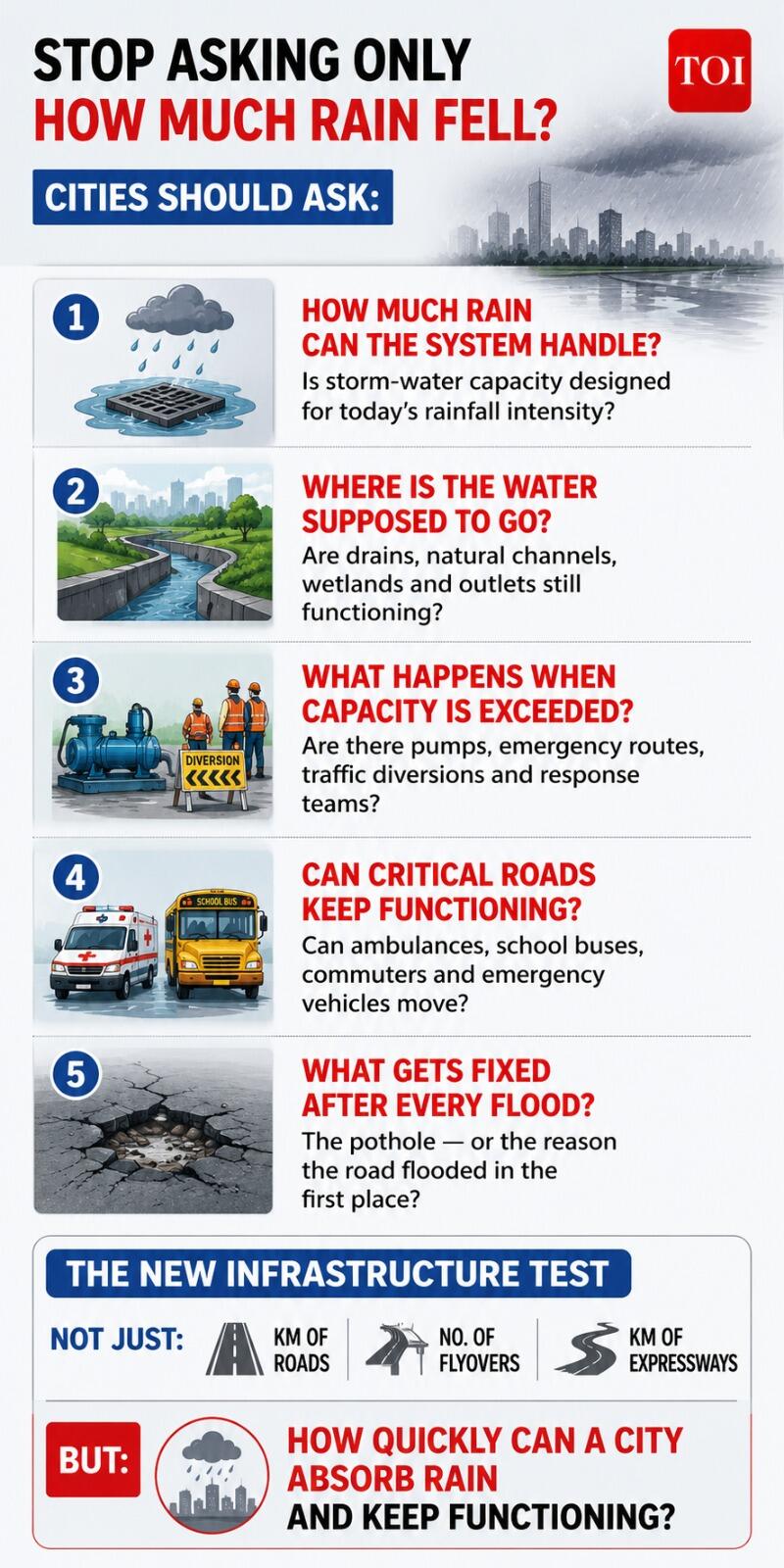
Addressing this requires improving drainage and preserving natural water bodies.
We repair the road. We don’t fix the systemThis is where India’s familiar monsoon cycle begins. Heavy rain is followed by waterlogging, traffic jams, emergency pumping, drain cleaning, road repairs and promises of permanent solutions. Then the roads are patched, traffic resumes and the issue gradually disappears from public attention — until the next serious downpour. In Gurgaon, even a road costing around Rs 11.8 crore has faced flooding, while stretches such as MG Road, Ghata Road, Palam Vihar and Sheetla Mata Mandir Road have repeatedly suffered from waterlogging and damaged surfaces.There is also a problem with the way cities plan and manage infrastructure. The agency building a road may not be the one responsible for the drains alongside it. Another authority may control land development, while another responds when flooding occurs. Each part of the system can function reasonably well on its own and yet the city can fail as a whole. A flyover may remove a traffic bottleneck without addressing the drainage problem below it. An expressway may dramatically cut travel time on a normal day, but become another choke point when surrounding roads and underpasses are submerged.Monsoon has become a stress test for urban planningIndia does not necessarily need to respond to every traffic problem by building another road, flyover or elevated corridor. It needs cities that can continue functioning when extreme weather hits. That means identifying and protecting natural drainage channels, preserving wetlands, creating more permeable surfaces, increasing storm-water capacity and ensuring that roads are designed with proper gradients and outlets. It also means completing drain cleaning before the monsoon, rather than treating it as an emergency operation once water has already entered homes and roads.Technology can help too, but only if it is connected to action on the ground. Mumbai and Chennai have experimented with more sophisticated urban flood-warning systems, showing how rainfall forecasts, flood modelling and local alerts can help authorities respond before roads disappear under water. But a warning is useful only when there are pumps, clear drainage routes, traffic diversions and emergency teams ready to act on it.So the question after a major downpour needs to change. Instead of simply asking how much rain fell, cities should be asking how much rain their infrastructure was designed to handle, where the excess water was supposed to go and why critical roads became impassable. India’s infrastructure progress cannot be measured only by kilometres of expressways, the number of flyovers or the width of its roads. If a few hours of rain can still strand schoolchildren, delay ambulances, disrupt airport operations and bring major business districts to a halt, the biggest infrastructure gap may not be the road above the ground. It may be the city underneath it.