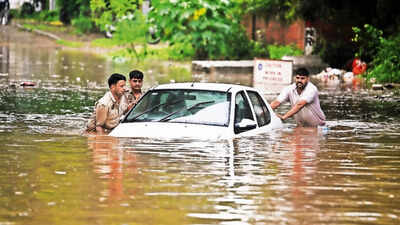









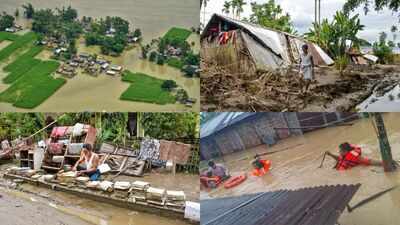
GUWAHATI: The water had receded. The families could return home. But there was no home to return to.In Assam’s Sivasagar, a family that had spent years saving money and storing grain was left with little more than a mud-covered house after the floods.20 quintals of grain were destroyed. Their refrigerator and other household belongings were damaged or washed away. For several days, they stayed with someone else before moving into a rented room.“I came back today after the water receded to clean up, but everything is destroyed, absolutely everything is gone,” a resident said.The account captures a phase of Assam’s flood crisis that is harder to measure than the rising death toll or the number of people rescued: what remains when the water leaves.For families who have lost homes, food stocks, furniture and farming resources, receding floodwaters do not mean a return to normal life.They mark the beginning of another struggle, i.e., cleaning homes, finding somewhere to live, replacing essentials, restoring livelihoods and waiting for financial assistance.
The numbers
When the water goes, the losses remain
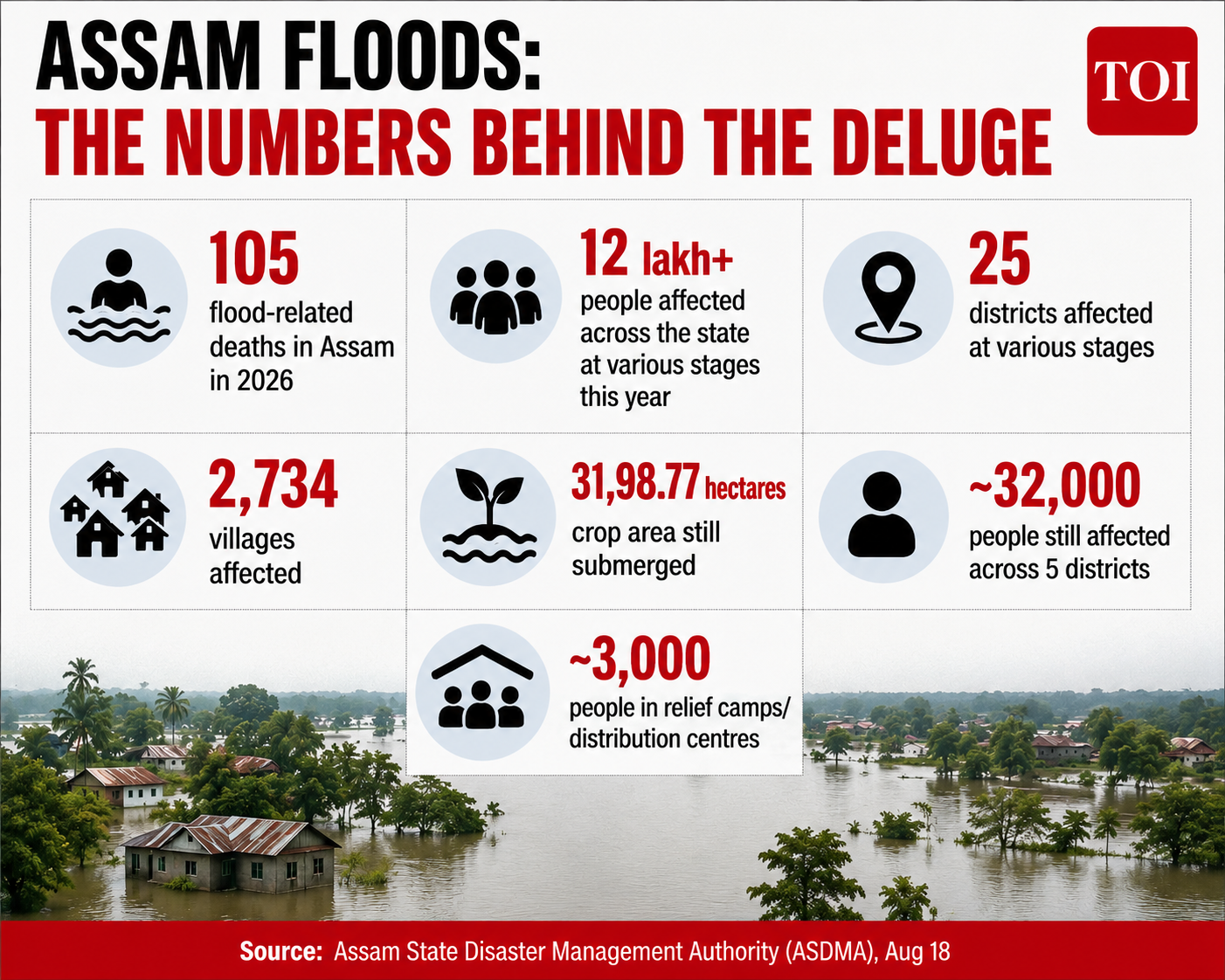
The latest official figures show that Assam’s flood emergency has eased considerably from its peak, but the damage left behind remains substantial.As of August 18, 105 people had died in flood-related incidents in the state this year, while nearly 32,000 people across five districts were still affected.Sivasagar recorded the highest number of deaths at 53, followed by Charaideo with 22 and Jorhat with nine. More than 3,198 hectares of crop area remained submerged.The numbers, however, do not capture what individual families have lost inside their homes.For households that stored paddy for months, the destruction of grain can mean losing both food security and a source of income.Furniture, appliances, utensils and clothing may appear small in official damage assessments, but replacing them can be difficult for families already struggling to recover.In some villages, the physical work of returning has barely begun. Water may have disappeared from a courtyard, but mud and silt remain inside rooms. Walls and floors need cleaning and repairing, while belongings that survived the flood may be too damaged to use.For families whose houses are structurally unsafe or completely destroyed, even returning is not an option.That leaves an uncomfortable gap between being rescued from a flood and actually recovering from it.
From rescue to rebuilding
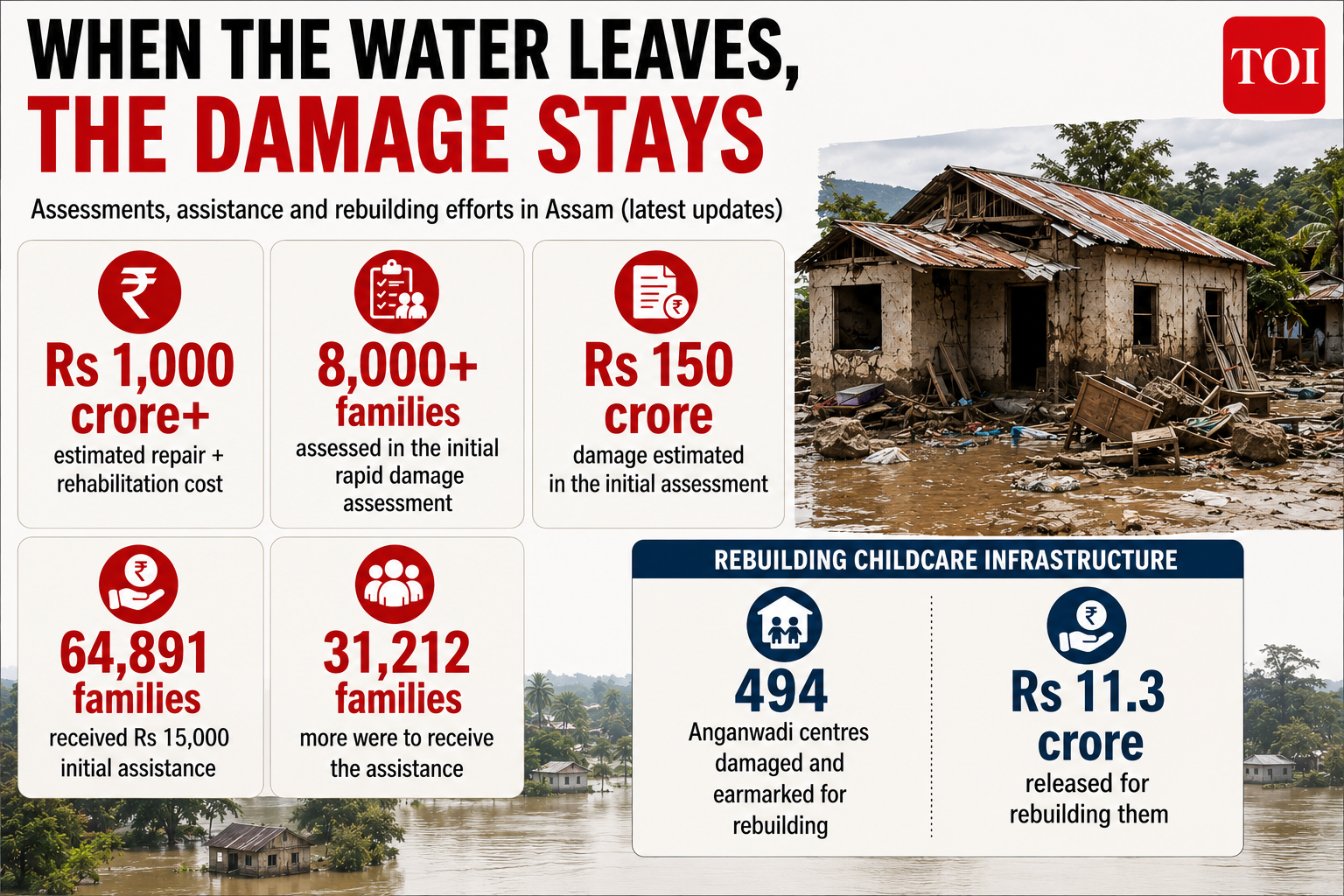
The Assam government has begun shifting its focus from immediate relief to damage assessment and rehabilitation.Chief minister Himanta Biswa Sarma recently said the state could require more than Rs 1,000 crore to repair damaged properties and rehabilitate people affected by the latest wave of floods.The government launched a rapid damage assessment drive on August 9. An initial assessment of more than 8,000 families had estimated damage at around Rs 150 crore, with the exercise expected to cover 50,000-60,000 families in severely affected Upper Assam districts.Sarma said the assessment would be carried out in multiple stages, with the final survey likely to be completed by September.The exercise is significant because compensation depends on establishing the extent of damage. The government has already said 64,891 flood-hit families had received Rs 15,000 each as initial assistance, with another 31,212 families expected to receive the aid.But for a family that has lost a house, grain stocks and essential belongings, initial assistance is only the first step.The government is also exploring longer-term housing solutions. Sarma said discussions were being held with the Centre and social scientists on a possible model housing scheme for families whose houses were completely damaged.In the worst-hit areas, he said, every house in places such as Nepalikhuti, Majgaon and Kamal Chapori had suffered damage.The state has also released Rs 11.3 crore for rebuilding 494 flood-damaged Anganwadi centres across Upper Assam, with each centre receiving up to Rs 2.5 lakh for restoration.
Water left, wreckage stayed: The cost of starting over
A house can be cleaned; a livelihood is harder to replace
For many flood-hit families, rebuilding does not stop at repairing the four walls.Agricultural losses can stretch the impact of a flood well beyond the period during which fields remain underwater.The latest Assam State Disaster Management Authority (ASDMA) figures show thousands of hectares of farmland still submerged, while the state government has begun distributing seedlings and setting up community paddy nurseries in affected areas.Agriculture minister Pijush Hazarika visited Charaideo to review rehabilitation measures and launch programmes aimed at helping farmers resume cultivation during the current agricultural season.That urgency comes from a simple reality: if a farmer loses a crop, the loss does not end when the water recedes.The family may have to buy seeds again, restore damaged fields, find money for the next cultivation cycle and manage the period before another harvest brings income. The same principle applies to households whose stored paddy was destroyed.The flood can thus create a chain of losses, such as food stocks disappearing, homes being damaged, livelihoods being interrupted and savings being spent on recovery.And while the water may leave quickly, that chain can last for months.
The infrastructure people need to return
The disruption is also visible outside homes.In Jonai, students have been using boats to cross the Kemi River after a 300-metre iron bridge connecting Kemi and Oyan was washed away by floodwaters on June 28.More than half the students at Kemi-Jelam Middle English School come from villages across the river, according to an assistant teacher.With boats not always available, some children are forced to cross the river on foot. Their clothes and books get wet, and irregular crossings have affected attendance.For the students, the flood is no longer an overflowing river in the conventional sense. It is the missing bridge between their homes and school.And that is perhaps the clearest picture of Assam’s post-flood reality: the water may be gone, but the things that made normal life possible have not necessarily returned with it.
When relief ends, another crisis begins
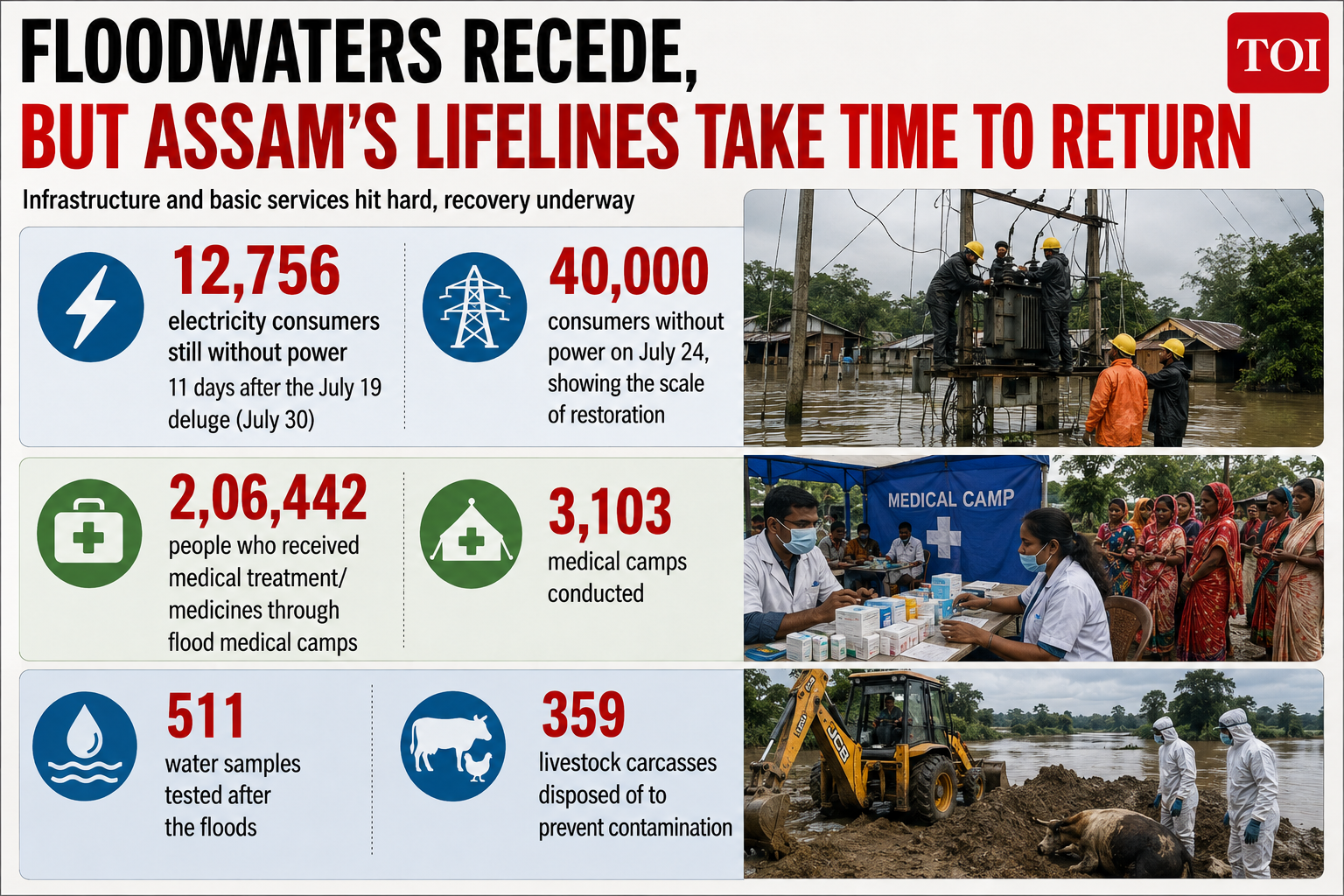
The aftermath is also creating a different kind of health challenge.As floodwaters receded across Upper Assam, the state health department shifted its focus from emergency medical care to preventing outbreaks of water- and vector-borne diseases.Health minister Ashok Singhal said skin diseases had been reported in flood-hit areas, while officials were also monitoring the risk of mosquito-borne infections.The department began deploying doctors from outside affected areas, including medical colleges, from July 21, two days after the flash floods struck.By August 10, 2,06,442 people had received free medical treatment and medicines through 3,103 medical camps in flood-affected areas. On August 10 alone, 116 medical teams treated 2,736 patients at 60 camps.Safe drinking water, however, remained a challenge.The health and public health engineering departments tested 511 water samples at IDSP laboratories. Contaminated sources were disinfected and subsequently tested again.Authorities also disposed of 359 livestock carcasses under prescribed safety protocols to prevent environmental and water contamination.
The power comes back, but not everything does
Electricity restoration has followed a similar pattern.Nearly 13,000 households in flood-hit areas were still without power 11 days after the July 19 deluge, according to an Assam Power Distribution Company Ltd report shared by the chief minister.The affected areas included Gaurisagar, Sivasagar, Nazira, Amguri and Demow.The number had fallen sharply from around 40,000 households without electricity on July 24, but restoration could not simply be treated as a switch being turned back on.Authorities had to assess whether inundated areas and transformers were safe before reconnecting consumers.The disruption went beyond the loss of electricity itself. For many households, a power cut also meant losing access to water because electric pumps are used to draw water from tanks.
The basics that haven’t come back yet
Gonggi, a native of Assam, said their own neighbourhood was largely spared, but several other parts of the city were badly affected.“There was no electricity during the floods, and without electricity there was no access to water, as water is drawn from tanks. When such situations happen, there is a shortage of drinking water, which is why NGOs work so hard to distribute food and other basic supplies,” she said.In affected homes, the damage extended from walls and furniture to refrigerators, washing machines and other electrical appliances, Gonggi said.Some families living in multi-storey houses moved to upper floors as floodwaters entered the lower levels, while damaged roads and vehicle engines made travelling difficult.“Even if there is no problem getting out of the house, the problem is on the main road. Roads get blocked, vehicle engines become difficult to start and people have to find alternative routes or travel on foot,” she said.
The compensation question
For the government, the next challenge is ensuring that the damage assessment translates into actual assistance.Chief minister Himanta Biswa Sarma said the second phase of the rapid damage assessment in Charaideo, Sivasagar, Jorhat and Golaghat would be completed around September 10 or 11. If complaints arise, a third round of assessment could also be conducted.The government has set a target of releasing flood-damage assistance to affected families before Durga Puja.The latest assessment has estimated damage at around Rs 480 crore, with 26,681 houses affected in the four districts, Sarma said.The state has also said it will try to expedite construction of PMAY houses for eligible beneficiaries in Charaideo and Sivasagar after consultations with the Centre.That makes the assessment process crucial for families waiting to rebuild.A house that appears partially damaged can mean lost flooring, electrical fittings, furniture, appliances and stored grain. A completely destroyed house represents an even larger loss.For families living through the aftermath, therefore, the question is not simply how much damage the flood caused on paper, but how much assistance will reach them and how soon?
Assam’s old problem, a new bill
The latest floods have also revived a problem Assam has grappled with for decades.According to the Assam Water Resources Department, 31.05 lakh hectares, about 39.58% of the state’s total area, have been assessed as flood-prone. The department says the average annual area affected by floods is around 9.31 lakh hectares.The state also faces a parallel erosion crisis. The water resources department says more than 4.27 lakh hectares of land has been eroded by the Brahmaputra and its tributaries since 1950, with the average annual loss estimated at nearly 8,000 hectares.These are long-term figures, but they help explain why recovery from one flood cannot be separated from Assam’s larger struggle with flooding and erosion.The state government has increasingly spoken about the need for longer-term solutions alongside immediate relief.During his visits to erosion-hit areas, Sarma announced that IIT Guwahati experts would be engaged to work on solutions to Brahmaputra erosion.The government has also indicated that greater attention needs to be given to tributaries such as the Dikhow, Dhansiri and Dorika, which contributed significantly to the latest devastation.
What does rebuilding actually mean?
For a family whose house has been damaged, rebuilding is not simply about putting up another structure.It means replacing the grain that was supposed to last months. Finding money for furniture. Repairing or replacing electrical appliances. Restoring farmland. Sending children back to school. Finding temporary accommodation until a house is habitable.For farmers, it can also mean finding money for the next cultivation cycle after losing the previous one.The government has begun distributing seedlings and setting up community paddy nurseries in affected areas, with agriculture minister Pijush Hazarika reviewing rehabilitation measures in Charaideo.The urgency is straightforward: if a farmer loses a crop, the loss does not end when the water recedes. The same is true for households whose stored grain was destroyed.A flood can thus create a chain of losses: food stocks disappear, homes are damaged, livelihoods are interrupted and savings are spent on recovery.The water may leave quickly. The financial consequences can last for months.
The flood after the flood
Assam’s latest deluge killed more than a hundred people and affected lakhs at different stages. The immediate emergency has now eased, but the recovery bill, for homes, crops, infrastructure and livelihoods, is still being counted.The state government is undertaking damage assessments, releasing initial assistance and exploring housing and rehabilitation measures. Health teams are monitoring disease risks, power is being restored and damaged infrastructure is being repaired.But for those who lost almost everything, recovery cannot be measured only by falling water levels or the number of relief camps being closed.It will be measured by whether a family can move out of a rented room and back into a safe house. Whether a farmer can plant again. Whether children can reach school without crossing a swollen river. Whether a household can replace the food and belongings it lost without sinking further into debt.The flood may have receded. For thousands of families, the rebuilding has only just begun.