









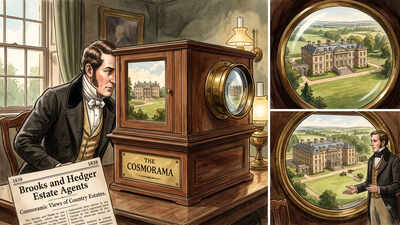
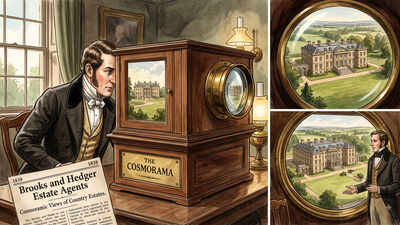
Decades ago, rich homebuyers viewed properties through a certain lens. In the 1830s, London estate agents used a technology called the cosmorama to give wealthy buyers a form of “virtual walkthrough” of mansions and country estates. A new study published in the journal Early Popular Visual Culture found evidence that the technology was being used for commercial real estate listings as early as 1838.The cosmorama allowed prospective buyers to view magnified and illuminated paintings of properties and their surrounding grounds through a lens. Estate agents Brooks and Hedger, later known as Brooks and Green, advertised these cosmoramic views as a way for buyers to inspect distant properties without immediately travelling to them.“Its great advantages over mere verbal description, is that a purchaser, intent on visiting a distant property may thus enjoy the advantage of having it brought, as it were, within his view, or of selecting for inspection from amongst many, that which best suits his taste and fortune,” one newspaper advertisement said.
Why cosmorama technology worked for real estate
Cosmoramas emerged in Paris in 1808 and became more widely used during the 1820s. The displays typically consisted of detailed paintings that viewers examined through magnifying lenses. The lens altered how the images appeared, creating a sense of depth and allowing viewers to see distant locations in greater detail.The technology was primarily used for visual entertainment. People could use cosmoramas to view scenes of cities, landscapes and places far from their homes. The format offered a way to see locations that many viewers would otherwise have been unable to visit.John Plunkett, a professor at the University of Exeter and co-author of the study, was researching 19th-century English cosmoramas when he found a newspaper advertisement from Brooks and Hedger dated to 1838. The estate agency said it offered cosmoramic views of properties available for sale.The advertisements described views showing mansions and their surrounding estates from a bird’s-eye perspective. Creating the images required artists to visit the properties and paint the scenes by hand before they could be displayed through the cosmorama.Brooks and Hedger continued offering the service for nearly two decades, with most of the advertisements found by Plunkett dating from the 1840s. One advertisement described a property view as showing the mansion and estate with “all the vividness and truth of nature.”Because producing each image required considerable work, the service was aimed at expensive properties and country estates.
How real estate agents used cosmoramas
The use of cosmoramas for property sales coincided with changes in the 19th-century real estate market. Population growth and urbanisation increased demand for property, while improvements in transport made it easier for people to travel between locations.The emergence of specialised estate agents also changed how properties were marketed. Instead of relying only on written descriptions, agents could use visual material to show prospective buyers what a distant property looked like.Plunkett said the commercial use of cosmoramas showed how the technology could be adapted beyond entertainment.“What we’ve discovered through this latest research project, however, is that its use extended beyond simple entertainment: the appeal of cosmoramas was that they sold an experience of virtual travel,” Plunkett said in a statement. “This was utilised by estate agents seeking to sell luxury properties and country estates.”The property advertisements therefore provided an early example of estate agents using visual technology to let prospective buyers examine properties remotely. The approach predates modern online listings, panoramic images and virtual reality tours by more than a century.“But the founding of the first specialised estate agents set in motion a more professional approach to marketing property, fuelled by population growth, urbanisation and improved transport links,” Plunkett added. “In that context, we can see how Brooks and Green pioneered the virtual tour, over 150 years before digital technology would fully realise this potential.”