








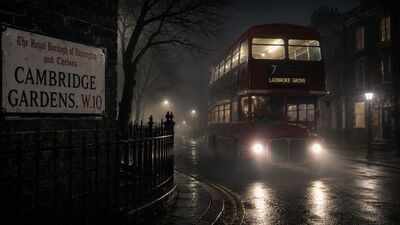
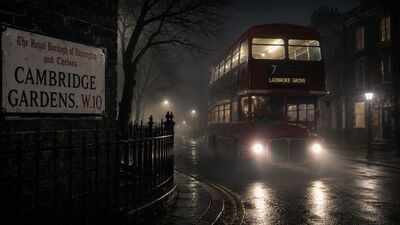
Imagine driving through North Kensington in the early hours of the morning when a red double-decker suddenly appears ahead of you. It seems to be travelling towards your car at speed. You look for the driver — but there appears to be nobody behind the wheel. You look upstairs and downstairs. There are no passengers. Then, just as suddenly as it appeared, the bus disappears. It sounds like something from a horror film. But for decades, a remarkably similar tale has been attached to a real stretch of road in North Kensington, West London.The legend concerns a phantom Number 7 bus said to appear around the junction of Cambridge Gardens and St Mark’s Road, near Ladbroke Grove. According to popular legend, the brightly lit double-decker would appear late at night, apparently travelling towards motorists, before vanishing without explanation. The story is old enough to have been discussed in newspapers in the 1930s and strange enough to have survived in London’s folklore for generations.But there is an important question at the heart of the story: was there ever a ghost bus at all? The answer becomes more complicated when the legend is compared with the historical record.A real road, a real crash and a ghost story The most famous event associated with the legend was a fatal road accident in 1934. On June 12 that year, 25-year-old Beaton was involved in a collision at the junction of Cambridge Gardens and St Mark’s Road. His small car collided with a Rolls-Royce driven by chauffeur George Pink. The crash was serious. Beaton died, while his passenger, Margaret Sim, was injured. Contemporary accounts described the car travelling in a zigzag course before overturning and catching fire. An inquest followed, and the jury returned a verdict of accidental death, with Pink exonerated. The accident is therefore a matter of historical record. Later versions of the story often claim that Beaton swerved to avoid a phantom Number 7 bus before crashing.There is no solid contemporary evidence establishing that this happened. Instead, the surviving accounts suggest that the phantom-bus story was already circulating locally before the fatal accident. The 1934 crash appears to have brought the strange tale into greater public attention.
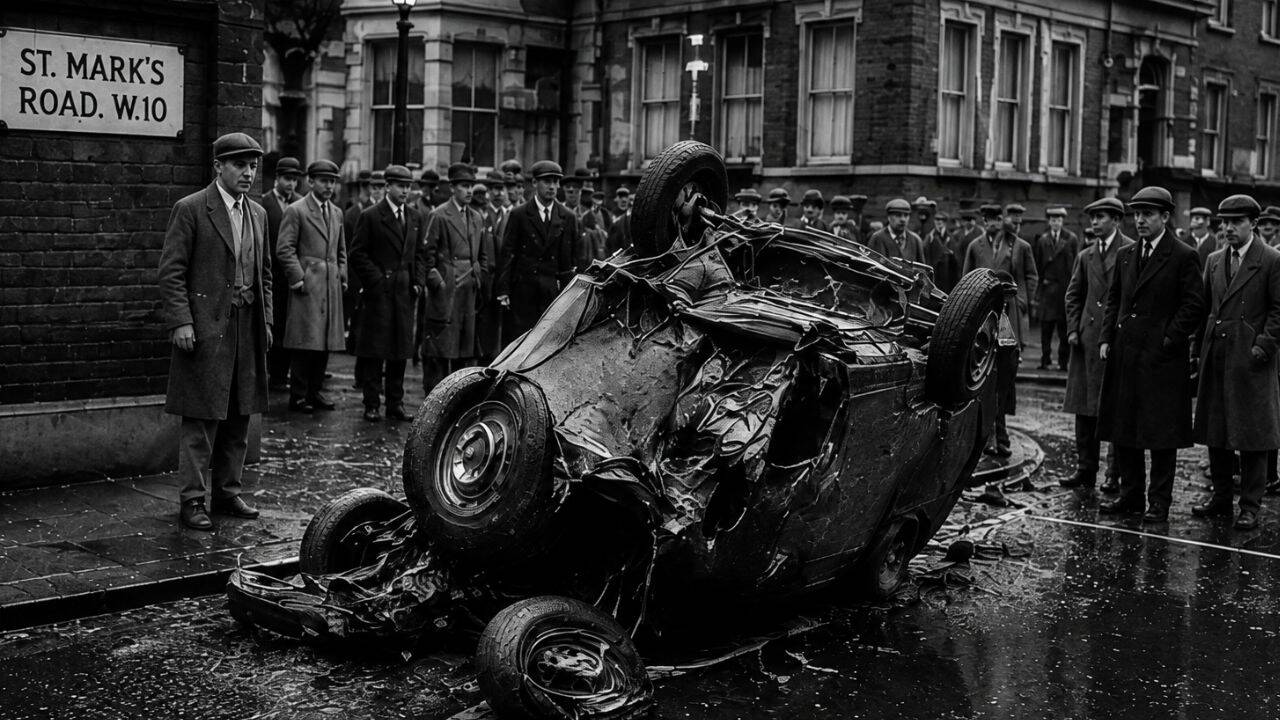
The 1934 crash
The ghost bus was already part of local folkloreResearch by historian and paranormal researcher Jonathan Miles suggests that the phantom-bus story may have originated around 1931 or 1932, several years before the fatal collision. One version of the earlier story involved a woman asking a bus conductor which bus she should take. The conductor allegedly directed her towards another bus. When she approached it, however, the mysterious vehicle was said to have disappeared. The story then appears to have circulated and changed through retelling. That makes the 1934 accident particularly interesting. Rather than a ghost story being invented to explain a mysterious crash, an existing local legend became associated with a real tragedy that happened at the same location.What did people supposedly see?Descriptions of the phantom bus have remained remarkably consistent in later accounts. It was generally described as a double-decker bus, often identified as a Number 7. The vehicle was said to appear late at night, after normal bus services had ended. Its lights were supposedly blazing, but the bus appeared to have no visible driver, conductor or passengers. One contemporary newspaper account, later reproduced by researchers, contains a particularly revealing detail. A local woman reportedly said that she herself had never seen the phantom bus and had never met anyone who had seen it. She had, however, heard stories that on some nights residents could hear the roar of a bus and see a brilliantly lit double-decker without anyone inside.That distinction matters.It suggests that even while the story was circulating in the 1930s, some people were aware that they were dealing with something they had heard about, rather than something they had personally witnessed. In other words, the legend was already becoming folklore.Why a Number 7?The use of a real London bus number helped make the story sound convincing. There was — and still is — a London bus route numbered 7, and the route has served the broader North Kensington area. Modern route information also places the Number 7 around the Cambridge Gardens and Ladbroke Grove area.However, this needs a historical qualification. The existence of today’s Number 7 route does not prove that the bus followed exactly the same route in 1934. Transport routes changed over time, and researchers have questioned some later claims about the precise historical route of the Number 7. That makes the bus number an intriguing part of the legend, but not proof that a real Number 7 was operating at the exact location and time described by later versions of the story. A real bus number, a real London road and a real transport network gave the story a believable setting. The supernatural element came from the details that could not be explained.The mysterious 1:15am appearanceOne of the most frequently repeated details in modern accounts is the time 1:15am. According to later versions of the legend, this was when the phantom Number 7 appeared.It is a wonderfully cinematic detail. The ghost seems to have its own timetable almost like an ordinary London bus, except that this one has no passengers, no driver and apparently no destination. But there is a problem. Research into the earliest newspaper accounts suggests that the 1:15am detail is not securely established in the original evidence. Miles has argued that this and other precise details were added or became established through later retellings.That is an important lesson in how ghost stories evolve. A story initially described simply as occurring “late at night” can gradually become “after midnight” and eventually “at exactly 1:15am”. The additional precision can make a story sound more authentic, even though the detail may have appeared much later.Was the junction unusually dangerous?There may have been a very ordinary reason why the location became associated with strange stories.The junction had a history of road accidents, and contemporary research into newspaper reports suggests that the area could be difficult for motorists to navigate. A later 1937 newspaper report quoted a local garage attendant describing motorists using Cambridge Gardens as a shortcut and some cars travelling at very high speeds. The geography of the road, traffic, darkness and speed could all have contributed to accidents. A dangerous junction is precisely the sort of place where a mysterious local story can take root. A sudden pair of headlights, a vehicle appearing unexpectedly around a bend or a fleeting glimpse of a bus in poor visibility could potentially be interpreted through an existing legend. Once people believe that a ghost bus appears at a particular corner, they may also become more likely to interpret an unexplained sight as that bus. One person’s story becomes another person’s expectation.Did Beaton see the phantom bus?This is where the popular version of the story goes too far. Some modern accounts say that Beaton was driving when he saw the phantom Number 7, swerved to avoid it and crashed. But the available evidence does not establish this sequence of events. The official inquest verdict was accidental death. Contemporary testimony dealt with the circumstances of the collision, but it did not establish the existence of a supernatural bus as its cause. The fact that the ghost-bus legend was discussed around the time of the inquest does not mean the coroner or jury accepted the apparition as a real explanation.
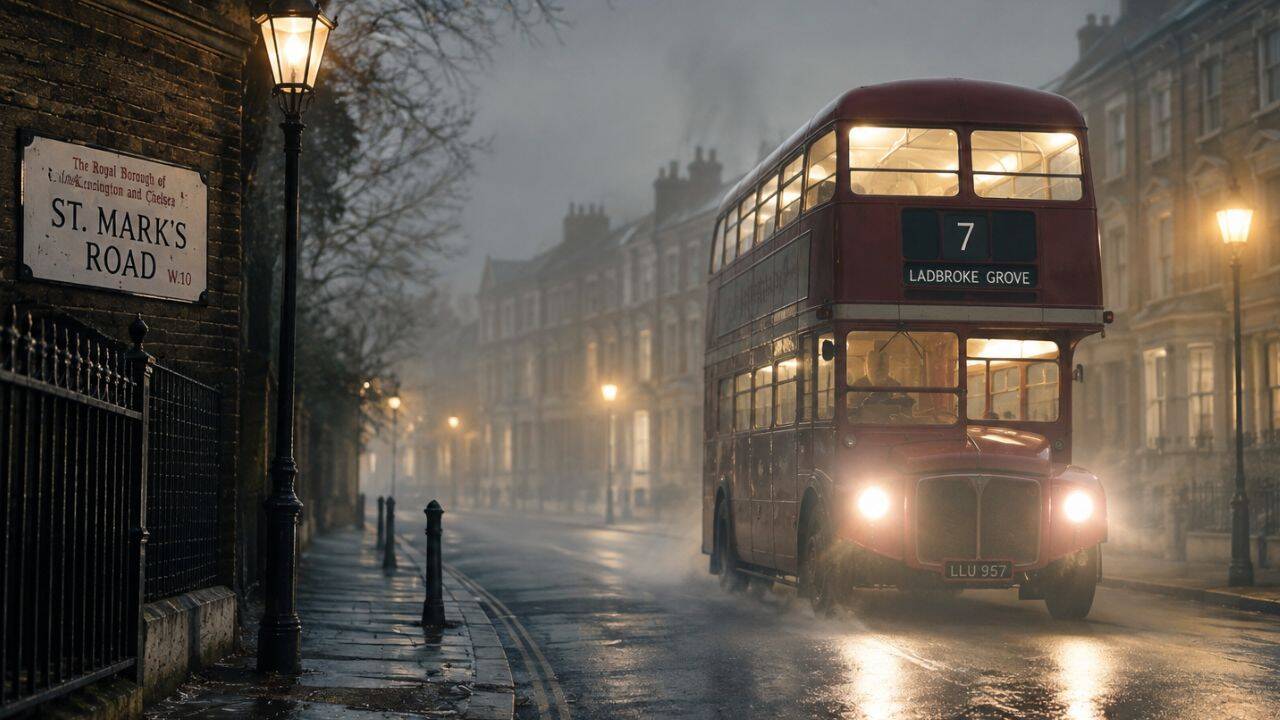
Th phantom bus
What about later sightings?The legend did not disappear completely.Later accounts have continued to describe alleged sightings of a phantom bus in the area, including claims dating as recently as the late 20th century. However, these reports are generally difficult to independently verify. Many alleged sightings are based on people reporting what they heard from friends, relatives or other residents rather than on independently documented eyewitness evidence.And over the decades, later writers and storytellers added details that became part of the popular version of the legend -including the precise 1:15am appearance and claims about the road being altered. The result is a classic urban legend: a mixture of documented history, local memory, hearsay and increasingly elaborate retelling.Perhaps that is what makes London’s ghost bus so enduring. You do not have to believe that a phantom double-decker once raced through North Kensington to find the story fascinating.