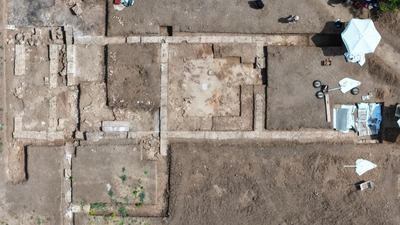





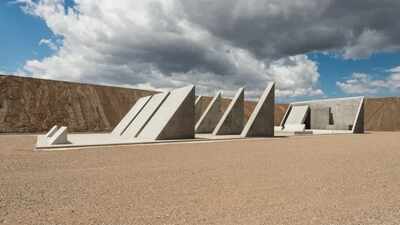
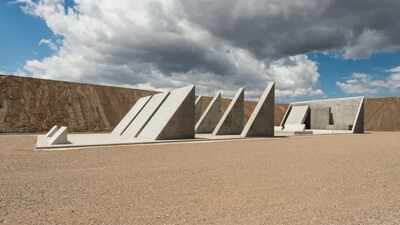
For half a century, Michael Heizer, a perfectionist, or maybe an obsessive, worked on a city that had no residents, no roads lined with traffic, and no buildings meant to house anyone. His vision for art didn’t fit galleries, so he wandered out into the middle of nowhere and started making his own landscape. In the remote Nevada desert, the American artist reshaped earth, rock, and concrete into a vast landscape of mounds, trenches, walls, and geometric structures.As The Art Newspaper details, in the early 1970s, he found a wide, empty stretch of Nevada desert and started moving the earth itself. He called his project “City.” On the surface, “City” sounds like a straightforward name, but what Heizer built was anything but ordinary: it’s a concrete-and-dirt wonderland roughly a mile and a half long, half a mile wide, and almost impossible to take in at once. It’s been called one of the largest works of contemporary art in the world.But for most of its fifty-year construction, almost nobody saw it.According to Dia Art Foundation, Heizer grew up in the shadow of history, thanks to a father who studied ancient civilizations and Native American cultures. The artist traveled through Peru, Mexico, and Egypt as a young man, soaking up the grandeur and silence of massive ancient sites. When he started making art, he turned away from the white-walled world of museums. Instead, he dug into the earth itself, helping lead the Land Art movement with pieces like “Double Negative,” where he literally cut two vast trenches into a cliff in Nevada, removing hundreds of thousands of tons of rock.But “Double Negative” was a warm-up. The idea for “City” arrived around 1970 and kept growing, both in ambition and in physical size. Over five decades, he shaped mounds, dug trenches, built concrete walls, and laid out geometric forms — all so enormous they blur the line between art and landscape. Standing in the middle, the piece seems ancient and futuristic at the same time, like stumbling onto a forgotten ruin or a crash-landed city.Heizer never let “City” become easy to reach. It sits in Garden Valley, miles from anything resembling convenience. For decades, only a handful of people, like other artists, writers, and the rare journalist, could get permission to visit. The rest of the world glimpsed it through grainy photos and rumors. Heizer seemed to enjoy the secrecy, almost as much as the construction itself. And when “City” finally opened to public visits in 2022, entry stayed tightly controlled. This wasn’t an attraction meant for quick selfies and bus tours. Visitors had to make the journey, face the silence, feel the scale.Inside a museum, you can walk around a sculpture, read the sign, and move on. But you can’t rush City. The desert keeps the piece at arm’s length. The heat, sky, and emptiness become part of the work. The landscape makes every visitor reckon with the sheer weirdness and ambition of turning so much land into, well, not much of anything; at least in the usual, practical sense.Also read:Talent Opens the Door, Practice Builds Excellence: Gauranga Das Prabhu on Vaibhav SuryavanshiDon’t throw away broken glass jars: 6 smart ways to reuse them at homeCity isn’t a city, not really. There are no streets, no houses, no markets; just monumental forms that might look like collapsed factories or half-excavated temples. You get the feeling of walking through a lost civilization or a movie set for some far-off future, but nothing is spelled out. Heizer resists tidy explanations. He wants the desert to swallow you up a little, for the meaning to stay ambiguous.Per The Guardian, art critics have called City a masterpiece of Land Art, connecting it to the ancient urge to shape the earth, to build monuments that point beyond their own use. City is a monument to effort, to stubbornness, to the strange American ambition that says, “Why not?” Heizer and the other land artists of the late 20th century pushed back against art made easy: they wanted to see what happened if you took art out of the marketplace, away from comfort, and just left it in the wild.After five decades and so much work, you might expect City to be about grand statements. But really, it’s an experiment in letting art disappear into the world, asking people to slow down, to pay attention, and to accept that not everything needs to be useful. In an age when everything gets tweeted, tagged, reviewed, and forgotten in minutes, City is the opposite: inconvenient, silent, demanding, and somehow enduring.And maybe that matters more than ever now.