









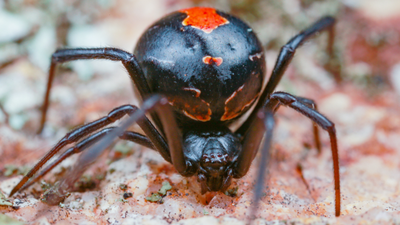
Male Australian redback spiders perform an acrobatic somersault during mating that sends their abdomen directly toward the female’s fangs. Scientists have now found that this deadly self-sacrifice behavior comes from a surprisingly simple genetic region.In a study led by Kardelen Özgün Uludağ and published in Biology Letters, researchers found that although the movement is physically complex, the male’s tendency to throw itself toward the female’s jaws is controlled by a single gene region on the X chromosome.The discovery challenges the long-held idea that complex physical and behavioral traits must always depend on many interacting genes.
Self-sacrifice brings reproductive benefits
The Australian redback spider (Latrodectus hasselti), a close relative of the North American black widow, is well known for extreme sexual cannibalism.During mating, the male performs an acrobatic somersault and places its vulnerable abdomen directly over the female’s mouthparts. The male is often eaten, but this apparent self-sacrifice has an evolutionary benefit. It can extend mating and increase the number of offspring the male fathers.Some male redbacks also have another physical trait called abdominal narrowing during mating. This narrowing makes it harder for the female to bite the abdomen right away. It delays the male’s death long enough for him to complete a second transfer of sperm.To understand how these different traits are inherited, researchers studied a closely related species from New Zealand, the katipo spider (Latrodectus katipo). Katipo males do not perform the self-sacrificing somersault or develop abdominal narrowing, and katipo females do not eat males during mating.When redback males mate with katipo females, however, the males still perform their usual somersault, even though the females do not attack them.As the researchers explain, this behavior suggests that both the male somersault and female cannibalism in redbacks have a genetic basis.
Hybrid breeding reveals a chromosome link
To understand how these mating traits are inherited, the researchers carried out controlled breeding experiments between Australian redbacks and New Zealand katipos.The first-generation hybrid males did not perform the somersault at all. This showed that the genetic trait behind the behavior is recessive.The researchers then bred hybrid females back with purebred males from both species. They raised and filmed 104 male offspring during live mating trials.By recording which males performed the somersault, developed abdominal narrowing, or showed both traits, the researchers were able to study how the traits were passed from parents to offspring.The results matched the pattern expected from a single gene or genetic region located on the X chromosome.
The two traits are inherited separately
The breeding experiment also showed that the somersault and abdominal narrowing are not controlled by the same genetic package.About half of the backcrossed male offspring showed only one of the two traits. This showed that the traits can separate and are inherited independently.Unlike the somersault, abdominal narrowing did not follow a simple X-linked or single-gene pattern. This suggests that the physical trait is controlled by several genes and may also be influenced by environmental factors.The researchers concluded that the two mating traits are not closely linked to one “supergene.” Because the traits separated so often, they must be controlled by two unlinked genetic regions. These regions could be far apart on the same chromosome or located on different chromosomes.
Rapid evolution across the Tasman Sea
Genetic evidence suggests that Australian redbacks and New Zealand katipo spiders split from a common ancestor about 100,000 years ago. In evolutionary terms, this is a very short period.Sex chromosomes can evolve faster than other chromosomes because they have smaller effective populations. This may help explain how such major differences in mating behavior developed in a relatively short time.The researchers suggest that the male self-sacrificing behavior was lost in most other Latrodectus species and later appeared again in Australian L. hasselti. They propose that New Zealand was colonized by redbacks from Australia, after which L. katipo evolved and lost the extreme mating traits.The study shows that even highly complex behaviors can have a simple genetic foundation. The researchers say that future genetic studies of the two species and their hybrids could identify the specific genes responsible for their very different mating behaviors.