



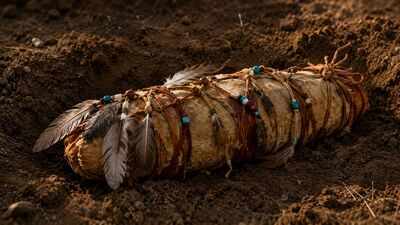
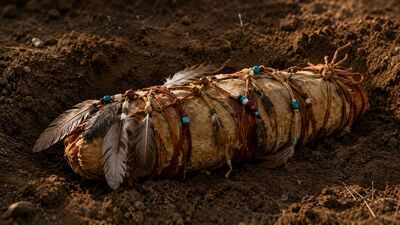
For decades, a small piece of Crazy Horse’s history may have been sitting beneath the ground in Minatare, Nebraska, with no marker to identify it. The object was not a weapon or a famous portrait of the Oglala Lakota leader. It was his medicine bundle, a private collection of sacred belongings that was treated with great care by the people who inherited responsibility for it. The bundle was eventually buried about six feet underground in 1942, when the Second World War made its owners uncertain about what lay ahead. Years later, the family returned to find that Minatare had changed so much that the hiding place could no longer be identified.
Why Crazy Horse entrusted his medicine bundle to Fast Thunder before 1877
The story begins shortly before Crazy Horse died in 1877. According to historian Thomas Powers, the Oglala leader entrusted his medicine bundle to his close friend Fast Thunder. After Crazy Horse was killed, Fast Thunder carried the bundle to the newly established Pine Ridge Reservation, where it remained within the family rather than becoming a public relic. Fast Thunder died in 1914. His wife, Jennie Wounded Horse, continued to protect the bundle and eventually placed it in the care of Nellie Ghost Dog. From there it passed to Theodore Means, Fast Thunder’s grandson. The chain of custody stretched across roughly six and a half decades, with the bundle remaining a private possession rather than something displayed or discussed openly. Medicine bundles are packages containing items considered sacred by their owners, potentially including stones, herbs, beads or hair.That privacy matters to the story. The bundle was not simply an old object associated with a famous historical figure. It had been entrusted to particular people, and its meaning was tied to Lakota traditions and family responsibility.
How Theodore Means hid the Crazy Horse medicine bundle six feet underground
During the 1930s, Oglala Lakota workers travelled from Pine Ridge to the North Platte Valley for seasonal agricultural jobs. Theodore Means was among those who found work in Minatare, where people came to pick potatoes. Then the Second World War changed the circumstances around the annual migration.In the autumn of 1942, Means decided the bundle needed to be hidden. He buried it in Minatare, roughly six feet below the ground, intending to protect it while he was away. The following year, he joined the army and went to war. The location was remembered using the landscape around it. A large cottonwood tree served as an important landmark. That might have seemed sufficient at the time. But the people who buried the bundle could not have known how dramatically the area would change over the following decades.The Nebraska History records the later account of the burial and the family’s attempt to recover it. The original Nebraska History article, “The Crazy Horse Medicine Bundle”, was written by Thomas Powers and appeared in volume 95 of the publication in 2014.
How changes in Minatare made the Crazy Horse medicine bundle impossible to locate
Theodore Means died in the early 1960s. Several years later, in 1968 or 1969, his wife Theresa returned to Minatare to search for the place where the bundle had been buried. It was no longer the same landscape. According to the Nebraska State Historical Society, many of the enormous cottonwood trees had been removed. Roads had also changed as cars became more common, altering parts of the town and its surroundings. The landmarks that had once made the burial place recognisable were gone, leaving Theresa unable to determine exactly where the bundle had been placed. That is how a possession that had been carefully handed down from one person to another became lost.There is no known modern marker identifying the spot. History Nebraska describes the bundle as being “six feet deep somewhere in Minatare, Nebraska”, making the location an unresolved part of the story rather than a confirmed archaeological site.
Why the family never identified the contents of the Crazy Horse medicine bundle
The contents were never properly identified. That uncertainty is one of the most striking parts of the story. A medicine bundle could contain objects regarded as sacred or powerful by its owner. But what Crazy Horse himself placed inside his bundle is not established by the surviving account. The family apparently did not recover the contents before the bundle was buried again. Powers’s account adds a more unusual detail. According to the family story, when the bundle was opened before burial, those present heard a sudden disturbance of owls outside the tent. In Lakota tradition, owls could be understood as warnings associated with death. The family became frightened and stopped opening the bundle, wrapping it again before putting it into the ground.That episode belongs to an oral family account rather than something that can be independently verified as an event. It is therefore best understood as part of the story preserved by the family, not as evidence that the bundle contained any particular object. The official Nebraska History account itself ends with the uncertainty. It says that the bundle may have remained a mystery by design and quotes Powers describing the lost bundle as a division “between the things that are lost and the things that survive.”
How Crazy Horse’s lost medicine bundle differs from the famous Crazy Horse Memorial
The lost bundle is sometimes easily confused with the much larger public story surrounding Crazy Horse’s name in the Black Hills of South Dakota. The Crazy Horse Memorial, begun in 1948, is an enormous mountainside sculpture honouring the Lakota leader. Its origins go back to Lakota elder Henry Standing Bear, who approached sculptor Korczak Ziolkowski with the idea of creating a monument to Native American leaders. The project remains unfinished. A separate source discussing the memorial notes that the planned carving is intended to become one of the largest sculptures in the world. But the two stories point in almost opposite directions. The memorial is a public representation of Crazy Horse, while the medicine bundle was kept private and passed quietly through family hands.That distinction is important because Crazy Horse himself has long been associated with an absence of confirmed photographic portraits. The separate account supplied for this article notes that he avoided photographers and that the location of his burial was also kept undisclosed. The medicine bundle fits into that broader pattern of an individual whose history contains deliberate silences. A public monument can preserve a name and an image. A hidden bundle preserves something else: an object that was never intended to become a public display.