








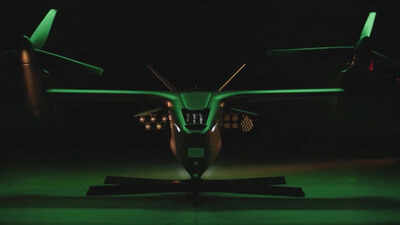
As technology leapfrogs and resets the boundaries of understanding, it moves from one milestone to another, with almost nothing left unchanged. These changes are visible in the realm of combat. One of these changes has been on display at the ongoing Farnborough Airshow, being held in the UK. At the premier global aviation event, US-based Anduril Industries has once again moved the lines of what can be.Anduril unveiled its autonomous attack rotorcraft Thunder, a Group 5 vertical take-off and landing aircraft developed with Archer Aviation. This unmanned system is designed as a drone wingman for current and future attack helicopters. This is the first rotary-winged unmanned wingman Combat Collaborative Aircraft (CCA).
Built with a hybrid-electric powertrain and tilt rotors, the aircraft is intended to operate alongside rotary platforms such as the Apache and Cheyenne II. The proliferation of drones and loitering munitions has made the near-surface domain increasingly lethal, placing attack helicopters and their crews at risk. Thunder, in development since 2024, is positioned as a solution to fight alongside crewed aircraft or independently across missions.The mission suite of Thunder is extensive, ranging from long-range strike and fire support to ISR, maritime patrol, anti-submarine warfare, search and rescue, and contested logistics. Its modular payload bays allow for a wide range of armaments, including precision munitions, electronic warfare payloads, rockets, air-launched effects (loitering munitions) and counter-drone systems. Configurable loadouts could see a single Thunder carrying 10 air-to-ground missiles, 16 launched effects or 76 70mm rockets, alongside counter-UAS munitions.Teaming multiple Thunder aircraft with a single-crewed platform would multiply combat mass, enabling formations to defeat more targets, sustain operations longer and keep human crews away from lethal threats. The unmanned aircraft will operate using Anduril’s Lattice for Mission Autonomy software, which manages flight formations and safety separation without pilot input, freeing crews to focus on more critical tasks. The system is also designed for ease of transport, fitting into a standard shipping container, which would improve its combat deployment across theatres. The first flight of this concept unmanned helicopter is targeted for 2027.India has also advanced its indigenous unmanned systems, with the Varun Mk I Naval Shipborne UAS developed for maritime domain awareness and Command, Control, Communications, Computers, Intelligence, Surveillance, and Reconnaissance (C4ISR) duties. Deployable from a ship’s flight deck and recoverable even in challenging sea states, Varun Mk I is designed for surveillance, reconnaissance, signal intelligence, target acquisition and building situational awareness around task groups. Secondary roles include anti-piracy and counter-terrorism operations.The system reflects India’s push to strengthen naval capabilities through indigenous unmanned platforms, which will complement manned assets. Both parallel developments highlight how unmanned rotary systems are likely to increasingly become central to modern warfare, offering flexibility, persistence and reduced risk to human crew.