






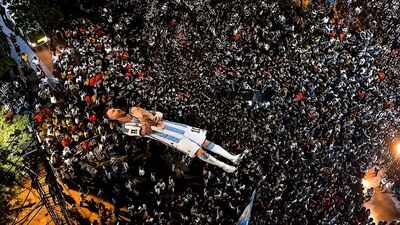
It’s left now to Argentina and Spain to fight it out for the football’s greatest prize, the rest have all bowed out of the game’s biggest stage. But in Kolhapur, Portuguese star Cristiano Ronaldo still watches over a traffic junction, and Brazil’s talisman Neymar Jr towers above a neighbourhood awash in yellow and green. Lionel Messi is there, too, presiding over a busy crossroads.The city of the Mahalakshmi Temple in central Maharashtra chooses a different set of gods for the football World Cup. Made of iron frames and printed flex, they rise 45ft above roads and markets. Between 12 and 16 of these giants dot Kolhapur’s skyline — an improbable sight in a country that lives and breathes cricket. “The posters announce that Kolhapur is football-crazy in a cricketcrazy nation,” says Vikas Patil, a former player. Adds Shivtej Kharade, the manager of the 92-year-old Shivaji Tarun Mandal, a football club: “There is no gully cricket here. There is gully football.”
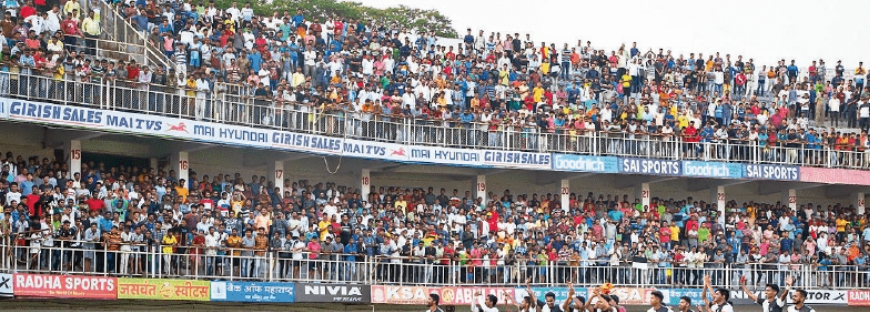
A packed Chhatrapati Shahu stadium in Kolhapur for a district-level game.
“When a child is born, we don’t put a cricket bat near him; we put a football at his feet,” Kharade says. His five-year-old son is already kicking a ball around.Royal Roots, Polish InfluenceFootball’s roots here go back to the early 20th century. Locals trace its arrival toChhatrapati Rajaram Maharaj, who is believed to have promoted it after returning from England around 1910. The Kolhapur Sports Association (KSA), which still runs the district leagues, was established in 1940 under the patronage of Chhatrapati Rajaram and Rajarshi Chhatrapati Shahu Maharaj.During World War 2, Polish refugees housed near Kolhapur played local footballers in matches encouraged by the royals. Older administrators say the Poles introduced passing and technique to the city’s players, who mostly relied on strength. Shivaji Tarun Mandal famously defeated a visiting Polish team, aresult still recalled with pride.The KSA now oversees 16 clubs each in the A and B Divisions and around 80 in the C Division. Practice Football Club, founded in 1927, is among the oldest. Register secretary Ramesh More’s grandfather was a founder and played through the 1940s and 1950s.Practice spends around Rs 15 lakh annually, largely from public donations. More puts in over Rs 2 lakh. Across Kolhapur, A Division clubs’ collective spend runs into a few crores annually – money that’s raised almost entirely without corporate sponsorship.“We don’t get sponsors like clubsoutside,” Kharade says. “We go to the public. We go to politicians. We adopt players. That’s how our club survives.”His club, founded in 1933, spends at least Rs 60,000 annually on each player and often helps them find jobs. “Earlier, it was emotional. Now, there is business in football. Boys don’t play unless they’re paid… their families depend on that income.”When The World Cup ComesThere is no official fan festival. Neighbourhood clubs and volunteers collect donations, design banners and organise screenings. Kolhapur also celebrates its own just as loudly. Aniket Jadhav was the city’s first player to represent India’s senior national team. When he represented India at the FIFA Under-17 World Cup in 2017, giant cutouts of him appeared across the city. Though born in Kolhapur, he trained in Pune and never actually played club football at home.Abhilash Chavan of AbhiAds, an ad agency, says he made around 25 cutouts this year. He charges roughly Rs 7,000 to print a 40ft Messi or Ronaldo. But Aditya Awale of the Kolhapuri Brazil Fan Club and More put the full cost closer to Rs 40,000 after adding the frame, permissions and rent for public space.“Individual karyakartas (workers) collect donations and organise the cutouts because they love their teams,” More says. However, inflation and the monsoon nearly stopped this year’s spectacle. “We weren’t sure whether we should put it up,” Awale says.Awaiting InvestmentKolhapur has proved it can pull a crowd. It has hosted an international women’s friendly between India and the Netherlands and several I-League matches. The 2013 match drew a packed crowd. In 2023, an estimated 18,000 people watched Maharashtra play Bengal in a Santosh Trophy tie at Chhatrapati Shahu Stadium.But infrastructure has not kept pace. Kolhapur has just one dedicated football stadium — Chhatrapati Shahu Stadium. Its natural grass pitch, Patil says, is a genuine luxury that is rare in Indian football. “There are no professional sponsors. Clubs survive almost entirely on what their own neighbourhoods are willing to hand over,” he says. Yet money has done little to weaken the devotion. Patil describes a tradition in which, during the ceremony held five days after a child is born, some families place a football and a club jersey before the family deity, alongside the customary books — a prayer that the child will one day play for that club.