








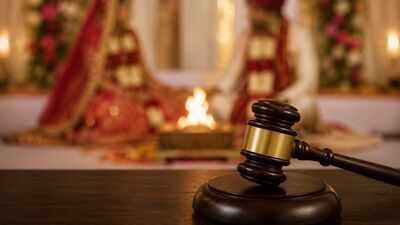
NEW DELHI: A marriage certificate cannot make a Hindu marriage valid if the couple never performed the essential religious rites, including Saptapadi — the seven sacred steps taken around the fire — the Gujarat high court has ruled.A division bench comprising Justices Ilesh J. Vora and R.T. Vachhani held that registration only proves a marriage that has already been properly performed; it cannot create a valid marriage on its own.What was the issueThe case was filed by a man based in the United Kingdom, seeking to have his alleged marriage declared null and void.The man said he came to know of the marriage only when the woman approached his parents with a marriage certificate, claiming to be his lawfully wedded wife.He stated that he never solemnised any marriage, never performed any Hindu rites, and never lived with her as husband and wife, and that his signature on the marriage documents was obtained fraudulently, under pressure of promotion or threat of losing his job, since he worked in her father’s company.In her written statement before the family court, the woman herself admitted that no rites and rituals were performed by the parties, that no lawful marriage was solemnized between them, and that the parties held no relation as husband and wife.Despite this admission, the family court did not cancel the marriage. It said a registered marriage certificate suggests the marriage is valid, so the case needed a full trial to decide the matter.The man then challenged this order in the Gujarat high courtWhat did the court sayThe high court said that under Section 7 of the Hindu Marriage Act, 1955, a marriage is valid only if it is performed with proper customary rites and ceremonies.The court explained that solemnised means the marriage must be carried out in the correct way, with the required ceremonies. Without this, there is no valid Hindu marriage in the eyes of law.The bench then looked at Section 8 of the Act, which deals with registration. It said registration only helps prove that a marriage has already taken place properly — it does not, on its own, make a marriage valid if the essential rites under Section 7 were never performed.Since the woman had already admitted that no rites were performed, the court said this admission was enough to disprove the presumption created by the registered certificate. It added that sending the case for a full trial would serve no real purpose.“When the very foundation of a Hindu marriage, namely the performance of the essential ceremonies, is admittedly absent, the spiritual, social, and legal status that Hindu law grants to marriage as a sacrament and samskara never came into existence,” the court noted.The court further referred to a Supreme Court judgment in Rathnamma & Ors. v. Sujathamma & Ors. , which held that simply registering a marriage is not proof that a marriage actually took place.The high court criticised the family court for assuming that a registered marriage certificate alone was enough to require a full trial, without first checking whether the essential rites under Section 7 were actually performed.“The learned family court ought to have appreciated that when one party makes a clear admission on the foundational fact that no marriage was solemnized, the Court can and should pass a decree on the basis of such admission instead of forcing the parties into a long and unnecessary trial,” the court said.Setting aside the family court’s order, the high court allowed the appeal and declared the marriage null and void from the very beginning, since no rights or responsibilities can arise from it. The man was allowed to approach the authorities to get the marriage registration and certificate cancelled.