






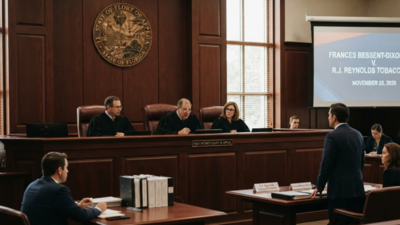
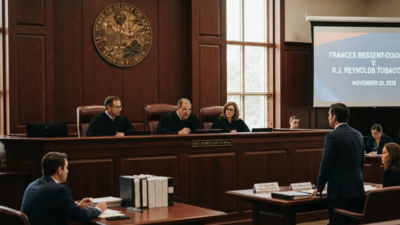
A Florida appeals court overturned key parts of a widow’s lawsuit against tobacco giant R.J. Reynolds, setting aside a fraud verdict and ordering a new trial to decide damages after a jury awarded her nearly $34.7 million over her husband’s death. The First District Court of Appeal ruled on 25 November 2026 that the widow did not show enough proof that her husband relied on the tobacco company’s statements about smoking’s health effects or addictiveness, telling the trial judge to rule for Reynolds on the fraud claims and hold a new trial on compensatory and punitive damages. The case was brought by Frances Bessent-Dixon, both on her own and as personal representative for her late husband, Tyrone M. Dixon, after the first jury awarded $8,975,000 in compensatory damages and another $25,748,176 in punitive damages for a total of $34,723,176.
The jury’s $34.7 million award
The award came after a trial in Alachua County, Florida, where the jury sided with Bessent-Dixon, finding R.J. Reynolds 60 per cent responsible and Dixon 40 per cent responsible with a verdict that included $8.975 million in compensatory damages and $25,748,176 in punitive damages, according to Courtroom View Network, which covered the trial. Courtroom View Network also reported that Tyrone Dixon died of throat cancer after smoking most of his life, with his family arguing R.J. Reynolds hid the dangers of smoking and its ads shaped his choices, while company lawyers argued Dixon knew the risks but did not try to quit. The case has gone through several trials and appeals, including a 2018 jury trial that ended in a mistrial during the punitive damages phase, according to Courtroom View Network. A later verdict was also challenged, and in January 2021, Florida’s First District Court of Appeal overturned that judgment and ordered a new trial because the jury was not properly told that the family had to prove Dixon relied on a false statement by Reynolds for the fraud claim, before the case went back to trial in April 2024 and produced the $34.7 million verdict now under appeal.
Why the appeals court rejected the fraud claims
In its 25 November ruling, the First District Court of Appeal looked at whether Dixon relied on statements from R.J. Reynolds or its predecessors about smoking, explaining that under Florida law, a claim of fraudulent concealment or conspiracy to hide information in this kind of tobacco suit requires proof that the smoker relied on a misleading statement and was harmed by it. The judges agreed Dixon saw plenty of Reynolds ads, noting witnesses said he lived in places where Kool and Newport cigarette promotions were common, collected branded clothes, clipped coupons, joined two promotions, and switched to Newport cigarettes after seeing ads in corner shops. The widow’s expert witness, epidemiologist Dr. Michael Cummings, testified about the company’s targeted ads and said Dixon’s smoking habits matched the advertising, which the trial court relied on along with Dixon’s ongoing smoking and his remarks to his wife that there was “nothing wrong with smoking”. Yet the appeals court said seeing ads did not, by itself, prove Dixon believed a specific statement about smoking and acted on it, stating the proof needed to link a specific company statement to his beliefs and choices.The court noted every fact witness testified that Dixon never tied his smoking choices or beliefs to tobacco company statements or ads, one witness remembered he mocked cigarette ads, and proof also showed he started smoking because he thought it was “cool” and had seen his parents smoke. His choice of menthol cigarettes was tied to their taste and his belief that menthol went easier on his throat, and even though he told his wife there was “nothing wrong with smoking”, the court said the proof did not show when he said it, what prompted it, or how he formed that belief. The judges also looked at Dr. Cummings’ testimony that tobacco companies helped spread doubt about smoking’s health risks, saying that did not prove Dixon received, believed, and acted on a statement made by Reynolds. The ruling said the jury would have had to make several assumptions to hold the company responsible for Dixon’s beliefs and continued smoking, and finding the proof did not back those conclusions, ruled the fraud claims should not have gone to the jury.
Dispute over race-targeted advertising evidence
R.J. Reynolds also challenged the use of proof and arguments about its ads aimed at specific racial groups, arguing the trial court wrongly let the jury see this material. The appeals court did not decide if the proof should eventually be allowed, finding instead that the trial judge did not do the legal review needed to weigh the company’s First Amendment rights on commercial speech and sending that issue back to the lower court for the required review without saying the ad evidence must be kept out.
Why a new damages trial was ordered
The appeals court also ruled that dropping the fraud claims meant the damages award could not stand because the jury weighed the fraud claims alongside the other claims when deciding fault and payout amounts. Even though the strict liability and negligence claims rested on different legal grounds, the judges said the fraud claims were part of the same case put before the jury, creating a fair chance the proof and arguments on fraud shaped the jury’s damages decisions. The court said the compensatory and punitive awards could not be split from the claims wrongly given to the jury, ordering a new trial to decide both whether to award damages and, if so, how much. The ruling tells the lower court to enter judgment for R.J. Reynolds on the claims of fraudulent concealment and conspiracy to commit fraudulent concealment, review the disputed race-targeted ad proof under the right First Amendment standard, and hold a new trial on compensatory and punitive damages. The decision was unanimous, with judges Kelsey, M.K. Thomas, and Long concurring, reversing the amended final judgment without throwing out the separate strict liability and negligence claims that still matter in the new damages trial. The case will go back to the Alachua County Circuit Court, where the trial judge must follow the directions from the First District Court of Appeal.