

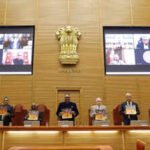



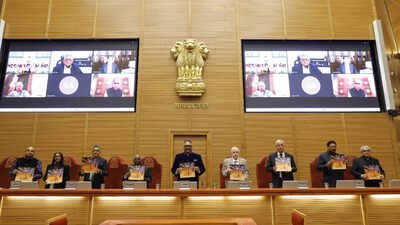
India’s first museum dedicated to the Chief Justices of India was inaugurated at OP Jindal Global University (JGU) in Sonipat on Wednesday, with 10 former Chief Justices of India attending the event in person or virtually.The museum, inaugurated on the eve of Constitution Day, documents the lives and contributions of former Chief Justices and traces the evolution of the Supreme Court and India’s constitutional framework.It has been set up across five galleries, featuring more than 280 busts of Supreme Court judges, models of 25 High Courts, 22 language tapestries, 20 interactive biographical pillars and displays on 20 landmark judgments.The inauguration was attended by former Chief Justices MN Venkatachaliah, BN Kirpal, S Rajendra Babu, KG Balakrishnan, P Sathasivam, RM Lodha, Dipak Misra, Sharad A Bobde, UU Lalit and BR Gavai.The event was held ahead of Constitution Day, observed on November 26 to mark the adoption of the Constitution by the Constituent Assembly in 1949.
Museum traces history of Supreme Court and constitutional law
According to the university, the museum seeks to present the office of the Chief Justice as an institution central to constitutional governance, while documenting the people, decisions and debates that have shaped the judiciary.Its exhibits include a holographic courtroom, artworks, sculptures and installations, alongside biographical displays and recordings of former judges.Former Chief Justice MN Venkatachaliah said the rule of law and democratic freedoms had played an important role in India’s progress. He said the museum could contribute to legal education and help prepare future practitioners.Former CJI BR Gavai said the museum documented the work of successive Chief Justices as well as the Supreme Court’s contribution to constitutional law over the past 76 years. He also spoke about the Constitution’s emphasis on inclusion and representation, referring to the participation of Scheduled Castes, Scheduled Tribes, minorities and women in public institutions.Former CJI UU Lalit said the museum traced the development of jurisprudence alongside the country’s growth. He said the evolution of law was closely connected with economic development and the well-being of the population.Former CJI Sharad A Bobde spoke about the responsibility of the judiciary to uphold the rule of law and recalled the Supreme Court’s functioning during the Covid pandemic, including the introduction of online hearings.Former CJI RM Lodha said the museum’s displays included judgments that had shaped India’s constitutional framework. He referred to the development of public interest litigation and the basic structure doctrine, while also acknowledging that the judiciary had faced periods of difficulty.Former CJI P Sathasivam said the Supreme Court had grown in importance since it began functioning in January 1950. He identified independence from the executive, integrity and transparency as essential to maintaining public confidence in the institution.Former CJI Dipak Misra said the museum could help students understand constitutional values, including liberty, equality and fraternity. Former CJI S. Rajendra Babu said the exhibits would be useful to law scholars and researchers by helping them understand the evolution of the judiciary and the issues it had addressed.Former CJI KG Balakrishnan urged law students to study the Constitution and understand their responsibilities as future legal professionals.Former CJI BN Kirpal also participated in the proceedings.
Five galleries feature judgments, judicial history and artworks
The museum is organised into five galleries: Pathways of Justice, Pillars of Justice, Hall of Constitutional Voices, Keystones of Justice and Ideas of Justice.Pathways of Justice explores the historical and social foundations of justice through 10 marble plaques recalling trials from colonial India.Its artworks address themes such as untouchability, dowry, bonded labour, education, transparency, workplace dignity and climate justice. The gallery also features a model of the Supreme Court and a display titled ‘Branches of Justice’.Pillars of Justice focuses on the lives of former Chief Justices through 20 interactive pillars, each equipped with four screens. It also features 22 regional handloom tapestries representing the languages listed in the Eighth Schedule of the Constitution, along with models of 25 High Courts.Hall of Constitutional Voices presents recordings of 11 figures associated with India’s constitutional history. It also includes an oral history project featuring conversations with former Chief Justices and other senior judges.Keystones of Justice examines 20 landmark judgments and the principles behind them. Its exhibits include a holographic courtroom and an installation titled ‘From Paper to Precedent’, made using ceramics, paper and jute.
Share your thoughts in the comments
Be respectful · TOI community guidelines
Ideas of Justice features a sculpture garden and busts of judges. Its installations include ‘The Robe of Justice’ and ‘The Right to Fly’, which refers to JGU founding chancellor Naveen Jindal’s legal battle over citizens’ right to fly the national flag.Jindal said the museum extended the university’s existing Constitution Museum by focusing on the Supreme Court’s role in upholding constitutional values. JGU founding vice-chancellor C. Raj Kumar said the project aimed to bring together law, history, memory and public engagement to document the institution’s constitutional role.