






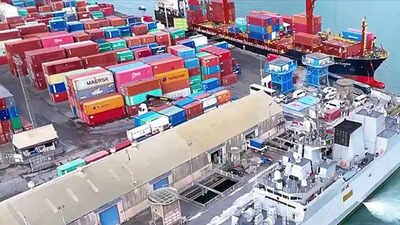
NEW DELHI: Indian exporters are now far better prepared to tackle US President Donald Trump’s tariff turbulence but are bracing for fresh uncertainty till a bilateral trade deal is finalised.“There will be two-three months of uncertainty while we finalise orders for next (2027) winter. Summer won’t be impacted so much as goods would have almost reached (US shores by February),” said Israr Ahmed, director at Farida Group, one of the largest footwear exporters, which has also reduced its exposure to the US.Although the proposed 25 per cent tariffs for structural excess capacity will put India at a disadvantage, exporters are confident that the bilateral trade deal with the US will be signed, reducing the additional burden to 17 per cent.“The proposed US tariff measures are a matter of concern for Indian exporters. The consultation window remains open, and the possibility of a lower tariff under a bilateral trade agreement provides a basis for constructive engagement. The exporting community is taking the development in its stride. Fieo (Federation of Indian Export Organisations) is confident that govt will make a strong case for India and work towards the best possible outcome for the country and its exporters,” said Fieo DG Ajay Sahai.While questioning the rationale of the USTR action, AEPC secretary general Mithileshwar Thakur said that there was no reason to panic. “We are again looking at an increase in tariffs from the US. However, thanks to our govt’s negotiation, we are in a better position compared to other competing manufacturing countries. India should be at 17 per cent (after signing the deal) as compared to 18 per cent for Bangladesh, Indonesia, and for Vietnam, potentially at 20 per cent, once they sign the deal.
Share your thoughts in the comments
Be respectful · TOI community guidelines
China has even higher penalties. Ensuring that India is not singled out with a higher penalty tariff is important for all of us,” added Pallab Banerjee, MD, Pearl Global Industries, one of the largest garment exporters.When it comes to business, exporters are likely to rush with consignments to beat the new tariff deadline so that their summer shipments stay unharmed by the latest USTR action.Of course, this is subject to ships and containers being available amid the disruption in global logistics. Since the Iran war started, exporters are opting for free-on-board or FOB shipping where the buyer bears the shipping cost.“The duties will not kick in at least until mid-Feb, which means exporters will rush their consignments, even if it means diverting some production meant for other markets,” said an industry veteran.