








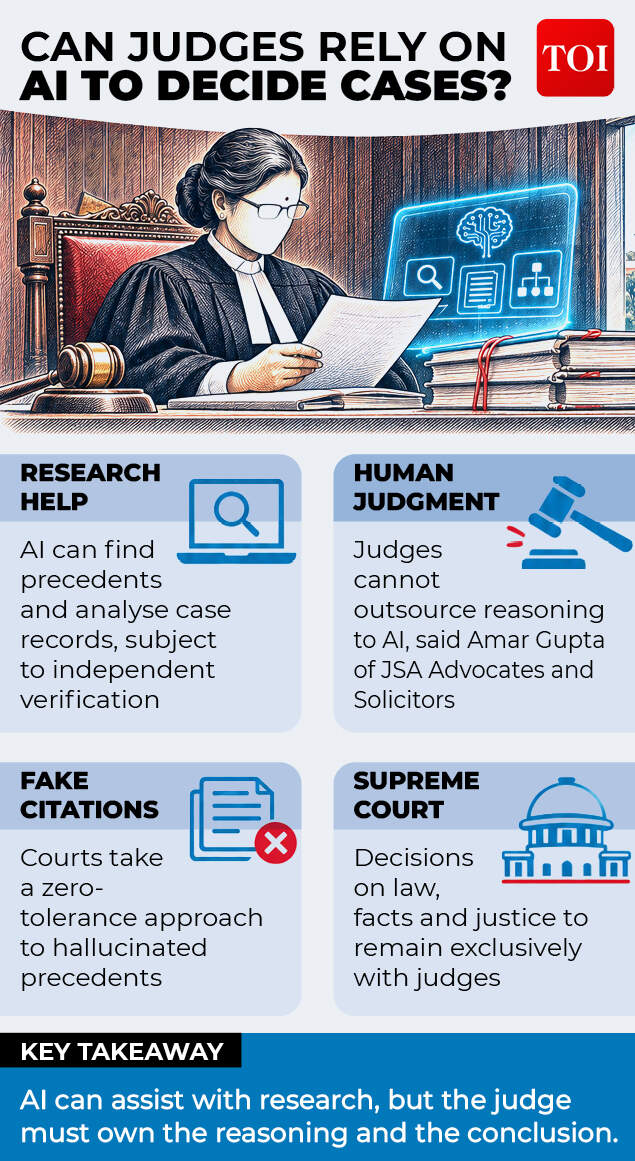
NEW DELHI: The Supreme Court has released its first draft Regulations for Use of Artificial Intelligence in Courts, 2026, as AI is increasingly used to translate judgments, record witness statements and do legal research. These tools can cut delays, but they also raise concerns about accuracy, privacy, fake evidence and who is responsible when something goes wrong.The bigger question is whether judges can rely on AI-generated research without compromising independent decision-making, and who will be held accountable if an AI tool produces incorrect legal information.Let’s understand how AI is being used in courts, the risks involved and why human supervision must remain central to the process.How is AI changing the way courts work?Amar Gupta, Joint Managing Partner at JSA Advocates and Solicitors, said AI is changing how courts handle routine work, not how they decide cases.“AI is beginning to change how Indian courts manage information and carry out time-consuming procedural work, rather than how they decide disputes. By supporting legal research, transcription, translation, scrutiny of filing defects, and case management and scheduling, it can reduce procedural friction and make court processes more accessible,” Gupta said.He said adoption is uneven. SUVAS, which translates judgments into more than 15 languages, is in use, while SUPACE (Supreme Court Portal for Assistance in Courts Efficiency), meant to help understand case records and find precedents, remains experimental.Tanveen Singh, Partner at Legal Torque, said AI is helping with translation, real-time transcription and legal research.Can judges rely on AI research?AI can help judges find information, but it cannot do their thinking. Singh said AI analysis can follow similar patterns because it depends on what it is fed, and judges who accept it without question may stop thinking differently.She pointed to Kerala, whose high court issued an AI policy in 2025, the first by any high court. It made Adalat AI mandatory across the state to record witness depositions faster. Many judges have gone further, using it to dictate orders and judgments and to research and edit documents.
–
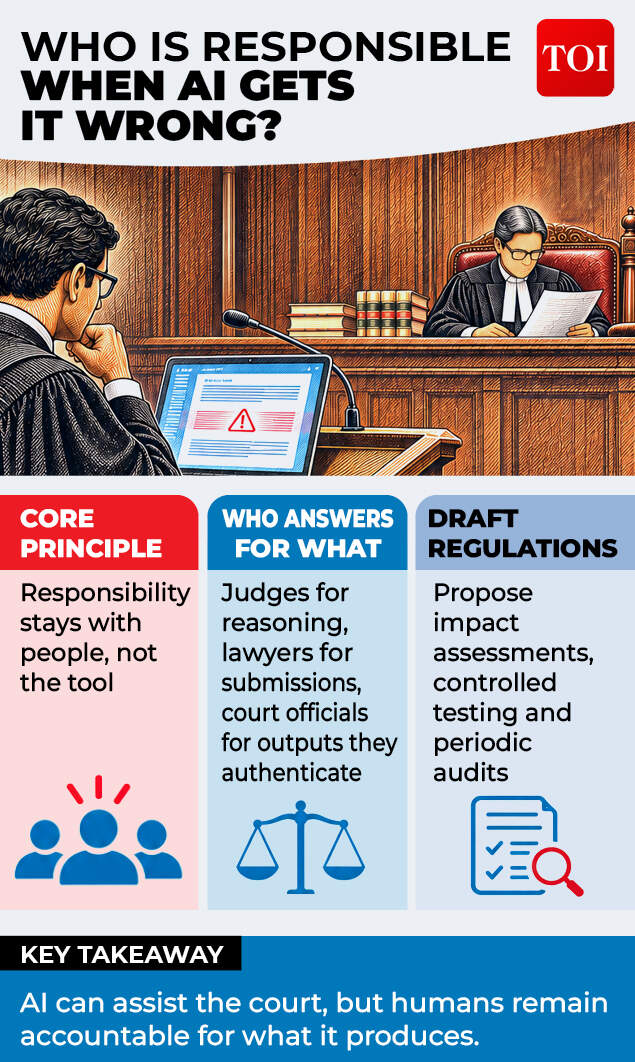
Gupta said judges must separate using AI to find precedents from letting it build their reasoning.“Meaningful human-in-the-loop oversight therefore requires the judge to examine the sources and take ownership of both the reasoning and the conclusion, rather than merely approve an output. This also explains the courts’ zero-tolerance approach to hallucinated precedents: legitimate research assistance remains valuable, but neither fabricated authorities nor unexamined reasoning can form the basis of a judgment,” he said.Deepfakes and AI-generated evidenceAI can now create fake videos and recordings, which makes it harder for courts to tell what is genuine. Singh said judges and lawyers need training and guidance to understand how deepfakes are made, and that the only way to learn the difference is to engage more with AI.Under the Bharatiya Sakshya Adhiniyam, 2023, electronic records must come with a certificate, which also includes an expert’s opinion, to be admitted in court. Gupta said this is not enough on its own.“These safeguards help establish provenance and integrity, but certification does not by itself prove that the event depicted actually occurred. Courts can therefore assess disputed material through a documented chain of custody, examination of original records, metadata and hash values, appropriate forensic expertise, and an effective opportunity for the opposing party to challenge its authenticity,” he said.What do Indian laws say?India has no single law for AI. Singh said the Supreme Court’s draft is its first attempt at a nationwide framework for AI in courts. It is built on the idea that humans come first, keeps decisions on law, facts and justice exclusively with judges, and proposes mandatory disclosure of any AI use. She also pointed to the Information Technology Act, the Bharatiya Nyaya Sanhita, the Bharatiya Sakshya Adhiniyam and the Digital Personal Data Protection (DPDP) Act, 2023.Gupta said India has taken a light-touch approach, closer to the United States than to the European Union’s AI Act. The India AI Governance Guidelines build on existing laws rather than a new statute, and the Supreme Court’s regulations are still a draft.Who is responsible if AI gets it wrong?Singh said responsibility stays with people, and that courts have already acted. “There are enough instances seen in the past of lawyers submitting fake case laws or evidence and getting penalised by the same,” she said. She cited a counsel fined $800 in Singapore and a lawyer fined Rs 50,000 in India for submitting fake case laws.Gupta said the same principle should apply across the system.“Accountability remains with the people and institutions that deploy and rely on an AI tool: judges are responsible for their reasoning, lawyers for the authorities and submissions placed before courts, and court officials for the outputs they authenticate,” he said.
–
He said court AI systems should explain how they reached a result instead of giving a “black-box output”. He added that procurement standards and incident reporting can help. The draft regulations propose impact assessments, controlled testing and periodic audits.Protecting confidential informationCourt cases involve sensitive personal details. Singh warned that cloud tools such as ChatGPT and DeepSeek could send personal information across borders, and said courts need their own safeguards.Gupta said the fix has to be built into the system itself.“Privacy and confidentiality can be protected through safeguards built into the way an AI system processes court material, rather than relying only on warnings against its use. Approved private deployments can combine data minimization, redaction, encryption, and access controls with no-training settings, retention controls, and audit mechanisms that verify whether data is used only for the authorized purpose,” he said.He said these controls should also cover prompts and the inferences AI generates, not just uploaded documents. The DPDP Act allows consent for a specific purpose and erasure when consent is withdrawn or the purpose is served, subject to legally required retention.AI can help courts work faster, but not at the cost of fairness. Judges and lawyers must still verify information and protect confidential records, and justice must remain a human decision.