








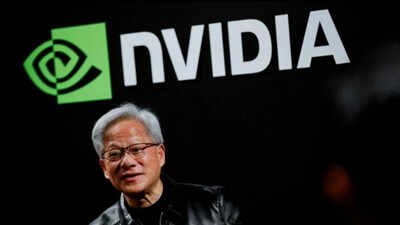
Nvidia’s announcement bringing back Jensen Huang has all the parts you would expect. There is a unanimous vote, a warm line from the chair calling Huang “the right person to lead Nvidia”, and a humble quote from Huang thanking his family. Then the last two paragraphs change the subject. They cover the investigation into him that will “proceed to conclusion”, a new national security committee, a compliance chief who will not report to him, and the government inquiries Nvidia will keep cooperating with.It is an unusual way to welcome back a founder, and it says a lot about the job he is returning to.The people who work for him kept it simpler. When Huang walked into Nvidia’s Santa Clara headquarters on Monday, employees were waiting on the staircases and balconies, many of them filming on their phones. He had swapped the leather jacket for a fleece, took the hugs and the applause, and made them a promise: “Thank you all for the second chance. I’m going to be a better CEO the second time around.” It was the welcome the statement had left out.They were the easy audience. The day before, he had spent several hours with a board that had pushed him out over his honesty, and that still had questions about what else he had not told it.
Huang’s board kept learning the truth from everyone but him
When Huang left, the board was clear about why. Chair Harvey Jones told staff the resignation had been accepted over Huang’s “lack of candor”. The affairs were the trigger, but the charge was about what the CEO had told his own board, and when.The record explains the concern. Nvidia’s general counsel reportedly had to go to Huang’s home after a news report and ask him whether it was true. The board learned about a second relationship, with a vice president who reported directly to him, from The New York Times, and about a third, with another employee, from a later report.Each time, someone other than Huang told the board first. His only public account, posted after he resigned, admitted “serious mistakes” in his personal life without saying what they were.So when Nvidia said directors were now “satisfied” with his candour, that was the heart of the decision. According to The Wall Street Journal, Huang used Sunday’s meeting to tell the board about affairs beyond those already reported. The Journal did not say how many, or with whom. He expressed remorse, and directors discussed his lack of transparency.Then they voted unanimously to reinstate him.The board can say it finally heard the truth from Huang himself. It can also be asked why that took a resignation, a week of headlines and a meeting about his comeback.The known relationships are serious enough. One was with Alice Huang (no relation), a former Megaspeed executive whom US officials have linked to Chinese intelligence. Two were with people at Nvidia, which bars managers from relationships with subordinates for an obvious reason: a boss holds power over the people who report to him. Whether any of the newly disclosed affairs involved staff is not yet known, and the board’s investigation is still open.The board was not weighing all this alone.Nvidia’s statement credits only “senior levels of the United States government”. Trump has been less discreet, saying he spoke to the board himself and “convinced” it. He also asked Vice President JD Vance to work with Huang and the directors, and Vance spent the weekend on calls with them. The New York Times reported that the administration offered two assurances: that it did not see Huang as a national security threat, and that he was not facing criminal charges.The White House makes no secret of its role. “President Trump was totally involved,” communications director Steven Cheung said. Trump himself told the Journal that as Nvidia’s stock plummeted, “the conditions became more favorable”, and after the vote he called Huang “a Great Patriot and National Treasure”.There is also Trump’s own portfolio to consider. His disclosures show he bought Nvidia shares in September and may have held about 370,000 of them by the end of the month. By one estimate, that stake rose by roughly $15 million on the day Huang got his job back. Vance has said independent advisers manage the president’s money. What those advisers did between Huang’s exit and his return will not be known until Trump’s October and November trades are disclosed.Even Altimeter Capital’s Brad Gerstner, one of the investors who wanted the door kept open for Huang, had warned against political pressure forcing a decision before directors knew what had happened. A week later, the board had fresh disclosures, an unfinished investigation and the White House telling it there was nothing to worry about.It agreed the same day.
Behind the personal scandal is a national security case that has not closed
The board’s decision was about Huang’s honesty. What Washington cares about is the chips.Megaspeed began as an offshoot of a Chinese gaming company and grew by buying restricted Nvidia hardware, reportedly more than $4 billion worth. Investigators say Alice Huang used industry contacts and shell companies to reach 240,000 chips banned for export to China. Nvidia itself reportedly introduced her to Alibaba in 2022. The New York Times has reported that US officials concluded she was a Chinese intelligence asset in contact with an officer of China’s Ministry of State Security during the relationship. It also reported that Huang was unmasked in US surveillance without ever receiving a defensive briefing, the warning normally given to someone a foreign intelligence service is targeting.The warnings were not new. Senator Tom Cotton asked the Commerce Department to investigate Megaspeed in October 2025, and Singapore held Alice Huang’s passport for eight months before barring her from the country. The spy claims themselves remain unproven. China calls them a smear, Singapore says it never investigated her for espionage, and Megaspeed says she left in August 2025 and denies wrongdoing.The export questions stand either way. The Justice Department is running a criminal investigation into Megaspeed. The rules have tightened in the meantime. The Commerce Department has issued a new rule on remote access to advanced chips through overseas data centres, and Nvidia has said it is not shipping its Hopper data centre chips, including the H200, to China. On the day Nvidia’s board voted, Director of National Intelligence Jay Clayton said the inquiry into Alice Huang and her former firm was ongoing. “Nvidia chips, they are the jewel,” he said.So the government that told Nvidia’s board Huang posed no threat is still investigating where his company’s chips ended up.The rest of Washington is not finished with him either. House Democratic leader Hakeem Jeffries said Huang should not return at all. Huang now faces a closed-door interview with House committees on December 1, and Senate Banking Committee chairman Tim Scott wants him two days later. Shareholders have sued over Nvidia’s disclosures, the SEC is reportedly examining its accounting, California’s attorney general has served a subpoena, and Moody’s has cut its outlook on the company, citing governance.Inside Nvidia, the board has rebuilt the structure around him. Jones, a director since 1993, is the company’s first-ever chair and is keeping the role. A National Security and Export Control Committee of independent directors will oversee trade compliance, and a Chief Compliance Officer will report to a board committee rather than to the CEO.Huang sits on neither.
The staff who cheered him have heard the other stories too
Monday made it clear how much of Nvidia still belongs to Huang. Employees on three floors chanted his first name as he made his way in. With a hand on his heart, he admitted he had made terrible mistakes and joked that nobody had given him a computer yet.The welcome was loud, but it was not unanimous. According to Wired, some current and former employees saw his exit as a rare chance to change the “one team” culture he built over three decades, one in which, they say, challenging leadership was discouraged and abusive behaviour tolerated. Most spoke anonymously, fearing a backlash from colleagues.One wrote internally that everyone agreed mistakes had been made, and “the question is what we are ready to forgive”. Another said they would stop doing HR trainings if he came back.Even the public show of support comes with an asterisk. The Stand With Jensen petition claims more than 10,000 Nvidia employees among its signatories, out of roughly 49,000 staff and 18,000 contractors. One employee told colleagues they had found 75 suspicious names in an hour of checking.The loyalty is real, and much of it is earned. Supporters credit Huang with keeping bureaucracy down, staying available to staff and making Nvidia feel like a family, and his AI bets have made many long-serving employees rich. Others are torn. Jason Sequeira, a longtime engineering leader, wrote publicly that he could not decide whether he wanted Huang back. He set the case for a second chance against the danger of making exceptions for powerful leaders.That danger is what a New York Times investigation, published while Huang was out of the job, puts on the record. In 2024, he said he would rather “torture you into greatness” than fire people, calling it tongue-in-cheek.Drawing on more than a dozen current and former staff and hundreds of pages of court records over 20 years, the investigation describes executives berated in front of their teams, people mocked for spending time with their children, and violent threats, including one about ripping off a subordinate’s arms and beating the person to death with them. Huang reportedly told staff they had become too rich to be motivated by money, which left humiliation. Nvidia paid more than $1 million to settle confidentially with a former head of HR who said he was fired after confronting Huang. A former company lawyer said in a lawsuit that the conduct sent him for emergency medical help for severe anxiety.Neither settlement included an admission of wrongdoing, and Huang’s spokesperson called the HR chief’s account “fabrications” from a fired employee.For other employees, the bigger worry is accountability. Some told Wired they wanted to know whether the board would hold Huang to account for allegedly misleading directors about his affairs.They have also watched Nvidia cope without him. Colette Kress ran the earnings call, raised the growth outlook and reportedly handed out pay raises and extra equity. Investors still backed Huang, sending the shares up about 31% on his return, though the stock remains roughly a third below its October peak.So “a better CEO” comes with a fairly specific brief. It means telling his board things before they surface elsewhere. It means a company where senior staff are not threatened in meetings, concerns can be raised without fear, and the rule on relationships with subordinates applies at the top too. And it means giving answers under oath in Washington, to lawmakers who did not want him back.The AI boom has concentrated an unusual share of the world’s computing power, market value and strategic leverage in a few companies and the founders who run them. Washington treats Nvidia’s chips as a national asset, investors treat Huang as close to irreplaceable, and many of his staff see the company and the man as one.Last week, all of them pushed in the same direction.The usual checks on a chief executive are a board, a code of conduct, an internal investigation and the threat of being shown the door. They were built for companies that matter, not for companies a government considers too important to be without their founder. Nvidia’s board used every one of them and still ended up where the White House and the market wanted it to.That leaves a question bigger than Nvidia: when a company becomes this central to a country’s economy and security, who is still in a position to hold the person running it to account?