









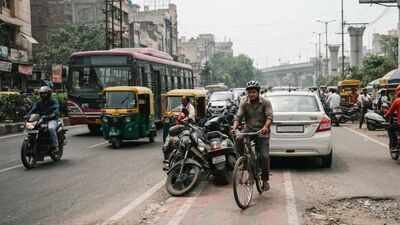
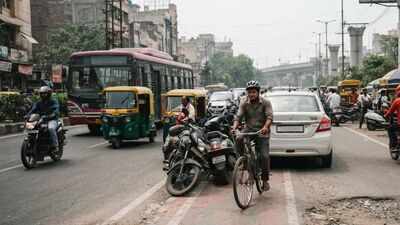
NEW DELHI: Delhi’s roads are becoming increasingly hostile to cyclists, with parked vehicles, wrong-way driving and poorly managed roadside activities emerging as major safety hazards, according to a study by researchers at IIT Delhi.The study, published in Elsevier’s ‘Journal of Transport & Health’, found that on-street parking was associated with 2.6 times higher odds of a bicycle crash. Cyclists riding on the wrong side faced 3.1 times higher odds, while motor vehicles driving against traffic were associated with 2.5 times higher odds.The findings are based on interactions with 844 cyclists across 27 locations in Delhi. Researchers identified 106 self-reported non-fatal crashes at midblock locations and compared them with 319 control locations along the cyclists’ pre-crash routes. While midblock locations refer to sections of road between two intersections, control locations are randomly selected points along the same cyclists’ routes.The extent of roadside parking emerged as a particular concern. Researchers observed parking-related activity at 72% of the control locations against nearly 90% of the crash locations. The definition included not just parked cars and two-wheelers but also autos, e-rickshaws and taxis stopping to pick up or drop off passengers, and vehicles halting for loading and unloading.The researchers estimated that eliminating on-street parking could potentially avert 55% of non-fatal midblock bicycle crashes, assuming other risk factors remained unchanged.Other road features also showed significant associations with crashes. The presence of a bus stop was associated with 2.38 times higher odds, while flyovers and U-turns were associated with 2.44 times and nearly twice the odds, respectively. Researchers suggest that widely spaced U-turns and the removal of convenient crossings may force cyclists to navigate multiple lanes or take longer detours.There was, however, dedicated cycling infrastructure in some areas, and the presence of a segregated cycle track was associated with fewer crashes.The study also found that arterial roads with fewer kerbside hazards had one-ninth the odds of a crash compared with the most hazardous category of national highways with a high concentration of roadside activities. The research recommends physically segregated cycle tracks, designated parking and vending spaces, dedicated pick-up and drop-off zones, and stronger enforcement against unauthorised parking and wrong-way driving. They also call for traffic-calming measures where separate cycle tracks are not feasible.The findings are significant for a city where cycling’s share of travel has fallen from 36% in 1957 to 5% in 2013. Delhi recorded an average of 41 cyclist deaths annually between 2021 and 2023, according to figures cited in the study.