








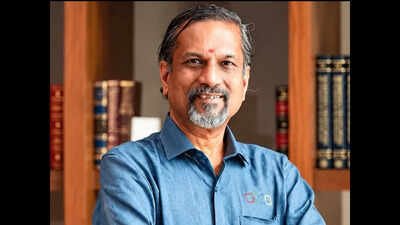
Zoho founder Sridhar Vembu has drawn parallels between the impact of artificial intelligence on knowledge workers and the effect mechanisation had on traditional craftsmen during the industrial revolution, warning that AI beginning to transform professions once considered safe from automation. In a post shared on social media platform X (formerly known as Twitter), Vembu wrote that recent advances in AI have demonstrated capabilities which can dramatically reduce the time and expertise needed for tasks ranging from software development to engineering design. He also emphasised that the disruption is now reaching programmers, mathematicians and other intellectual professions mirrors what farmers, weavers, carpenters and ironsmiths experienced during earlier waves of industrialisation.
‘What machines did to weavers, AI is starting to do to mathematicians and programmers’
Vembu said he recently used AI to optimise a complex piece of software code while travelling, a task he believes would have taken a highly skilled programmer at least a month to complete. “Yesterday, I personally prompted AI to optimize a piece of code in about an hour,” he wrote. According to Vembu, the AI not only understood the intended objective but also created a detailed execution plan, implemented the changes and generated extensive test cases on its own.“The whole thing cost about $4 in tokens,” he added.He also described how a non-technical colleague used a personal AI account to create a mechanical CAD design for a motor housing using newly released software, despite having no engineering background. Based on such experiences, Vembu concluded that AI is beginning to reshape intellectual professions in much the same way mechanisation transformed traditional manual trades. “What happened to farmers and weavers and carpenters and ironsmiths in the waves of mechanization and automation is now starting to happen to mathematicians and programmers,” he said.
AI lowers barriers to specialised work
While highlighting the potential disruption, Vembu also pointed to what he sees as AI’s democratising effect. He said his colleague’s ability to perform engineering-related design work without formal training demonstrates how AI can empower people with curiosity and initiative to explore domains that were previously inaccessible.“AI can enable a curious and active mind to explore realms he could not imagine doing before AI,” Vembu wrote. The comments come as AI systems continue to demonstrate stronger capabilities in coding, mathematics, scientific research and engineering, fuelling debate over their impact on jobs and professional expertise.
Agreeing with a professor’s essay
Vembu said he agreed with Prof Subbarao, whom he credited with extensive work evaluating AI capability, and reacted to the professor’s essay on whether AI is destroying humanity’s sense of purpose. That essay, part of a “Sunday Harangue” series, argues that every technological revolution destroys purpose for some group, as industrialization did for weavers and craftsmen. What may be different this time, it says, is the class of people affected. Intellectuals have rarely faced such a loss, and they are articulate about it, which would explain the heightened angst.The essay says mathematicians may be conflating the loss of purpose in their own lives with a loss of purpose for humanity. A weaver could rightly say finished cloth is only a fraction of the experience of making it, it notes, yet most people welcome cheap machine-made cloth and civilization advanced. Civilization, it suggests, may not end because humans are not the only ones doing math. It adds that the angst does not pass down generations. The children of displaced weavers found purpose native to the new world. The loss is real but “generation-bounded,” the essay argues, which underlies its optimism that humanity, if not every individual, finds “a new equation” after the dip.
Read Sridhar Vembu’s complete post here
“The intellectual class never quite experienced the loss of purpose in their lives that many other classes of humans experienced. And this explains the heightened written angst..”I agree with Prof Subbarao, who has done a lot of work in evaluating AI capability.Yesterday, I personally prompted AI to optimize a piece of code in about an hour (while I was on the road) that would have easily taken a very smart programmer at least a month to do. It was not an easy piece of code at all and AI understood my high level intent very clearly and came up with a detailed plan and cleanly executed it and tested it against very detailed and exhaustive test cases it had constructed itself. The whole thing cost about $4 in tokens.And also yesterday, one of my non-technical colleagues showed me how he used his personal AI account to do the detailed mechanical CAD design for a motor housing, and the AI used a newly released low cost CAD software he had in his machine, which I doubt the AI was trained on. He has no engineering background, but has a curious and active mind.What happened to farmers and weavers and carpenters and ironsmiths in the waves of mechanization and automation is now starting to happen to mathematicians and programmers and …On the positive side, the example of my non-technical colleague shows how AI can enable a curious and active mind to explore realms he could not imagine doing before AI.